
Horse Chestnut
Aesculus hippocastanum
Overview
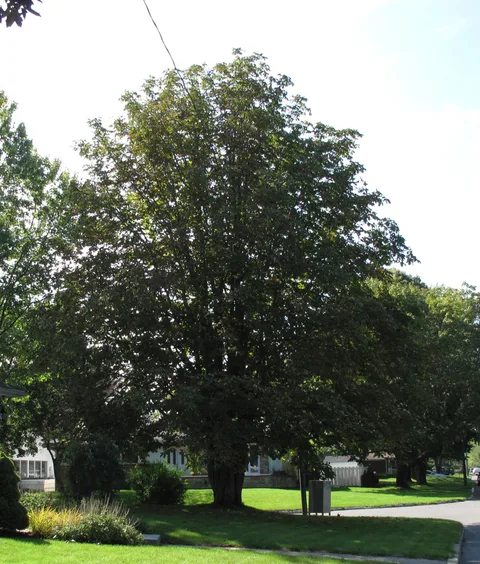
Horse chestnut is an old-fashioned ornamental. Around Belleville and the Quinte area the big specimens are mostly in older neighbourhoods and on long-established properties, where they were planted for their May flower candles and dense shade. Most homeowners know them for two things: the brown, blotched leaves every August and the conkers that cover the lawn in September. It is not a true chestnut, and its seeds are not edible.
Native to mountain forests of Greece and Albania, horse chestnut has been planted throughout the temperate world as a park and street tree. It is unrelated to the edible chestnuts (Castanea) of the beech family, including Ontario's endangered American chestnut; the similar-looking seeds are the source of the shared name.
Full Tree
Identification
Leaves
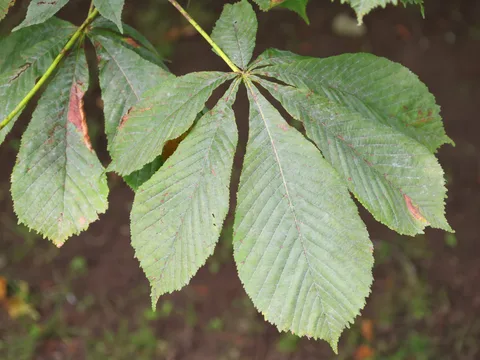
Large hand-shaped leaves of usually seven leaflets, each broadest near the tip with a short point, deeply impressed veins giving a corrugated look. Leaves are set opposite each other on the twig. Light green as they unfold in spring, dark green in summer; fall colour is a poor yellow or simply brown, because by late summer the leaves are usually blotched and scorched.
Leaves
Bark
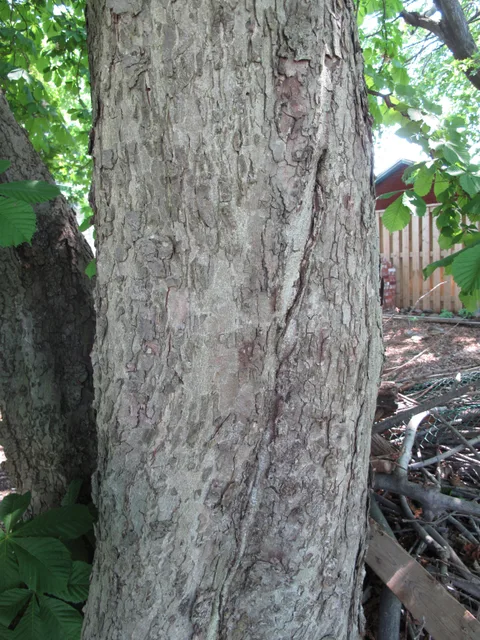
Mostly dark grey to brown bark that, on older trunks and branches, breaks into plates that peel away and expose orange-tinged bark underneath.
Bark
Flowers
Showy upright flower spikes 13 to 30 cm (5-12 in) tall, peaking in mid-May. Each white flower carries a yellow-to-red blotch at its base.
Fruit
Round capsules 5 to 6 cm (2-2.5 in) across with a leathery, spiny husk, ripening in September and October and splitting to release one or two glossy brown seeds (conkers). The seeds are toxic and are easily mistaken for edible chestnuts; a horse chestnut capsule usually holds a single seed, while the burs of edible chestnuts (including the native American chestnut) are covered in dense, needle-like spines and hold several nuts.
Growing Conditions
Climate
Fully hardy in Eastern Ontario winters. The weak point is summer: wet, humid springs drive leaf blotch infections, and hot, dry spells bring scorch, so trees in exposed, paved or salted sites look worst by August. It does best in deep, moist but well-drained soil; on the heavy clay of the Bay of Quinte lowlands, avoid low spots where water sits.
Hardiness Zones: 3, 4a, 4b, 5a, 5b
Light Requirements
Soil
Moisture: moist
Drainage: well-drained, moderate
pH Range: 5.5 - 8
Tolerance
Care & Maintenance
Pruning
Best Season: Winter
Frequency: Every 3-5 years for mature trees; structural pruning every 2-3 years when young
- Thin the crown modestly to improve air movement, so leaves dry faster after rain and leaf blotch has less chance to take hold
- On large old trees, focus on deadwood and on reducing the end weight of long limbs over roofs, driveways and streets
- Raise low, sweeping limbs gradually over sidewalks and driveways
- Prune in the dormant season, late fall to late winter, when the branch structure is easy to see
Avoid: Heavy pruning during spring leaf-out and flowering; Removing a large share of the crown at once, which stresses a tree that already loses leaves early to blotch and scorch
Watering
Establishment: Water deeply once a week in dry spells for the first 2-3 summers after planting
Mature: Prefers evenly moist soil; dry, hot summers worsen leaf scorch
Seasonal Care Timeline
Spring
- Wet weather in May and June drives new leaf blotch infections from last year's fallen leaves
- Flowering peaks in mid-May
- Check for thin leaf-out or dead limbs on large old trees
Summer
- Leaf blotch spots appear from late June and spread through summer
- Leaf scorch on hot, dry, exposed sites
- Many trees are brown by August; this is usually cosmetic
Fall
- Conkers drop in September and October; they are toxic
- Rake and remove fallen leaves to cut next year's leaf blotch
- Good time to plan pruning of heavy limbs over roofs and driveways
Winter
- Dormant season is the best time for pruning
- Heavy wet snow and ice on long, low limbs
- Large sticky buds make winter identification easy
Common Issues
Leaf Blotch (Guignardia blotch)
ModerateA fungal leaf disease (Phyllosticta paviae, formerly Guignardia aesculi) widespread in eastern Canada and common on urban horse chestnuts, especially after wet springs. It is mainly cosmetic: severe cases can brown the whole crown and drop leaves early, but this comes late in the season and does not usually shorten the tree's life.
Symptoms: Large, water-soaked spots that turn reddish-brown with a yellow margin, appearing from late June, Blotches merging until leaves curl, brown and become brittle, Tiny black specks (fruiting bodies) on the dead areas, Early leaf drop in late summer
Treatment: Rake and remove fallen leaves in autumn (bag them for yard-waste collection rather than home compost) to reduce next spring's infections. A fungicide in early summer is only worth considering for high-value trees
Prevention: Leaf clean-up every fall; modest crown thinning for air movement; avoid planting horse chestnut in sheltered, humid spots
Leaf Scorch
ModerateBrowning of leaf edges from heat, drought and salt stress. It occurs to some degree almost every year on horse chestnut, particularly on hot, dry sites, and is often confused with leaf blotch.
Symptoms: Leaf edges and tips turning brown and crisp, Browning worst on the sunny, exposed side of the crown, No black fruiting specks in the brown areas (which separates it from blotch)
Treatment: Deep watering during drought; mulch the root zone
Prevention: Plant away from hot, dry, reflective sites; keep salt-laden snow off the root zone; water young trees in dry summers
Powdery Mildew
LowA fungal coating on the leaves, usually late in the season.
Symptoms: White to grey powdery patches on leaves, Yellowing of affected leaves
Treatment: Usually none needed; rake fallen leaves
Prevention: Good air movement through the crown
Toxic Seeds (Conkers)
ModerateAll parts of horse chestnut are toxic, and the seeds are the main concern because they look like edible chestnuts. Eating them can cause serious stomach upset.
Symptoms: Glossy brown seeds and spiny husks on lawns, sidewalks and driveways in September and October, Children or pets picking up or chewing seeds
Treatment: If someone has eaten horse chestnuts, call the Ontario Poison Centre; for pets, call your veterinarian
Prevention: Pick up fallen seeds where children and dogs play; never eat a nut you have not positively identified
Limb Failure on Large Old Trees
HighBig, old horse chestnuts carry heavy limbs that can fail, especially where there is decay at old pruning wounds or a weak fork.
Symptoms: Dead limbs in the upper crown, Cracks at forks or under heavy limbs, Cavities, oozing or fungal brackets on the trunk, Sections of crown leafing out thinly in spring
Treatment: Have an arborist assess the tree; deadwood removal, end-weight reduction, cabling or, where defects are severe, removal
Prevention: Regular inspection and pruning of large trees near houses, streets and play areas
Professional arborist recommended
Sources & References
Information compiled from the following authoritative sources:
Quick Facts
When to Call an Arborist
Recommended inspection: Every 2-3 years; yearly for large old trees over houses, streets or play areas
- •Dead limbs or thin, sparse leaf-out in spring
- •Dark, oozing patches or cankers on the trunk or main limbs
- •Fungal brackets, cavities or soft wood at the base or old wounds
- •Cracks at forks or under heavy horizontal limbs
- •Whole-crown browning in June, earlier than the usual late-summer blotch
Free consultation for Belleville residents
Recommended Services
Based on Horse Chestnut characteristics