
Tree of Heaven
Ailanthus altissima
Active Threats to Tree of Heaven
Spotted Lanternfly
The Canadian Food Inspection Agency confirmed Canada's first live spotted lanternfly detection in Windsor in September 2026 and, in October 2026, an established population in Essex County. A regulated area with movement restrictions covers Essex County, Windsor, Pelee Township and Chatham-Kent, and live insects have also been found in Niagara (St. Catharines, Fort Erie, Port Colborne). None of the CFIA's 2026 observations are in the Belleville or Quinte area. This sap-feeding planthopper prefers Tree of Heaven, and the CFIA uses Tree of Heaven locations to target its surveys. It spreads mainly by hitchhiking on vehicles, outdoor gear, firewood and nursery stock.
Signs to watch for:
- •Grey, mud-like smears (egg masses) on bark, stone, vehicles and outdoor items from September
- •Black nymphs with white spots in late spring and early summer, turning red with black and white spots by midsummer
- •Adults about 2.5 cm (1 in) long with pinkish-grey black-spotted forewings and bright red hindwings, July to November
- •Dark sap streaks, sticky honeydew and sooty mould at the base of host trees
Recommended Action: Photograph any suspected spotted lanternfly or egg mass, catch it or scrape it into a sealed container, and report it to the CFIA at Canada.ca/spotted-lanternfly. Report Tree of Heaven locations through iNaturalist or EDDMapS. After travel to the Windsor-Essex or Chatham-Kent area, check vehicles and outdoor gear for egg masses. Wilsaw Tree Service can identify and plan removal of Tree of Heaven.
Free consultation available
Overview
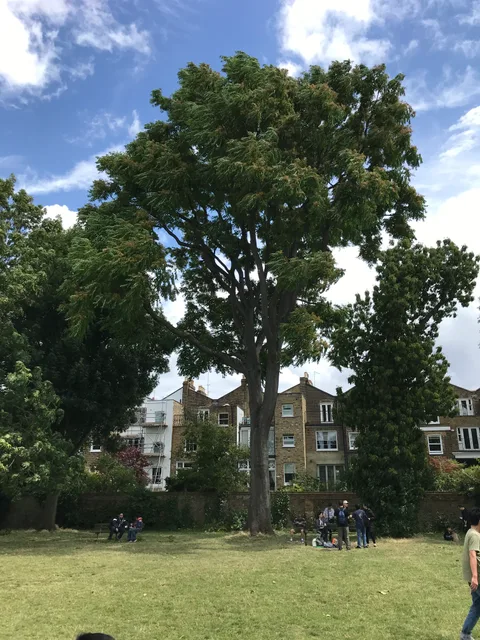
Tree of Heaven is native to Asia and was brought to North America as an ornamental in the 1820s. In Ontario it grows mainly in towns and cities and along roadsides, rail lines, riverbanks and other disturbed ground. It is not commonly seen around Belleville, which makes any stand found here worth dealing with early. Ontario regulates it as a restricted invasive species under the Invasive Species Act, 2015: it is illegal to bring it into Ontario, to plant, propagate, deposit or release it, to buy, sell, lease or trade it, or to possess or transport it in a provincial park or conservation reserve. Ontario notes that reducing the number of host trees can help limit the spread of spotted lanternfly.
Introduced as an ornamental and long valued for how easily it grows in polluted city conditions, it became invasive once its root suckers and wind-blown seeds escaped into natural areas. Because it is the preferred host of the spotted lanternfly, the CFIA now asks the public to report where Tree of Heaven grows.
Full Tree
Identification
Leaves
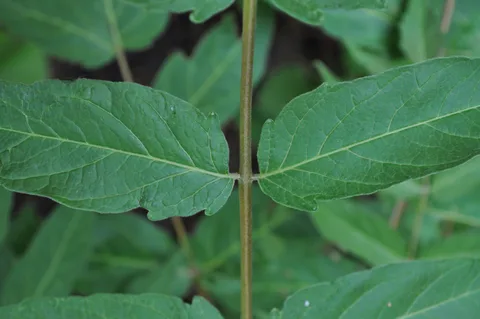
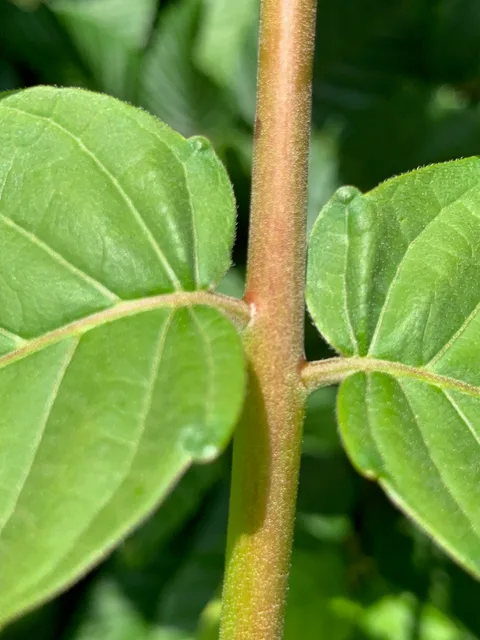
Very long compound leaves with 10-40 lance-shaped leaflets. The leaflet edges are smooth except for one or two small lobes near the base, each with a round gland on the underside: this is the single best identification feature. Crushed leaves and twigs give off a strong, foul odour, which is where the nickname 'stinking sumac' comes from. Look-alikes: staghorn sumac and black walnut have toothed leaflet edges along their whole length and never produce winged seeds, and ash leaves grow in opposite pairs.
Leaves
Bark
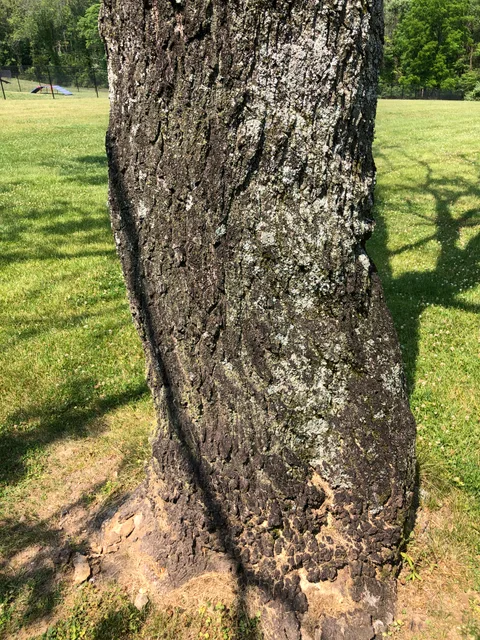
Thin, smooth, brownish-green bark on young stems, becoming pale grey to light brown and somewhat rougher on older trunks. Wear gloves when handling: the sap can irritate skin.
Bark
Flowers
Large clusters of small yellowish-green flowers at the branch tips in early summer. Trees are male or female; only female trees set seed. The tree is a heavy pollen producer and a moderate allergy source for some people.
Fruit
Dense clusters of twisted, papery winged seeds (samaras) 2-5 cm (1-2 in) long, each with a single seed in the middle. They ripen from green to tan and often hang on the tree through winter, dropping and blowing away from fall into spring. A single female tree can produce more than 300,000 seeds a year.
Growing Conditions
Climate
Hardy enough for Belleville's zone 5b, though young seedlings are not cold resistant and frost dieback is common near its northern limit, where it often resprouts from the base. It tolerates poor, compacted, dry or rubble-filled urban soil and a very wide pH range, so heavy Bay of Quinte clay and thin soils over limestone will not stop it. The brittle limbs break easily in wind and ice storms.
Hardiness Zones: 4a, 4b, 5a, 5b
Light Requirements
Soil
Moisture: dry, moist
Drainage: well-drained, moderate, poor
pH Range: 4.5 - 8
Tolerance
Care & Maintenance
Pruning
Best Season: Summer, Fall
Frequency: Do not prune or cut to control it: treat with herbicide, then remove
- Never just cut it down. Cutting or mowing triggers a flush of stump sprouts and root suckers that can come up as far as 15 m (50 ft) from the trunk
- Systemic herbicide works best from July until the leaves start to colour in fall, when the tree is moving sugars down to its roots
- Foliar spray suits small trees and sucker patches; basal bark treatment (lower 30-45 cm of the trunk) suits stems under about 15 cm (6 in); hack-and-squirt (spaced downward cuts with herbicide applied) suits larger stems
- If a tree must come down for safety, treat it with herbicide first, wait about 30 days for it to die back, then fell it. Treating only the cut stump does not stop root suckering
- Hand-pull young seedlings when the soil is moist and remove the whole root; root suckers are nearly impossible to pull
- Plan on follow-up treatment of sprouts and suckers the next year and monitoring for several years
- Wear gloves, long sleeves and eye protection: the sap can cause skin irritation
Avoid: Cutting, mowing or girdling without herbicide at any time of year; Spring and early summer herbicide applications, which mostly injure top growth
Watering
Establishment: Not applicable: do not plant (it is illegal to plant it in Ontario)
Mature: Thrives without care in poor, dry, compacted urban soil
Seasonal Care Timeline
Spring
- Pull new seedlings while the soil is moist
- Mark suckering stands now for herbicide treatment later in summer
- Do not cut or mow suckers: it multiplies them
Summer
- July to early fall is the effective window for systemic herbicide treatment
- Watch for spotted lanternfly nymphs and adults on Tree of Heaven and report suspects to the CFIA
- Brittle limbs can drop in summer storms
Fall
- Finish herbicide treatment before the leaves colour
- Check outdoor items and vehicles for grey, mud-like lanternfly egg masses (September onward), especially after travel to the Windsor-Essex or Chatham-Kent regulated area
- Fell treated trees about 30 days after treatment; contain seed clusters on female trees so they are not spread
Winter
- Seed clusters hang on and blow away through winter
- Ice and wind break the brittle limbs
- Plan treatment and removal for next summer
Common Issues
Root Suckering and Invasive Spread
SevereTree of Heaven spreads by prolific seed and by root suckers, forming dense clonal thickets that crowd out native plants. It also releases chemicals that inhibit other plants. Cutting or injuring the tree makes suckering worse.
Symptoms: Clusters of fast-growing shoots coming up from roots metres away from a tree, Dense thickets in yards, laneways, fencerows and rail or road edges, Vigorous sprouts from old cut stumps, Bare ground under the stand
Treatment: Treat with a systemic herbicide (late season, before fall colour), using foliar, basal bark or hack-and-squirt methods depending on size, then remove dead stems. In Ontario, herbicide work on invasive plants is regulated under the Pesticides Act and generally needs a licensed exterminator.
Prevention: Never cut without herbicide treatment, remove seedlings while they are small, and report new stands.
Professional arborist recommended
Spotted Lanternfly (preferred host)
HighTree of Heaven is the preferred host of the invasive spotted lanternfly, a sap-feeding planthopper. The CFIA confirmed an established population in Essex County, Ontario in October 2026, with a regulated area covering Essex County, Windsor, Pelee Township and Chatham-Kent. The CFIA's 2026 observation list includes no reports from the Belleville or Quinte area. The CFIA uses Tree of Heaven locations to target its surveys.
Symptoms: Grey, mud-like smears (egg masses) on bark, stones and outdoor items from September, Black nymphs with white spots, later red with black and white spots, Adults with pinkish-grey black-spotted forewings and bright red hindwings, July to November, Dark sap streaks, sticky honeydew and sooty mould at the base of the tree
Treatment: Photograph, catch or scrape the insect or egg mass into a sealed container and report it to the CFIA right away.
Prevention: Report Tree of Heaven locations through iNaturalist or EDDMapS and remove the trees properly. Check vehicles and outdoor gear coming from the regulated area or from infested U.S. states.
Brittle Limbs and Root Damage
ModerateBranches are brittle and break easily even when green, and the tree sheds broken branches often. Its aggressive roots can lift pavement and damage foundations, walls and sewer lines.
Symptoms: Broken limbs after wind or ice, Cracked or heaved pavement and walkways near the tree, Suckers coming up through cracks in asphalt or along foundations
Treatment: Have trees near buildings, driveways and wires assessed and removed using the herbicide-first method.
Prevention: Remove seedlings before they establish near structures.
Professional arborist recommended
Verticillium Wilt
LowA soil-borne wilt fungus (Verticillium nonalfalfae) has killed large areas of Tree of Heaven in Pennsylvania and Ohio and is being studied as a biological control. It spreads between trees through grafted roots.
Symptoms: Wilting and yellowing leaves, Premature leaf drop, Crown dieback spreading through a stand
Treatment: No treatment; removal is the goal for this species anyway.
Prevention: Not applicable.
Sap and Pollen Irritation
LowContact with the leaves, bark, seeds or sap can cause skin irritation, and rare cases of heart inflammation (myocarditis) have been linked to sap entering cuts. The pollen is a moderate allergen.
Symptoms: Rash or skin irritation after handling, Allergy symptoms when trees are flowering
Treatment: Wash exposed skin; seek medical advice for persistent reactions.
Prevention: Wear gloves, long sleeves and eye protection when cutting, pulling or chipping it.
Sources & References
Information compiled from the following authoritative sources:
Quick Facts
When to Call an Arborist
Recommended inspection: Check the site each summer for root suckers and seedlings for several years after treatment
- •Any Tree of Heaven large enough to need felling (it must be herbicide-treated first)
- •Suckers spreading across a lawn, garden or neighbouring lot
- •Broken or hanging limbs over buildings, cars or wires
- •Roots lifting pavement or near foundations
- •Any insect matching the spotted lanternfly description (report to the CFIA)
Free consultation for Belleville residents
Recommended Services
Based on Tree of Heaven characteristics