
Blue Beech
Carpinus caroliniana
Overview
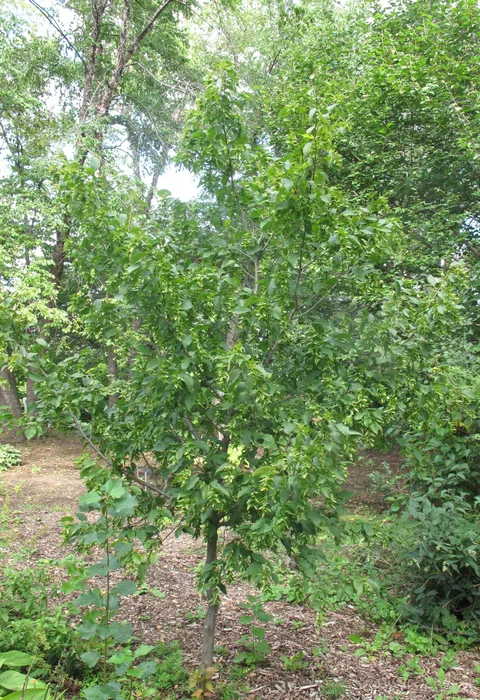
Blue beech is native to southern Ontario around the shores of Lake Ontario and Lake Erie, so it belongs here: around Belleville and the Bay of Quinte it grows in rich, moist woods, along creek and river banks and at the edges of swamps, usually as a small understory tree under maples, beech and oaks. It is far less common in yards than in the woods, but it makes an excellent small native tree for a shady, moist corner of a property, with smooth, sculpted bark that stands out all winter. Watch the names: Ontario's tree atlas lists ironwood among blue beech's other names, but in most of Ontario 'ironwood' means hop-hornbeam (Ostrya virginiana), a different tree of drier upland woods with shreddy bark and hop-like fruit.
The wood is very hard, heavy and tough but is rarely sawn into lumber because the tree is so small. Early settlers used it for bowls and plates, and it has long been used for mallets, levers, wedges and tool handles.
Full Tree
Identification
Leaves
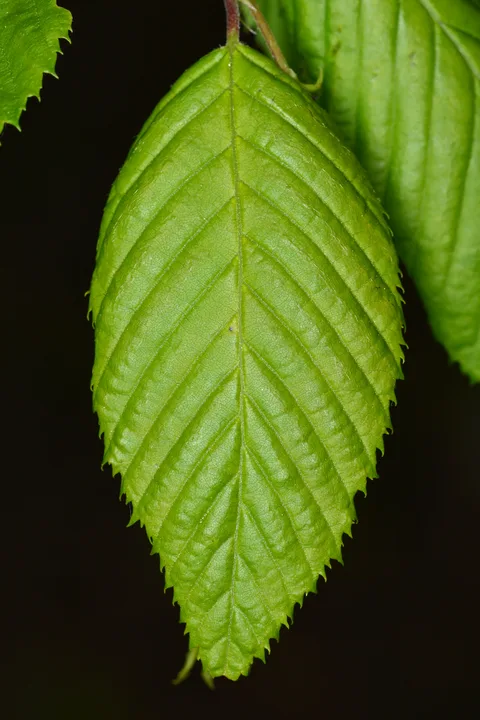
Thin, firm, bluish-green leaves, paler yellowish-green underneath, with straight, evenly spaced veins and a finely double-toothed edge. New leaves open bronze to reddish-purple. Leaves get progressively larger along each shoot. Fall colour ranges from yellow to orange and scarlet. Blue beech is in the birch family and is more closely related to birches than to American beech, despite the name.
Leaves
Bark
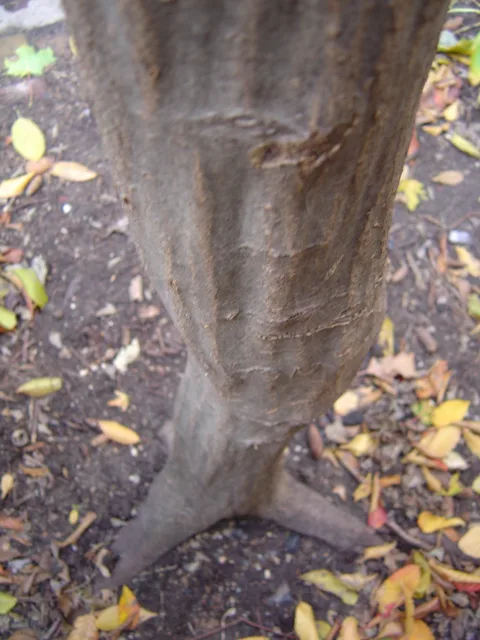
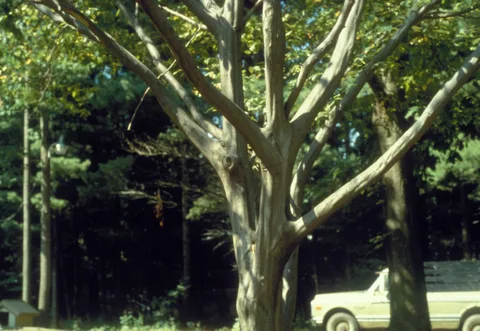
The best field mark. The trunk stays smooth and thin-barked for life, but it is fluted with irregular, rounded ridges that run up and down the stem, giving it a wavy outline in cross-section and the look of a flexed arm. That is where the name musclewood comes from. Ironwood (hop-hornbeam), which grows in the same woods and is often confused with it, has greyish-brown bark that breaks into short, peeling vertical strips.
Bark
Flowers
Small catkins appear in April to May as the leaves come out. Hanging male catkins are about 2.5-4 cm (1-1.5 in) long, green-brown with red on the scales; the smaller female catkins sit at the tips of the new leafy shoots. Pollen is spread by wind.
Fruit
Small ribbed nutlets, 5-9 mm long, each sitting at the base of a three-lobed, leaf-like bract about 2.5 cm (1 in) long. They hang in loose clusters 5-15 cm (2-6 in) long, green in summer and brown by late fall. Ironwood's fruit looks different: each nut is sealed inside an inflated, hairy, papery sac, and the clusters look like hops. Birds such as ruffed grouse and wild turkey, and squirrels, eat the seeds and buds.
Valuable wildlife food source
Growing Conditions
Climate
Hardy well beyond Belleville's zone 5b climate and very windfirm. It is at home on the moist clay loams of the Bay of Quinte lowlands and tolerates seasonal flooding and brief spring wet spells, though not standing water for long periods. It is less suited to thin, dry soils over limestone or the exposed rock of the Canadian Shield edge north of Highway 7 unless the site stays moist. Hot, dry, exposed sites and summer drought are the main stresses.
Hardiness Zones: 3, 4a, 4b, 5a, 5b
Light Requirements
Soil
Moisture: moist, wet
Drainage: well-drained, moderate
pH Range: 4 - 7.5
Tolerance
Care & Maintenance
Pruning
Best Season: Winter
Frequency: Light structural pruning while young, then only as needed
- Prune in the dormant season, late fall to late winter
- Decide early whether you want a single trunk or a multi-stemmed clump, and remove competing stems while they are small
- Remove crossing, rubbing and low branches gradually; the dense wood heals slowly from large cuts
- It takes shearing well and can be kept as a tall hedge or screen once established
- Keep mowers and string trimmers off the trunk: the bark is thin and wounds easily
Avoid: Hot, dry spells in summer, when the tree is already under water stress; Heavy pruning in the first two years after planting
Watering
Establishment: Plant a young, container-grown tree in spring and water deeply every week through the first two or three summers; it transplants poorly when larger
Mature: Prefers evenly moist soil; mulch the root zone and keep turf back from the trunk
Seasonal Care Timeline
Spring
- Best time to plant: use small, container-grown stock
- Check for winter browsing by rabbits and deer on young trees
- Catkins and new leaves emerge together in April to May
Summer
- Leaf scorch during hot, dry spells, especially in full sun
- Keep the mulch ring topped up and water young trees deeply
- Minor leaf spots in wet summers
Fall
- Yellow, orange and red fall colour
- Seed clusters ripen brown and are eaten by birds and squirrels
- Good time to plan structural pruning for the dormant season
Winter
- Dormant-season pruning
- Beaver damage on trees near creeks and ponds
- Identify by the smooth, fluted grey trunk, which is easiest to see in winter
Common Issues
Transplant Shock and Drought Stress
ModerateBlue beech is a moist-woods understory tree. It transplants poorly because of its deep, spreading lateral roots, is moderately sensitive to drought, and does not do well on hot, exposed sites.
Symptoms: Leaf scorch (brown, crispy leaf edges) in July and August, Early leaf drop or poor fall colour, Slow or no new growth for several years after planting, Thin crown on trees in full sun on dry ground
Treatment: Water deeply and mulch the root zone. Trees that keep struggling in a hot, open spot may do better moved to, or replaced in, a shadier, moister site.
Prevention: Buy small container-grown stock, plant in spring, choose a sheltered spot with part shade and moist soil, and mulch well.
Soil Compaction and Trunk Injury
ModerateOf 22 hardwood species studied in forested campgrounds, American hornbeam was the least able to cope with heavy foot traffic, which left it more open to disease, insects and decline. The same applies to construction traffic, grade changes and equipment around a yard tree.
Symptoms: Dieback in the crown a few years after construction or landscaping, Wounds or peeled bark at the base from mowers or equipment, Bare, hard-packed soil over the roots
Treatment: Have a professional assess trees showing dieback after construction. Mulching and aerating the root zone can help a lightly affected tree recover.
Prevention: Fence off the root zone during construction, keep vehicles and stockpiles off it, and use a wide mulch ring instead of grass right up to the trunk.
Professional arborist recommended
Leaf Spots
LowMinor fungal leaf spots show up in some wet summers. They are a cosmetic problem rather than a threat to the tree.
Symptoms: Small brown or dark spots on the leaves, Some early yellowing and leaf drop in late summer
Treatment: None usually needed. Rake up and dispose of fallen leaves.
Prevention: Good air flow and avoiding overhead watering.
Silver Leaf
ModerateA wood-decay fungus (Chondrostereum purpureum) that Natural Resources Canada lists on blue beech. It enters through wounds and can affect branches, stems and roots.
Symptoms: Leaves with a dull, silvery sheen, Dieback of individual branches, Small purplish to tan, crust-like fungal growths on dead wood
Treatment: Prune out affected branches into healthy wood in dry weather and dispose of the wood. Have a professional check a tree with silvering throughout the crown.
Prevention: Avoid wounding the trunk and prune in the dormant season.
Professional arborist recommended
Sources & References
Information compiled from the following authoritative sources:
Quick Facts
When to Call an Arborist
Recommended inspection: Every 3-5 years, or after construction or landscaping near the tree
- •Dieback in the crown after construction, grading or trenching nearby
- •Wounds, cracks or peeled bark at the base of the trunk
- •Silvery leaves or branch dieback
- •Leaning or split multi-stemmed trunks
- •You are not sure whether the tree is blue beech or ironwood
Free consultation for Belleville residents
Recommended Services
Based on Blue Beech characteristics