
Bitternut Hickory
Carya cordiformis
Overview
Ontario's Tree Atlas calls it the most widespread hickory in Canada. In the Quinte area it grows best on low, moist ground and rich soil, such as the floodplain and valley woods along the Moira and Trent rivers and damp farm woodlots on the Bay of Quinte lowlands, and is usually mixed in with maples, elms and ash rather than in pure stands. It is the fastest-growing of our hickories.
Its strong, tough, shock-resistant wood was used for tool handles, wheel spokes and lacrosse sticks, and it is still burned to give smoked meat a hickory flavour.
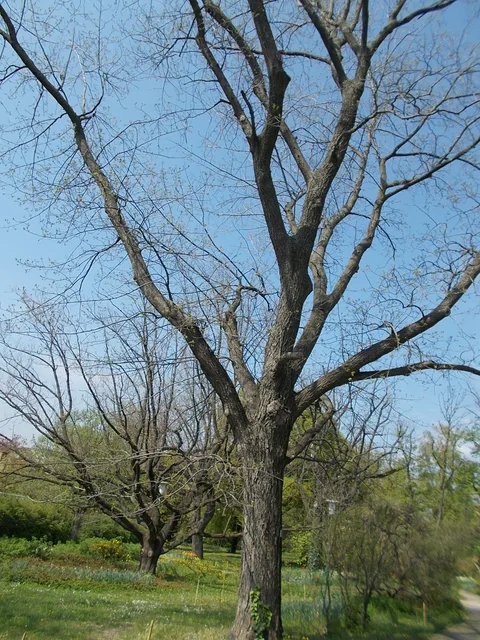
Full Tree
Identification
Leaves
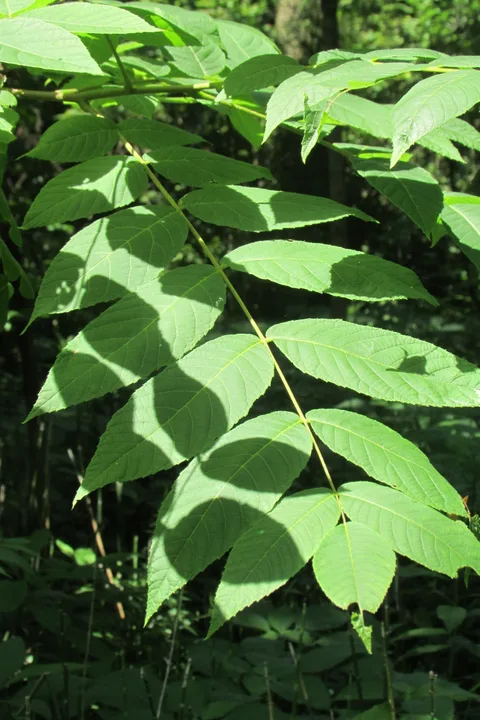
Compound leaves with 7-11 long, narrow, pointed leaflets, commonly 7-9, much longer than they are wide and often curving back. Leaflets are dark to yellow-green above and paler underneath, with finely toothed edges. More and narrower leaflets than shagbark hickory, which has five broad ones. Leaves turn yellow to gold in fall.
Leaves
Bark
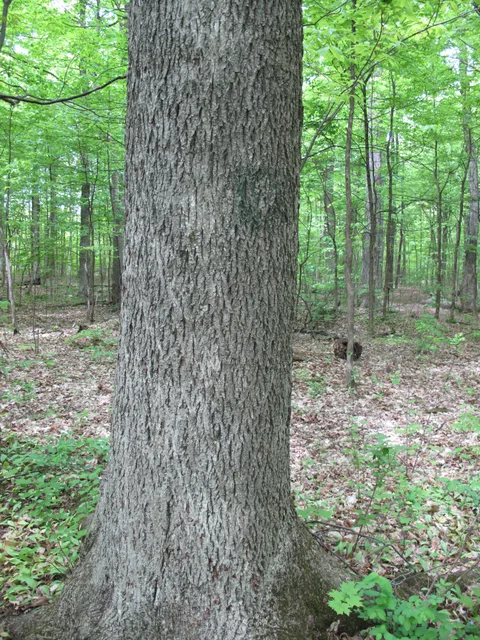
Light to silvery grey bark with shallow, interlacing ridges that stay tight to the trunk for the life of the tree. It never peels in plates like shagbark hickory; check for the yellow buds to be sure.
Bark
Flowers
Long, green catkins of male flowers hang from the twigs in spring as the leaves open; female flowers are small and inconspicuous at the shoot tips. Wind pollinated.
Fruit
Round nut 2-3.5 cm (3/4-1 1/2 in) long in a thin husk with four slight wings along the seams. The kernel is very bitter and inedible; some birds and small mammals eat the nuts but they are not a preferred food. Nuts ripen in September and October and fall from September through December. Little seed before about 30 years of age; good crops every 3-5 years.
Valuable wildlife food source
Growing Conditions
Climate
Hardy across Southern Ontario and the St. Lawrence valley, well beyond Belleville's zone 5b. It copes with the heavier, wetter clay soils of the Bay of Quinte lowlands better than shagbark, but it needs plenty of summer moisture, so trees on thin, dry soils over limestone or on sandy ridges suffer in drought summers like 2025, when the province recorded drought damage along Hwy 401 from Belleville to Napanee. Strong wood and a deep root system give it good wind firmness.
Hardiness Zones: 4a, 4b, 5a, 5b
Light Requirements
Soil
Moisture: moist, wet
Drainage: well-drained, moderate
pH Range: 5.5 - 7.8
Tolerance
Care & Maintenance
Pruning
Best Season: Winter
Frequency: Every 5-10 years while young; mature trees need only deadwood and hazard work
- Prune in late winter while the tree is dormant
- Train young trees to a single leader with well-spaced scaffold limbs
- Remove dead branches promptly; hickory wood is heavy and hard
- Plant small: the long taproot makes bitternut hard to transplant, and spring is the only good time to move it
Avoid: Spring leaf-out; Drought periods, when wounded hickories are more attractive to bark beetles
Watering
Establishment: Water deeply every week for the first 2-3 summers
Mature: Needs plenty of water in summer; it grows best in damp soil and should be watered in dry spells if planted on drier ground
Seasonal Care Timeline
Spring
- Look for sprouts dying on the trunk or dark bleeding spots on the bark (signs of hickory decline)
- Phylloxera galls appear on new leaves; they are cosmetic
- Tolerates the spring flooding of low, floodplain sites better than most hickories
Summer
- Water young trees and trees on dry sites during drought
- Fall webworm tents appear from mid-summer
- Leaf spot appears in wet summers; no treatment needed
Fall
- Nuts and husks drop from September into December; they are bitter, so wildlife leave many on the lawn
- Rake and dispose of fallen leaves if leaf spot was heavy
Winter
- Best time for pruning and deadwood removal
- The sulphur-yellow buds make winter the easiest time to identify it
- Check trunk guards on young trees for rabbit and rodent damage
Common Issues
Hickory Bark Beetle and Hickory Decline
HighA native bark beetle (Scolytus quadrispinosus) that breeds under the bark of hickories weakened by drought, flooding, root damage or crowding, and rarely infests healthy trees. With the canker fungus Ceratocystis smalleyi it causes hickory decline: when beetle numbers are high, trees can decline and die in as little as two years. Populations rose in Middlesex County in southwestern Ontario between about 2020 and 2024, killing mature hickories in woodlots there.
Symptoms: Sparse, small or yellowed leaves and early leaf drop, Dead branches in the upper crown, Round exit holes about 3 mm (1/8 in) across on the upper trunk and branches, Dark bleeding spots on the bark in May or June over reddish-brown cankers, Clusters of sprouts on the trunk that wilt and die within a year
Treatment: No cure once a tree is heavily attacked. Remove and dispose of infested trees before the beetles emerge in spring, and keep nearby hickories watered and mulched.
Prevention: Reduce stress: water during drought, protect the root zone and avoid wounding the trunk.
Professional arborist recommended
Fall Webworm
LowNative caterpillar that builds silk tents over the ends of branches in late summer. Bitternut hickory is a frequent host in Southern Ontario; provincial surveys recorded moderate defoliation on bitternut east of Havelock along Hwy 7 in 2024. Damage comes late in the season and rarely kills trees.
Symptoms: Loose silk webs enclosing leaves at branch tips from mid-summer, Skeletonized leaves inside the webs, Hairy, pale caterpillars inside the tents
Treatment: Prune out or pull down webs within reach; on large trees it is usually left alone.
Prevention: None needed on healthy trees; high populations usually last only 2-3 years.
Hickory Leaf Spot (Anthracnose)
LowFungal leaf spot (Gnomonia caryae) that shows up in wet summers. It appears late in the season and rarely harms the tree.
Symptoms: Irregular reddish-brown spots on the upper leaf surface, Brown spots on the underside, Some early leaf drop in bad years
Treatment: No treatment recommended.
Prevention: Rake up and dispose of fallen leaves in autumn to reduce the fungus near the tree.
Phylloxera Galls
LowTiny aphid-like insects (Phylloxera) cause round, pouch-like galls on hickory leaves, leaf stalks and new shoots in early summer. Mostly cosmetic.
Symptoms: Round green to reddish bumps on leaves and leaf stalks, Swollen, distorted shoot tips
Treatment: Not usually needed on established trees.
Prevention: Prune out old galled twigs in winter, before eggs hatch in spring.
Sources & References
Information compiled from the following authoritative sources:
Quick Facts
When to Call an Arborist
Recommended inspection: Every 3-5 years, and after a drought summer
- •Thin, yellowing crown or dead upper branches
- •Small round holes or bleeding spots on the trunk
- •Dead limbs over the house, driveway or play areas
- •Planned digging, grading or paving within the drip line
- •Cracks or a new lean after an ice or wind storm
Free consultation for Belleville residents
Recommended Services
Based on Bitternut Hickory characteristics