
Shagbark Hickory
Carya ovata
Overview
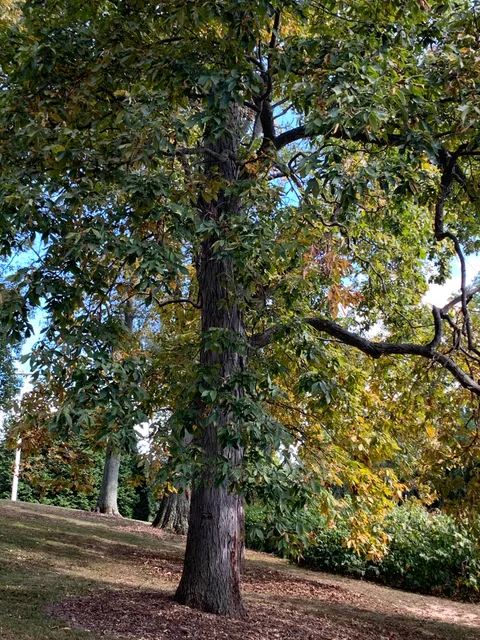
A native of Southern Ontario's hardwood woodlots that grows well on the shallow, limestone-derived soils of the Quinte area. Shagbarks are typically found in old fencerows, pasture edges and farm woodlots south of Hwy 7, and big open-grown trees on rural lots around Belleville, Quinte West and Prince Edward County are often well over a century old. It is the native hickory with sweet, edible nuts.
Ontario's Tree Atlas notes that lone stands near Lake Huron and Georgian Bay may have been planted by Indigenous peoples hundreds of years ago. Its strong, shock-resistant wood made tool handles, sporting goods and flooring, and it is still prized for long-burning firewood and smoking meat.
Full Tree
Identification
Leaves
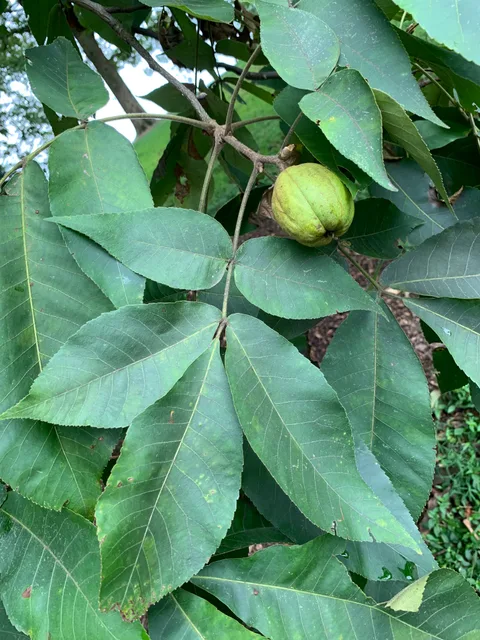
Large compound leaves with five leaflets, sometimes seven. The three leaflets at the tip are much bigger than the lower pair and broadest above the middle. Leaflets are green on top and paler and hairy underneath, with finely toothed edges. Leaves turn golden yellow to golden brown in fall.
Leaves
Bark
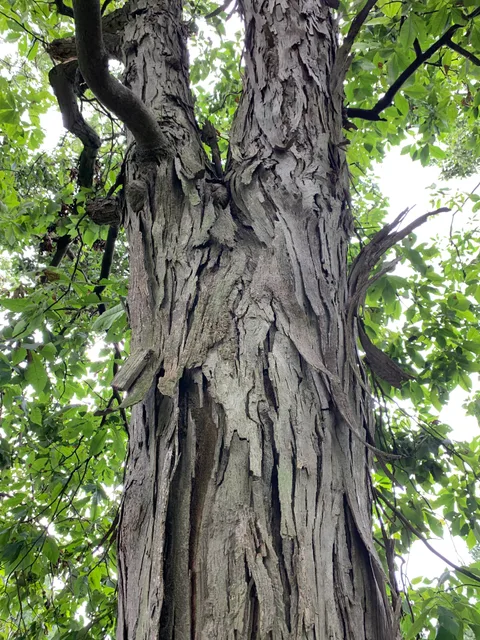
The easiest native tree to recognize by its bark. Young trees have smooth grey bark, but with age it splits into long, thin plates that stay attached in the middle and curl away from the trunk at the ends, giving the trunk a shaggy look. Loose plates come off in storms and pile up at the base of the tree.
Bark
Flowers
Male flowers hang in drooping yellow-green catkins as the leaves open in May; female flowers are small and inconspicuous in short spikes at the shoot tips. Wind pollinated.
Fruit
Round, sweet, edible nut 3-4.5 cm (1 1/4-1 3/4 in) long inside a thick husk that splits into four parts when ripe in fall. Squirrels favour the nuts, and chipmunks, black bears, birds and other wildlife eat them too. Trees start bearing at about 40 years and produce good crops every 1-3 years, with little in between.
Valuable wildlife food source
Growing Conditions
Climate
Very hardy (it survives -40 C) and well suited to Belleville's zone 5b. It tolerates alkaline soil and dry sites, so it handles the thin soils over limestone better than many shade trees, but it grows best on deep, moist, well-drained ground. Its dense, very strong wood and deep taproot make mature shagbarks among the more storm-resistant trees in the area, though dead limbs still come down in ice storms. Drought summers like 2025, when the province recorded drought damage along Hwy 401 from Belleville to Napanee, are when hickory bark beetle problems start.
Hardiness Zones: 4a, 4b, 5a, 5b
Light Requirements
Soil
Moisture: moist, dry
Drainage: well-drained, moderate
pH Range: 6 - 7.8
Tolerance
Care & Maintenance
Pruning
Best Season: Winter
Frequency: Every 5-10 years while young; mature trees need only deadwood and hazard work
- Prune in late winter while the tree is dormant
- Train young trees early to a single straight leader; the slow growth means mistakes take decades to correct
- Remove dead branches promptly: dead hickory limbs are heavy and very hard, and fall with real force
- Leave the shaggy bark alone; peeling plates are normal and are not a sign of disease
- Cut back limbs over driveways and parking areas if nut drop is a problem, rather than topping the tree
Avoid: Spring leaf-out, when the tree is pushing new growth; Drought periods, when wounded hickories are more attractive to bark beetles
Watering
Establishment: Water deeply every week for the first 2-3 summers; the long taproot makes shagbark slow to establish and hard to transplant, so plant it small
Mature: Deep-rooted and fairly drought tolerant once established
Seasonal Care Timeline
Spring
- Look for sprouts dying on the trunk or dark bleeding spots on the bark (signs of hickory decline)
- Phylloxera galls appear on new leaves; they are cosmetic
- Late frosts can brown newly opened leaves
Summer
- Water young and stressed trees deeply during drought
- Watch for thinning or yellowing crowns, which can mean bark beetle attack
- Leaf spot appears in wet summers; no treatment needed
Fall
- Heavy nut and husk drop on driveways, decks and lawns in good years, which can be a slipping hazard
- Rake and dispose of fallen leaves if leaf spot was heavy
- Good time to plan root-zone protection before spring construction
Winter
- Best time for pruning and deadwood removal
- Check for dead limbs over roofs and driveways before ice storms
- Protect young trees from deer browse
Common Issues
Hickory Bark Beetle and Hickory Decline
HighA native bark beetle (Scolytus quadrispinosus) that breeds under the bark of hickories weakened by drought, flooding, root damage or crowding, and rarely infests healthy trees. With the canker fungus Ceratocystis smalleyi it causes hickory decline: when beetle numbers are high, trees can decline and die in as little as two years. Populations rose in Middlesex County in southwestern Ontario between about 2020 and 2024, killing mature hickories in woodlots there.
Symptoms: Sparse, small or yellowed leaves and early leaf drop, Dead branches in the upper crown, Round exit holes about 3 mm (1/8 in) across on the upper trunk and branches, Dark bleeding spots on the bark in May or June over reddish-brown cankers, Clusters of sprouts on the trunk that wilt and die within a year, Woodpecker damage on the bark
Treatment: No cure once a tree is heavily attacked. Remove and dispose of infested trees before the beetles emerge in spring, and keep nearby hickories watered and mulched.
Prevention: Reduce stress: protect the root zone, water during drought and avoid wounding the trunk.
Professional arborist recommended
Hickory Leaf Spot (Anthracnose)
LowFungal leaf spot (Gnomonia caryae) that shows up in wet summers. It appears late in the season and rarely harms the tree.
Symptoms: Irregular reddish-brown spots on the upper leaf surface, Brown spots on the underside, Some early leaf drop in bad years
Treatment: No treatment recommended.
Prevention: Rake up and dispose of fallen leaves in autumn to reduce the fungus near the tree.
Phylloxera Galls
LowTiny aphid-like insects (Phylloxera) cause round, pouch-like galls on hickory leaves, leaf stalks and new shoots in early summer. Mostly cosmetic.
Symptoms: Round green to reddish bumps on leaves and leaf stalks, Swollen, distorted shoot tips, Galls split open and turn black later in summer
Treatment: Not usually needed on established trees.
Prevention: Prune out old galled twigs in winter, before eggs hatch in spring.
Root Damage and Construction Stress
ModerateShagbark hickory has a deep taproot and does not recover well from root loss. Trenching, grading, paving or septic work within the root zone can set off a slow decline that ends with bark beetle attack years later. Fire scars and large wounds also let in decay.
Symptoms: Thinning crown and small leaves a few years after nearby work, Upper branches dying back, Sprouts along the trunk
Treatment: Mulch, deep watering in dry spells and deadwood pruning; trees with heavy root loss should be assessed for safety.
Prevention: Fence off the root zone (at least to the drip line) before any construction and route trenches around old hickories.
Professional arborist recommended
Sources & References
Information compiled from the following authoritative sources:
Quick Facts
When to Call an Arborist
Recommended inspection: Every 3-5 years, after a drought summer, and before any construction near the tree
- •Thin, yellowing crown or dead upper branches
- •Small round holes, bleeding spots or woodpecker damage on the trunk
- •Dead limbs over the house, driveway or play areas
- •Planned digging, grading or paving within the drip line
- •Cracks, cavities or a new lean after an ice or wind storm
Free consultation for Belleville residents
Recommended Services
Based on Shagbark Hickory characteristics