
Northern Hackberry
Celtis occidentalis
Overview
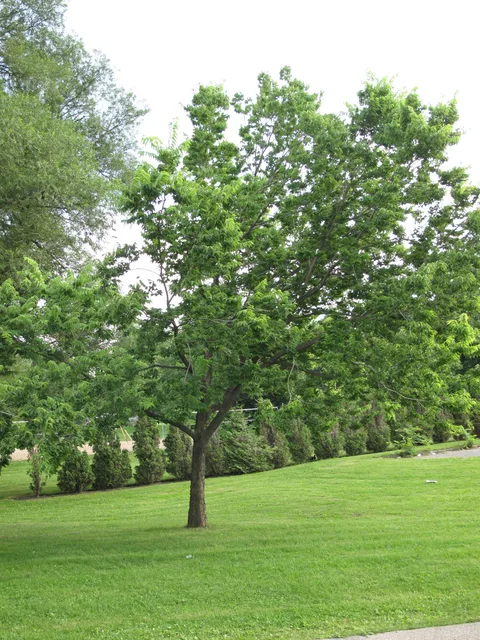
A native tree found across southern Ontario from Windsor to the Ottawa Valley and north to the edge of the Canadian Shield. Natural Resources Canada describes it as sparsely distributed in Ontario, so around Belleville wild trees are scattered along river valleys, limestone slopes and hedgerows rather than common, but it is increasingly planted as a street and yard tree. It is one of the toughest native shade trees for city conditions: the City of Windsor's tree guide lists it as tolerant of wind, wet and dry sites, alkaline soil, salt and air pollution. It is a relative of the elms that is not affected by Dutch elm disease, and the Canadian Food Inspection Agency lists it among the recommended alternatives for replacing ash killed by emerald ash borer. Its persistent fruit feeds robins and other birds through winter, and it is the host plant of the hackberry emperor butterfly. Note: its shrubby relative, Dwarf Hackberry (Celtis tenuifolia), is listed as threatened in Ontario and protected under the Species Conservation Act, 2025; activities impacting a protected species may require registration or a permit through the Species Conservation Registry. If you are not sure which hackberry you have, Wilsaw Tree Service can help confirm the identification and check the requirements before any work.
The wood is heavy and hard but weak and rots easily, so it has never been an important timber. It was used for cheap furniture, boxes, barrel hoops and the flooring of pioneer cabins.
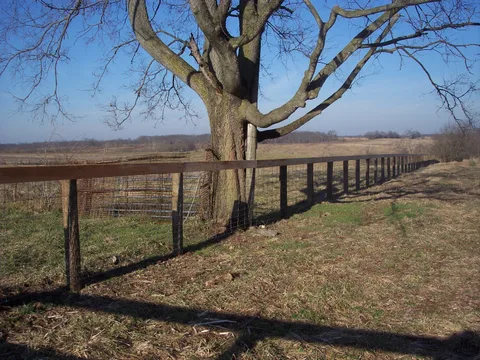
Full Tree
Identification
Leaves
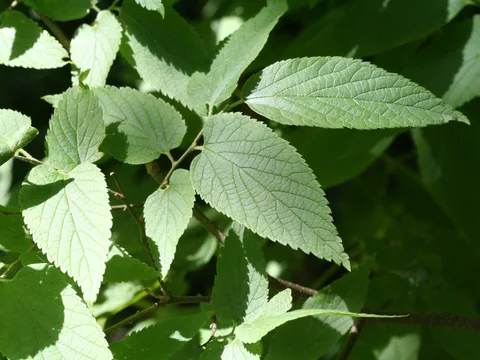
Bluish-green leaves set in two rows along the twig, with a long, tapering tip and an uneven, lopsided base. Three prominent veins start at the base of the blade, and the veins are hairy underneath. Many leaves carry small, bumpy nipple galls on the underside, which helps confirm a hackberry. Leaves turn yellow in fall.
Leaves
Bark
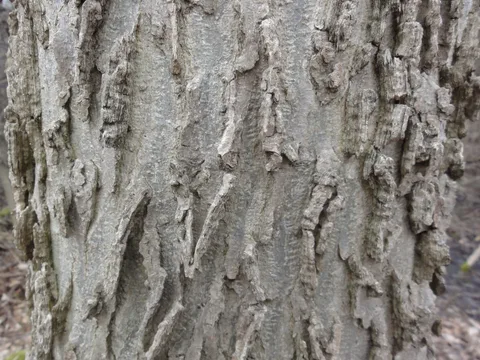
The easiest way to know a hackberry. Smooth grey-brown bark on young trees soon breaks into corky 'warts', which grow into rough, irregular, narrow ridges with wart-like projections. No other common Quinte tree has bark quite like it.
Bark
Flowers
Small greenish flowers open in spring as the leaves expand. Male flowers sit in small clusters at the base of the new shoot; female flowers grow singly where the new leaves join the twig. They are wind-pollinated and easily missed.
Fruit
Pea-sized, berry-like fruit 6-8 mm (about 1/4 in) across, each on its own slender stalk, ripening from orange-red to dark reddish-purple in early fall. The thin, sweet flesh around a large pitted stone is edible and is said to taste like dates. Fruit hangs on through winter and is a reliable winter food for robins, cedar waxwings, wild turkey and other birds and small mammals. Most years bring a good crop.
Valuable wildlife food source
Growing Conditions
Climate
Very cold-hardy and comfortable in Belleville's zone 5b climate. It thrives on the alkaline, limestone-derived soils south of the Shield and takes dry roadside and boulevard sites better than most native shade trees, though heavily compacted soil still holds it back. It survived extreme droughts on the Great Plains better than American elm. Best in moist, well-drained soil and full sun; avoid low spots on heavy Bay of Quinte clay that stay waterlogged.
Hardiness Zones: 3, 4a, 4b, 5a, 5b
Light Requirements
Soil
Moisture: dry, moist
Drainage: well-drained, moderate
pH Range: 6 - 8
Tolerance
Care & Maintenance
Pruning
Best Season: Winter
Frequency: Structural pruning every 2-3 years while young; every 5 years or so once mature
- Train young trees to one central leader and remove narrow, tight forks early: the wood is hard but weak
- Witches' brooms are mostly cosmetic; cut out the worst clusters where they spoil the look of a small tree, but there is no need to chase every one
- Avoid wounding trunks and roots; decay and Armillaria root rot get in through injuries
- Shade-grown hackberries become poorly formed, so give planted trees full sun and room to spread
Avoid: Long summer droughts, when the tree is stressed; Heavy pruning at any one time; take no more than about a quarter of the live crown in a year
Watering
Establishment: Deep watering every week or two for the first two growing seasons
Mature: Very drought tolerant once its deep roots are established
Seasonal Care Timeline
Spring
- Psyllids lay eggs on new leaves (nipple galls follow; cosmetic only)
- Waterlogged soil can harm young trees on heavy clay
- Good time to plant
Summer
- Nipple galls become obvious on the leaf undersides
- Water newly planted trees in dry spells
- Watch for fungi or dieback on older street trees
Fall
- Fruit ripens and draws robins, waxwings and other birds
- Psyllid adults leave the galls to spend the winter in bark cracks
- Yellow fall colour
Winter
- Witches' brooms show up clearly once the leaves are off
- Best season for structural pruning
- Fruit persists as winter food for birds
Common Issues
Hackberry Nipple Gall
LowTiny psyllids (jumping plant lice, Pachypsylla species) lay eggs on the new leaves in spring, and the leaf grows a small gall around each feeding nymph. The USDA Forest Service and the City of Windsor's tree guide both call the damage minor or cosmetic. In the fall the adults leave the galls and spend the winter in bark cracks.
Symptoms: Small, round, nipple-shaped bumps on the underside of the leaves, Matching raised spots on the top of the leaf, Heavily galled leaves may drop a little early
Treatment: None needed. Sprays are not worth it for a cosmetic problem.
Prevention: None practical; nearly every hackberry has some galls.
Witches' Broom
LowThe USDA Forest Service calls it the most important disease of hackberry, though it rarely threatens the tree. A gall mite (Eriophyes) and a powdery mildew together make buds sprout into dense, bushy clusters of short twigs.
Symptoms: Dense, broom-like clusters of short twigs scattered through the crown, Most obvious in winter, when the tree is bare
Treatment: Mostly cosmetic. Prune out brooms where practical on small or showpiece trees.
Prevention: None practical. Keep the tree vigorous; the brooms do not usually threaten its health.
Trunk Decay and Armillaria Root Rot
ModerateHackberry is very sensitive to fire and wounding, which open the way for wood decay, and Armillaria root rot can spread through roots that are already injured or dying (USDA Forest Service). Weak, decayed limbs are the main safety concern on large yard and street trees.
Symptoms: Mushrooms or shelf fungi at the base or on the trunk, Cavities, cracks or soft wood, Thinning crown and dead limbs
Treatment: A professional risk assessment for any large tree near a house, driveway or road; remove dead and decayed limbs.
Prevention: Keep mowers, trenching and construction away from the trunk and roots.
Professional arborist recommended
Soil Compaction and Waterlogged Sites
ModerateHackberry handles drought, alkaline soil, road salt and polluted air, but the City of Windsor's tree guide lists it as intolerant of compacted soil. Mature trees tolerate short floods, but seedlings and young trees are badly hurt by saturated soil, and a permanently high water table is unsuitable (USDA Forest Service). The CFIA advises against sites that flood regularly.
Symptoms: Slow growth and thin crown on new plantings, Dieback after a wet spring on poorly drained clay, Yellowing leaves in standing water
Treatment: Mulch over the root zone, keep traffic off it, and improve drainage where water sits.
Prevention: Plant in well-drained ground; avoid low, wet spots on heavy Quinte clay.
Sources & References
Information compiled from the following authoritative sources:
Quick Facts
When to Call an Arborist
Recommended inspection: Every 3-5 years for large trees; yearly for big trees over roads, driveways or houses
- •Fungi, cavities or cracks on the trunk or root flare
- •Large dead or hanging limbs
- •Narrow V-shaped forks with cracks
- •Sudden thinning or dieback of the crown
- •Planning construction or grade changes within the root zone
Free consultation for Belleville residents
Recommended Services
Based on Northern Hackberry characteristics