
Alternate-leaf Dogwood
Cornus alternifolia
Overview
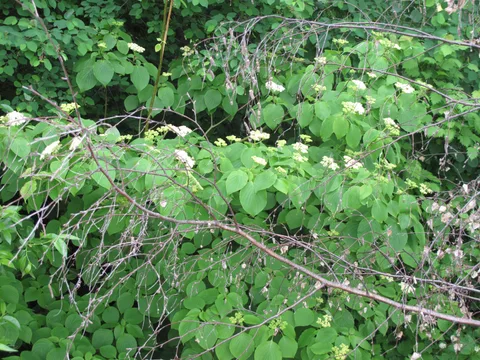
A common native understory and forest-edge shrub or small tree across southern and parts of central Ontario, including the Quinte region, where it grows in moist woods, along woodlot edges and near streams. It is a favourite native ornamental for shady yards: small enough for city lots and spaces under utility lines, with tiered branches, creamy flowers in June and berries that draw birds in midsummer. Its one weakness is golden canker, which is far more likely when the tree is planted in hot sun or allowed to dry out.
Full Tree
Identification
Leaves
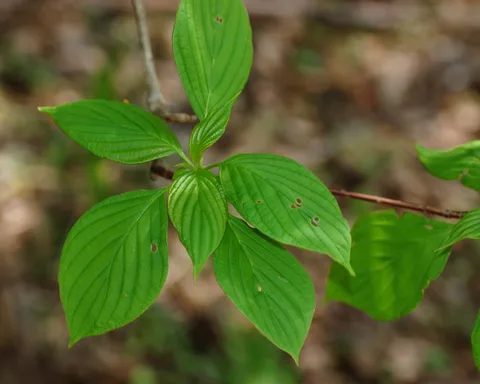
Dark green leaves, paler and finely hairy underneath, with 5-6 pairs of deep veins that curve forward toward the tip, the classic dogwood leaf. The difference is the arrangement: the leaves are alternate and crowded into clusters at the branch tips, so they can look whorled at a glance. It is the only one of our native dogwoods with alternate leaves; red-osier, grey and the other native dogwoods all have leaves in opposite pairs. Fall colour is burgundy-red to reddish-purple.
Leaves
Bark
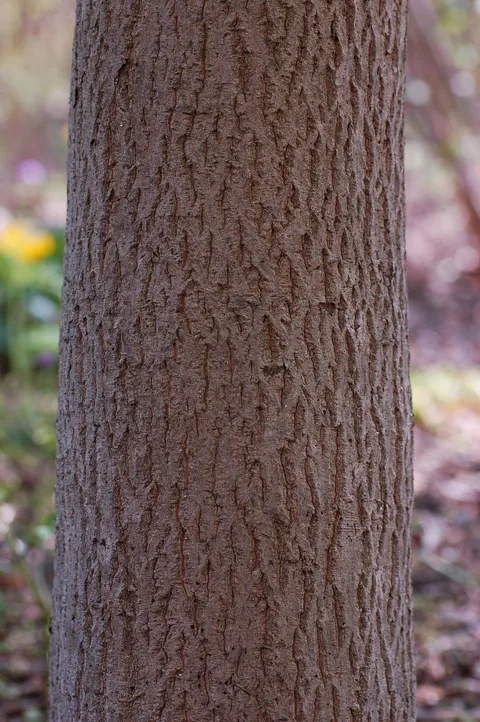
Young stems are smooth and bright green with fine vertical white streaks, which makes the tree easy to spot in winter. New growth and twigs are purplish. Older trunks darken and develop shallow ridges. Healthy bark is purplish-green; bark that turns bright yellow or golden is a sign of golden canker.
Bark
Flowers
Small, sweet-smelling, creamy-white flowers in flat-topped clusters about 5 cm (2 in) across appear in May and June, held above the tiers of leaves. Unlike flowering dogwood there are no large white 'petals' (bracts). Butterflies, moths and other pollinating insects visit the flowers, and it is a host plant for spring azure butterfly caterpillars.
Fruit
Small dark blue to blue-black berries ripen in July on bright red stalks, a striking combination. Birds strip them quickly: at least 11 bird species, including ruffed grouse, eat the fruit, along with chipmunks and black bears.
Valuable wildlife food source
Growing Conditions
Climate
Fully hardy in Belleville's zone 5b climate. The challenge here is summer heat and drought, not winter cold. On the heavy clay of the Bay of Quinte lowlands, keep the mulch thinner (2.5-5 cm, 1-2 in) so the shallow roots stay cool and moist without waterlogging; on thin soils over limestone, or the shallow, rocky ground near the Canadian Shield edge north of Highway 7, it needs extra mulch and watering in dry summers. A cool spot on the north or east side of a house, or under taller trees, suits it best.
Hardiness Zones: 3, 4a, 4b, 5a, 5b
Light Requirements
Soil
Moisture: moist
Drainage: well-drained
pH Range: 5 - 7
Tolerance
Care & Maintenance
Pruning
Best Season: Winter
Frequency: Light pruning only; check yearly for cankered branches
- Prune in the dormant season, late fall to late winter
- Keep the natural tiered shape: remove dead, crossing or rubbing branches rather than shortening the horizontal limbs
- Cut out any branch with yellow or golden bark 10-15 cm (4-6 in) below the discoloured area, into healthy wood
- Disinfect pruners for at least 30 seconds between cuts (70% alcohol is less corrosive than a 10% bleach solution) and dispose of cankered wood
Avoid: Hot, dry summer weather, when the tree is already stressed; Wet weather
Watering
Establishment: About 5 cm (2 in) of water a week for newly planted trees, ideally from a soaker or drip hose laid at the drip line; it transplants poorly, so start with a small tree
Mature: About 2.5 cm (1 in) a week in total from rain and watering; keep soil evenly moist
Seasonal Care Timeline
Spring
- Check for golden or yellow bark and dead branches as leaves open
- Plant in spring, starting with a small tree
- Refresh mulch and pull turf back to the drip line
Summer
- Water deeply in heat and drought; stress triggers golden canker
- Look for sawfly larvae on the leaves
- Flowers in May-June, blue-black fruit on red stalks in July
Fall
- Burgundy to reddish-purple fall colour
- Water deeply before freeze-up after a dry fall
- Mark cankered branches to remove in the dormant season
Winter
- Dormant-season pruning of cankered branches
- Rabbit and deer browsing on young plants
- Wet snow piling on the horizontal tiers
Common Issues
Golden Canker
HighA fungal canker (Cryptodiaporthe corni, recently renamed Aurantioporthe corni) that, as far as is known, attacks only alternate-leaf dogwoods. The fungus can live harmlessly inside healthy branches and turns into a disease when the tree is stressed, so heat, drought and hot, sunny sites make it much worse. If it reaches the main trunk it kills the tree above that point.
Symptoms: Leaves wilt and die on individual branches, Bark turns bright golden-yellow instead of purplish-green, Small orange, raised bumps on the yellowed bark, Branch dieback that spreads toward the trunk
Treatment: No fungicides control it. Prune out infected branches in the dormant season, 10-15 cm (4-6 in) below the yellow tissue, disinfecting tools between cuts, and dispose of the wood. A tree with cankers on the main trunk usually cannot be saved.
Prevention: Plant in a cool, shaded spot, keep the soil moist with deep watering and mulch, and avoid wounding. Reducing stress is the best defence.
Professional arborist recommended
Heat, Sun and Drought Stress
ModeratePagoda dogwood is a shade-tolerant understory tree with shallow roots. Planted in full sun, on a hot south or west wall, or in dry soil, it struggles, and the stress sets it up for golden canker.
Symptoms: Scorched, curled or drooping leaves in midsummer, Early leaf drop, Thin, sparse tiers and twig dieback
Treatment: Water deeply, widen the mulch ring and remove competing turf. Consider moving a struggling young tree to a shadier spot.
Prevention: Site it in part to full shade, sheltered from wind, in moist, rich soil.
Dogwood Sawfly
LowCaterpillar-like larvae of a small wasp relative that feed in groups on dogwood leaves in summer. They prefer grey, yellow and red-osier dogwoods and are an occasional, mostly cosmetic problem on pagoda dogwood.
Symptoms: Leaves skeletonized to a 'window pane' by small larvae, Larvae coated in white, waxy powder, becoming yellow with black spots and about 2.5 cm (1 in) long when mature, Whole leaves eaten except the main vein
Treatment: Hand-pick larvae or prune off the infested leaves. If treatment is needed, treat while larvae are small; Bt (Bacillus thuringiensis) does not work on sawflies.
Prevention: Check plantings through the summer, especially isolated trees, and encourage natural enemies such as birds and predatory insects.
Leaf Spots
LowMinor fungal leaf infections show up in some wet summers. They are cosmetic.
Symptoms: Small brown or purplish spots on the leaves, Some early leaf drop in late summer
Treatment: None usually needed. Rake up fallen leaves.
Prevention: Avoid overhead watering and keep the tree vigorous.
Sources & References
Information compiled from the following authoritative sources:
Quick Facts
When to Call an Arborist
Recommended inspection: Yearly, ideally in late spring once the tree is in full leaf
- •Branches with yellow or golden bark and orange bumps
- •Wilting or dieback in one or more tiers
- •Discoloured bark or cankers on the main trunk
- •Repeated summer leaf scorch
- •Heavy defoliation by sawfly larvae
Free consultation for Belleville residents
Recommended Services
Based on Alternate-leaf Dogwood characteristics