
Hawthorns
Crataegus spp.
Overview
Hawthorns are a group of closely related native species found across southern Ontario and well into the north. The more common ones in Ontario include downy, cockspur, dotted and fleshy hawthorn. Around Belleville and the rest of Hastings County they are classic trees of abandoned pasture, old fields, fencerows and woodland edges, especially on the calcium-rich soils over limestone, where they often form dense, thorny thickets. They are excellent for birds, which nest in the thickets and eat the haws, but the thorns make clearing an overgrown field or fencerow slow, painful work that needs protective gear and the right equipment. Wilsaw Tree Service can clear thickets, take out problem trees or simply raise and thin low thorny limbs over a path.
In some areas the fruits are known as haws or haw apples. Hawthorns are too small for commercial lumber, but the hard, heavy wood has been used for carving and turnery.
Full Tree
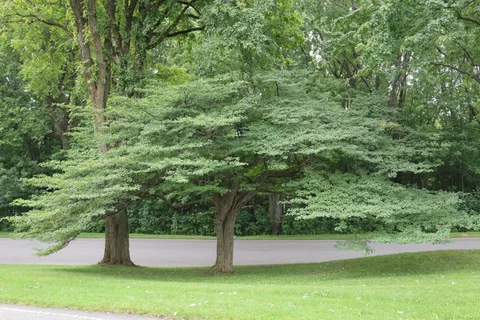
Identification
Leaves
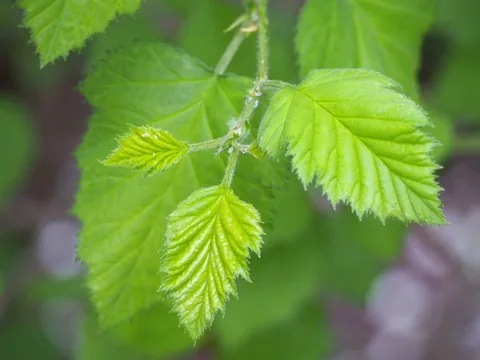
Small, toothed leaves that vary a lot between species: dotted hawthorn has wedge-shaped leaves widest near the tip, downy hawthorn has broad, softly hairy, shallowly lobed leaves, and cockspur hawthorn has glossy, narrow leaves. Two small leafy stipules often sit at the base of the leaf stalk.
Leaves
Bark
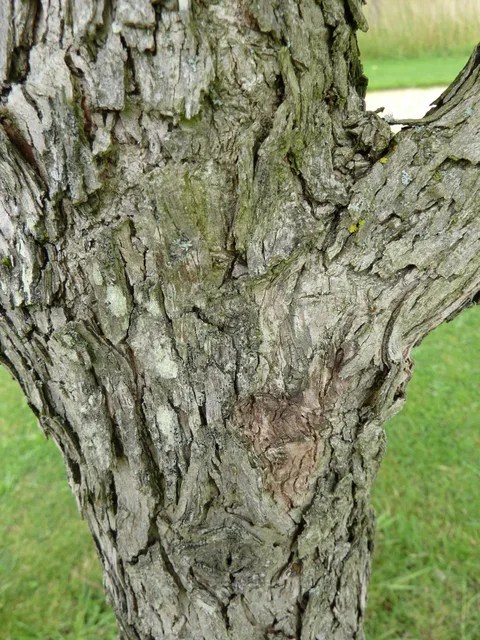
Rough, shredding bark that breaks into firm strips or scales loosening at both ends, on a short, often crooked trunk.
Bark
Flowers
Showy white (occasionally pinkish) five-petalled flowers in flat-topped clusters in late spring, with the leaves. Anthers may be white, pink or red. The scent is sweet with an unpleasant, slightly fetid note.
Fruit
Clusters of small apple-like fruits called haws, usually about 1-1.5 cm (1/2 in) across, red in most local species but sometimes orange, yellow or nearly black. They ripen in late summer and fall, often hang on into winter, and are edible and used for jams and jellies. Many birds and mammals eat them.
Valuable wildlife food source
Growing Conditions
Climate
Tough and very cold-hardy, well suited to Belleville's zone 5b. Hawthorns tolerate dry, windy, exposed sites and grow best in full sun on well-drained soil, though they take partial shade. On heavy, wet Quinte clay, Ontario recommends planting them on a slight mound and loosening the soil well beyond the planting hole.
Hardiness Zones: 3a, 3b, 4a, 4b, 5a, 5b
Light Requirements
Soil
Moisture: dry, moist
Drainage: well-drained, moderate
pH Range: 6 - 8
Tolerance
Care & Maintenance
Pruning
Best Season: Winter
Frequency: Light structural pruning every few years; more often for hedges
- Prune in late winter while dormant; fire blight bacteria spread most readily in warm, wet weather and at bloom
- Cut fire blight strikes out well below the blackened tissue, at least 25-30 cm (10-12 in), and disinfect tools between cuts
- Thin crowded interior branches to let air through the crown and dry the leaves faster, which helps against leaf spot and rust
- Wear heavy leather gloves, long sleeves and eye protection; the thorns go through light gloves easily
- Chip or remove thorny brush promptly; cut branches left on lawns puncture tires and feet
Avoid: Bloom and warm wet spring weather, when fire blight infects through flowers and fresh wounds; Heavy pruning in summer, which pushes soft regrowth
Watering
Establishment: Water weekly for the first two growing seasons
Mature: Drought-tolerant once established; does not like waterlogged ground
Seasonal Care Timeline
Spring
- Orange jelly-like rust horns on nearby junipers and eastern red cedar after spring rains
- Fire blight risk at bloom in warm, wet weather
- Flat-topped white flower clusters in late spring
Summer
- Orange rust spots and leaf spot causing early leaf drop
- Hawthorn lace bug stippling on leaves
- Blackened shoot tips from fire blight
Fall
- Haws ripen and colour up; many persist into winter
- Orange to red fall colour on some species
- Good time to plan thicket clearing once the leaves are down
Winter
- Best time for pruning and for clearing thorny brush
- Persistent fruit feeds birds through the winter
- Thorny brush in snow is a puncture hazard; clear it before spring mowing
Common Issues
Cedar-Hawthorn Rust and Cedar-Quince Rust
LowTwo Gymnosporangium rust fungi that need two hosts: eastern red cedar or other junipers, and hawthorns (also apples and crabapples). Cedar-hawthorn rust (G. globosum) spots the leaves; cedar-quince rust (G. clavipes) also attacks the fruit and twigs. Spores are produced on the junipers during long spring rains, and the fungus survives for years in the cedars, so hawthorns near infected junipers are exposed every year. See Eastern Red Cedar.
Symptoms: Brown or orange-yellow spots on the upper leaf surface, Fine whitish tubes on the leaf underside or fruit that release orange-brown spores, Swollen, deformed fruit and twigs (cedar-quince rust), Early leaf drop in summer
Treatment: Damage to hawthorn from leaf rust is usually slight. On valued trees, protective fungicide sprays timed for when the orange jelly-like horns appear on nearby junipers in spring can reduce infection.
Prevention: Choose rust-resistant hawthorns when planting, and avoid planting hawthorns, apples and junipers side by side.
Fire Blight
ModerateBacterial disease (Erwinia amylovora) of the rose family, carried by bees into the flowers at bloom. Hawthorns, apples, pears and mountain-ash are all hosts.
Symptoms: Shoots and leaves suddenly wilt and turn blackish-brown as if scorched, Discoloured, dying wood below the blighted shoots, Dead leaves clinging to blighted shoots
Treatment: Cut out infected wood well below the visible damage (at least 25-30 cm / 10-12 in) in dry weather, disinfect tools between cuts, and remove the prunings.
Prevention: Prune when dormant, avoid excess nitrogen, and keep trees out of heavy, wet ground.
Professional arborist recommended
Leaf Spot
LowFungal leaf spot (Diplocarpon mespili, also known as Fabraea maculata), the same fungus that spots pear leaves. Infected fallen leaves carry it over winter.
Symptoms: Small angular purple to reddish-brown spots from June, Yellowing leaves, Heavy leaf drop by mid to late summer
Treatment: Rake and remove fallen leaves before bud break; fungicides are rarely worth it except on specimen trees.
Prevention: Open, airy crowns and fall leaf clean-up.
Hawthorn Lace Bug
LowSmall sap-feeding lace bug (Corythucha cydoniae) that lives on the undersides of hawthorn leaves.
Symptoms: Pale yellow-white stippling on the upper leaf surface, Dark varnish-like spots of excrement under the leaves, Bronzed, dry-looking foliage by late summer
Treatment: Insecticidal soap or horticultural oil sprayed from below onto the leaf undersides after the eggs hatch in late spring.
Prevention: Keep trees vigorous; check leaf undersides in early summer.
Sources & References
Information compiled from the following authoritative sources:
Quick Facts
When to Call an Arborist
Recommended inspection: Every 2-3 years, or yearly for specimen trees near patios, play areas and paths
- •Blackened, scorched-looking shoots (possible fire blight)
- •Overgrown thorny thickets that need clearing
- •Low thorny limbs over paths, driveways or play areas
- •Large cankers or splits in the main trunk
- •Swollen, rusted fruit and twigs year after year
Free consultation for Belleville residents
Recommended Services
Based on Hawthorns characteristics