
American Beech
Fagus grandifolia
Active Threats to American Beech
LDD Moth (Spongy Moth)
Formerly known as Gypsy Moth. Caterpillars defoliate trees in late spring, with periodic outbreak years causing severe damage.
Signs to watch for:
- •Visible caterpillars with blue and red spots
- •Skeletonized or completely eaten leaves
- •Egg masses on tree trunks (tan, fuzzy patches)
- •Frass (caterpillar droppings) under trees
Recommended Action: Healthy trees typically survive defoliation. Repeated years of heavy feeding may require professional intervention.
Free consultation available
Beech Bark Disease
An invasive beech scale insect wounds the bark and lets Neonectria canker fungi in. The disease is advancing through most of beech's range in Ontario and has done the most damage in eastern and southern Ontario, where it has been present longest. Large, mature beeches die first, and weakened trunks become a hazard near homes, roads and trails.
Signs to watch for:
- •White, woolly wax specks or patches on the trunk
- •Small cankers and pitted, roughened bark
- •Tiny orange-red fungal fruiting bodies on bark in late summer and fall
- •Thin crown with small yellowish leaves
Recommended Action: Have large beeches near buildings, driveways or trails assessed for decline and removal risk. Keep beeches that show no scale, as some are naturally resistant, and do not move beech firewood.
Free consultation available
Beech Leaf Disease
A disease linked to an invasive microscopic nematode that feeds in beech buds and leaves. First found in Ontario in 2017, it has spread along Lake Ontario, with reports reaching Prince Edward County next to the Bay of Quinte. Young understory beech can die within 2-5 years.
Signs to watch for:
- •Dark green stripes between leaf veins, easiest to see from below
- •Thick, leathery, curled or shrunken leaves
- •Buds that fail to open and early leaf drop
- •Thinning crowns, especially on young trees
Recommended Action: Watch beech leaves in spring and summer and report suspected cases on EDDMapS or iNaturalist. Do not move beech seedlings, leaf litter or firewood. High-value mature trees can be assessed for an emergency-registered trunk injection.
Free consultation available
Overview
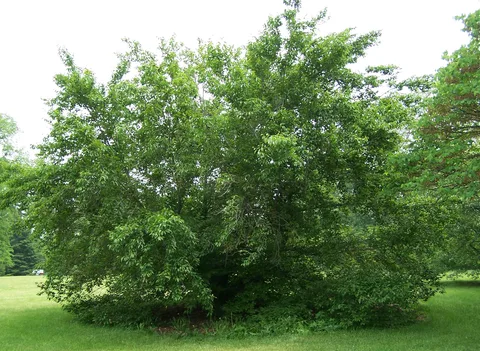
A native hardwood of the older woodlots north of Belleville, the Oak Hills and the Canadian Shield edge north of Highway 7, usually with sugar maple, hemlock and yellow birch. It prefers acidic, well-drained loams and is uncommon on the limestone-based clay plain around the Bay of Quinte, so in town it is mostly found as large old trees on older rural-edge properties. Large declining beeches are one of the most frequent hazard-removal jobs on wooded lots.
Beechnuts were once an important fall food for wildlife across the region. The beech scale reached Canada through Halifax in the late 1800s and spread west through Quebec into Ontario; Ontario researchers note the damage has been greatest in eastern and southern Ontario, where the disease has been present longest.
Full Tree
Identification
Leaves
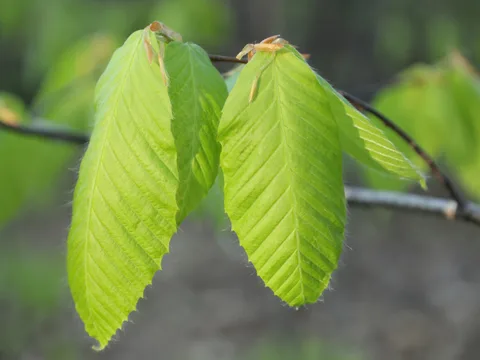
Glossy, somewhat papery oval leaves with straight, evenly spaced side veins that each end in a small sharp tooth. Leaves turn yellow to bronze in fall, and on young trees and lower branches many dry to a pale tan and hang on all winter (marcescence), rattling in the wind until the new buds push them off in spring.
Leaves
Bark
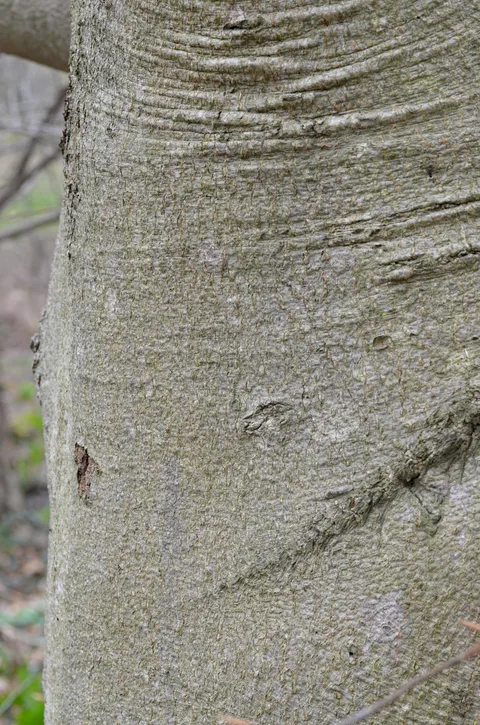
The smooth, thin, blue-grey bark is the easiest way to know a beech at any time of year. Unlike most of our hardwoods it never becomes furrowed. Beech bark disease changes this: infested trunks show white woolly specks of scale insects, then pitted, cankered and roughened bark. Carving initials wounds the tree and opens it to disease.
Bark
Flowers
Small yellowish-green flowers open in late April or May as the leaves expand. Male and female flowers are separate on the same tree and are pollinated by wind.
Fruit
Small bristly husks split in September to November to release two or three triangular brown nuts. The nuts are edible once ripe and are a major wildlife food for black bears, deer, squirrels, chipmunks, ruffed grouse, wild turkey and blue jays. Good crops come every 2-8 years; substantial nut production starts around age 40.
Valuable wildlife food source
Growing Conditions
Climate
Hardy across Eastern Ontario, but a moisture-loving, shade-tolerant woodland tree. Hot, dry summers, compacted soils and sudden exposure stress it, and stressed trees succumb faster to beech bark disease and beech leaf disease.
Hardiness Zones: 3a, 3b, 4a, 4b, 5a, 5b, 6a, 6b
Light Requirements
Soil
Moisture: moist
Drainage: well-drained, moderate
pH Range: 4.1 - 7
Tolerance
Care & Maintenance
Pruning
Best Season: Winter
Frequency: Minimal; remove dead, damaged or crossing branches only
- Prune while dormant (late fall to late winter) and keep cuts small; large wounds heal slowly and let decay in
- Avoid removing large limbs on mature trees; thin bark is easily injured and decay fungi enter through big cuts
- Never carve, staple or nail into the bark; it is a direct entry point for beech bark disease
- When a beech is removed, expect root suckers; plan to cut them back or have them treated for two growing seasons
Avoid: Spring sap flow and leaf-out; Hot summer weather when newly exposed bark can sunscald
Watering
Establishment: Water deeply every week for the first two growing seasons; the shallow roots dry out quickly
Mature: Needs consistently moist soil; a wide mulched root zone helps more than frequent light watering
Seasonal Care Timeline
Spring
- Look for dark striping between the veins on newly opened leaves (beech leaf disease)
- Buds that fail to open
- Spongy moth caterpillars hatching in May
Summer
- Drought stress on shallow roots
- Crown thinning and early leaf drop
- Spongy moth defoliation in outbreak years
Fall
- Orange-red fungal fruiting bodies on cankered bark (beech bark disease)
- Assess large declining beeches before winter storms
- Do not move beech firewood or leaf litter
Winter
- White woolly scale is easy to spot on bare grey trunks
- Beech snap: infected trunks can break in wind or under ice load
- Marcescent leaves on young trees catch snow and ice
Common Issues
Beech Bark Disease
SevereAn insect-fungus complex. The invasive beech scale (Cryptococcus fagisuga) feeds on the bark and leaves tiny wounds, and Neonectria canker fungi enter through them. It kills large trees first and is widespread in Eastern Ontario woodlots.
Symptoms: White, woolly wax specks or patches on the trunk (scale colonies), Small cankers and pitted, roughened bark, Tiny orange-red fungal fruiting bodies on the bark in late summer and fall, Thin crown with small yellowish leaves, Trunk snapping partway up (beech snap) in wind
Treatment: No cure for infected trees. Scale on high-value ornamental trees can sometimes be reduced with horticultural treatments; badly cankered trees should be assessed for removal before they fail.
Prevention: Do not move beech firewood. Keep trees that show no scale (some are naturally resistant). Avoid bark wounds and carving.
Professional arborist recommended
Beech Leaf Disease
HighA newer disease linked to a microscopic invasive nematode (Litylenchus crenatae mccannii) that feeds inside buds and leaves. First found in Ontario in 2017 and spreading north and east along Lake Ontario; detections now reach Prince Edward County.
Symptoms: Dark green stripes between the leaf veins, easiest to see from below or held up to the light, Thick, leathery, curled or shrunken leaves in later years, Early leaf drop and buds that fail to open, Thinning crown; young understory beech can die within 2-5 years
Treatment: No cure. A thiabendazole root-flare injection holds an emergency minor-use registration for beech in Ontario and is applied to mature trees by trained arborists; phosphite products may improve vigour.
Prevention: Do not move beech seedlings, leaf litter or firewood. Report suspected cases on EDDMapS or iNaturalist.
Professional arborist recommended
Root Damage, Compaction and Sunscald
ModerateBeech has a shallow root system and thin bark. Construction, grade changes, trenching and heavy equipment over the roots, or suddenly opening up the woods around it, often start a slow decline.
Symptoms: Dieback starting a few years after nearby construction, Cracked or dead bark on the sun-facing side of newly exposed trunks, Dense root suckers after root injury, Decay and fungal conks at old wounds
Treatment: Mulch and protect the root zone, water during drought, remove dead wood. Severely declining trees near targets should be assessed.
Prevention: Fence off the root zone during construction; avoid paving or adding fill over roots; thin around woodland beeches gradually.
Spongy Moth (LDD Moth)
ModerateAmerican beech is a listed host of spongy moth. Caterpillars can strip foliage in outbreak years, adding stress to trees already affected by beech bark disease.
Symptoms: Holes and missing leaves in June, Hairy caterpillars with blue and red spots, Tan, fuzzy egg masses on bark
Treatment: Scrape and destroy egg masses; healthy trees usually releaf. Repeated defoliation of high-value trees may justify professional treatment.
Prevention: Keep trees vigorous; check for egg masses in fall and winter.
Sources & References
Information compiled from the following authoritative sources:
Quick Facts
When to Call an Arborist
Recommended inspection: Every 1-2 years for large beeches near homes, driveways or trails; yearly once beech bark disease is present
- •White woolly specks or cankers on the trunk
- •Dark striping between leaf veins or curled, leathery leaves
- •Large dead limbs or thinning crown
- •Fungal conks, cracks or cavities on the trunk
- •A large beech leaning toward a house, road or play area
- •Decline after construction near the roots
Free consultation for Belleville residents
Recommended Services
Based on American Beech characteristics