
Butternut
Juglans cinerea
Active Threats to Butternut
Butternut Canker
Fungal disease that girdles and kills butternut of all ages. It is found throughout butternut's Canadian range and is the reason butternut is listed as endangered in Ontario. Butternut is protected under Ontario's Species Conservation Act, 2025.
Signs to watch for:
- •Elongated, sunken cankers starting at leaf scars, buds or wounds
- •Inky-black ooze from bark cracks in spring
- •Sooty black patches with a whitish margin in summer
- •Dieback starting in the lower crown
Recommended Action: Do not remove or cut back a butternut before checking the provincial requirements. Ontario says activities affecting a protected species may need registration or a permit. A qualified butternut professional's report can take the place of registration only for a tree so badly affected by canker that keeping it would not help the species, and it must be submitted through the Species Conservation Registry before work starts. Wilsaw Tree Service can confirm the identification and help you through the process.
Free consultation available
Overview
Butternut is listed as endangered in Ontario, mainly because of butternut canker, and it is protected under the Species Conservation Act, 2025, which replaced the Endangered Species Act, 2007 on March 30, 2026. The province says activities that affect a protected species may need registration or a permit. Ontario also says its older butternut health assessment guidelines no longer reflect the current law: under the new rules, work that would kill or harm a butternut generally needs registration or a permit, unless a qualified butternut professional's report shows the tree is so badly affected by canker that keeping it would not help the species, and that report is submitted through the Species Conservation Registry before the work starts. Around Belleville it grows as scattered single trees or small groups in hedgerows, woodlot edges and stream valleys, mostly on the limestone country south of the Canadian Shield. If you have a butternut you may need to remove, cut back or build near, talk to Wilsaw Tree Service first: we help homeowners confirm the identification, find a qualified professional where a report is needed, and work through the province's requirements before any cutting.
Valued for its sweet, oily nuts and for light, easily worked wood used in cabinetry and turnery. Butternut canker was first reported in Ontario in 1991, though it had probably been here since at least 1978, and the species has declined sharply since. Ontario's butternut assessment guidelines were written under the former Endangered Species Act, and the province now warns that they do not reflect the current law and should be relied on with caution.
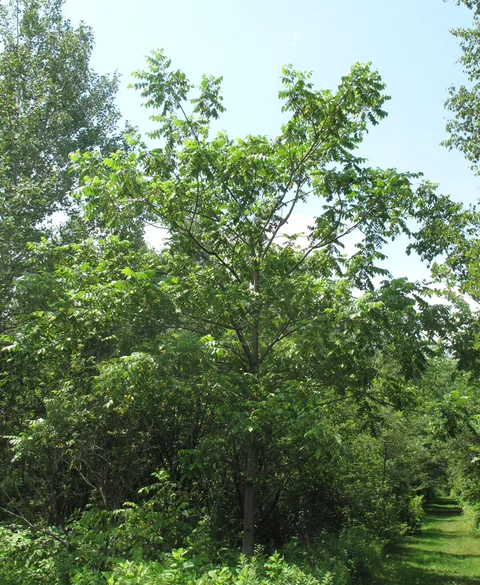
Full Tree
Identification
Leaves
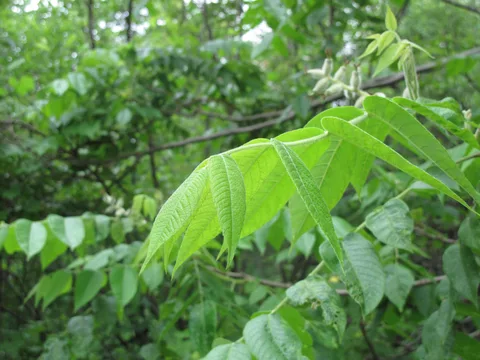
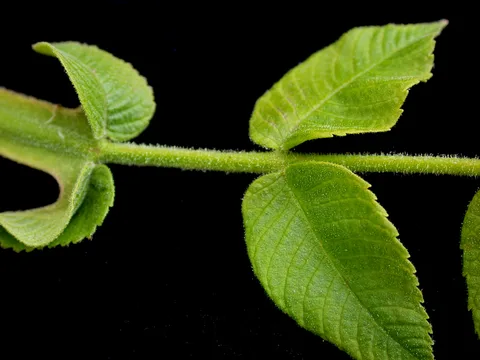
Large compound leaves of 11-17 leaflets, rough on top and densely hairy underneath, with a stout, hairy central stalk. Young leaves are sticky. Unlike black walnut, the end leaflet is usually present and about as big as the ones beside it, and the leaflets get smaller toward the base of the leaf.
Leaves
Bark
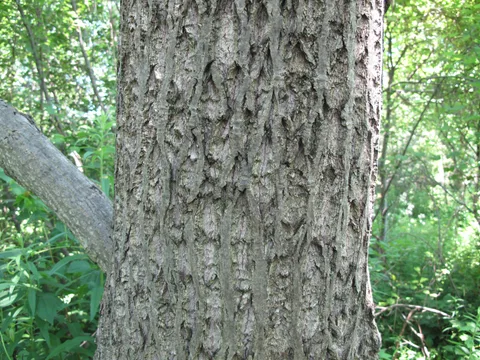
Smooth and light grey on young trees, becoming dark grey with wide, irregular, flat-topped ridges separated by narrow, shallow, dark fissures. The tops of the ridges usually stay light grey. Black walnut bark is much darker, nearly black, with rounded ridges.
Bark
Flowers
Male and female flowers grow on the same tree in late May or early June: drooping yellow-green pollen catkins 6-14 cm (2.5-5.5 in) long, and tiny female flowers in upright clusters of 4-7 at the branch tips.
Fruit
Elongated, pointed nuts 5-8 cm (2-3 in) long hang in clusters of 1-5. The husk is covered in dense, sticky hairs that leave your fingers tacky, and the shell underneath has sharp, jagged ridges. Black walnut fruit is round and not sticky. The sweet, oily kernels are eaten by squirrels and other wildlife.
Valuable wildlife food source
Growing Conditions
Climate
Very cold-hardy and comfortable in Belleville's zone 5b climate; disease, not climate, limits it here. It grows best on well-drained, fertile soils and also takes dry, rocky ground over limestone, but it is not suited to the wet, poorly drained clay found in parts of the Bay of Quinte lowlands, and it does not tolerate shade. The light, weak wood makes limbs prone to breaking under ice.
Hardiness Zones: 3, 4a, 4b, 5a, 5b
Light Requirements
Soil
Moisture: moist, dry
Drainage: well-drained
pH Range: 6 - 8
Tolerance
Care & Maintenance
Pruning
Best Season: Winter
Frequency: Only as needed: dead, broken or hazardous wood
- Call before you cut. Butternut is protected under Ontario's Species Conservation Act, 2025, and the province says activities that affect a protected species may need registration or a permit. Wilsaw Tree Service can help you check what applies before any pruning, removal or construction near the tree
- Prune in dry, dormant weather and keep wounds small: butternut canker commonly starts at leaf scars, buds and wounds
- Clean tools before moving on to another walnut
- Do not top or heavily thin a butternut; its wood is light, soft and weak, and large wounds invite decay
Avoid: Wet spring weather, when rain washes canker spores down the tree; Any time before the tree's identity and protected status have been checked
Watering
Establishment: Deep watering every week or two through the first two summers
Mature: Deep taproot; no regular watering needed
Seasonal Care Timeline
Spring
- Inky-black ooze from bark cracks, a sign of active butternut canker
- Rain spreads canker spores, so avoid pruning or wounding in wet weather
- Plan ahead: if a qualified butternut professional's report is needed, it must be submitted through the Species Conservation Registry before any work starts
Summer
- Leaf-on season, when a qualified butternut professional can best judge canker severity and the tree's identity
- Sooty black cankers with white margins on stems and branches
- Sulphur shelf fungus on the trunk (from July) signals internal decay
Fall
- Sticky-husked nuts drop and are quickly taken by squirrels
- Note dead branches before leaf fall for next season's assessment
- Book any work early so there is time to check the provincial requirements first
Winter
- Ice can break weak, canker-damaged limbs
- Confirm identification from twigs: chocolate-brown chambered pith and a hairy 'moustache' above each leaf scar
Common Issues
Butternut Canker
SevereFungal disease (Ophiognomonia clavigignenti-juglandacearum) that girdles and kills butternut of all ages and sizes. It was first reported in Ontario in 1991 and is now known throughout butternut's Canadian range; it is the main reason the species is endangered.
Symptoms: Elongated, sunken cankers starting at leaf scars, buds or wounds, Inky-black fluid oozing from cracks in the bark in spring, Sooty black patches with a whitish margin on stems in summer, Dieback that starts in the lower crown and spreads, Old cankers in bark fissures or under loose, shredded bark
Treatment: No cure for an infected tree. Under Ontario's current rules a qualified butternut professional's report determines whether a tree is so badly cankered that it can be removed without registration or a permit; otherwise the usual protected-species requirements apply.
Prevention: Avoid wounding trunks and roots. Healthy trees with little canker, especially ones growing near badly infected trees, may carry resistance and are the ones most worth keeping.
Professional arborist recommended
Trunk Decay (Sulphur Shelf)
HighOld cankers let decay fungi into the trunk. Butternut is a main host of Laetiporus sulphureus, a brown cubical rot of the lower trunk.
Symptoms: Bright orange-yellow shelf fungi on the trunk, usually from July, Cracks, cavities or soft wood at the base, Large dead limbs in a canker-weakened crown
Treatment: The fungus usually appears years after decay is established, so a tree showing it needs a professional risk assessment, especially near a house, driveway or play area. Check the provincial requirements with us before any cutting.
Prevention: Avoid wounding the trunk and roots with mowers, trenching or construction.
Professional arborist recommended
Hybrids with Japanese Walnut
ModerateButternut crosses readily with planted Japanese walnut. The vigorous hybrids ('buarts' or buartnuts) have been planted, often unknowingly, for decades and can be hard to tell from pure butternut.
Symptoms: A notch in the top edge of the leaf scar, Pith lighter than butternut's dark chocolate-brown, Elongated lenticels and green or tan twigs, Light bark plates with tan or pinkish fissures, Smooth, flattened or heart-shaped nuts (Japanese walnut traits)
Treatment: Identification only. Field traits narrow it down, but in some cases only genetic testing can separate a butternut from a hybrid.
Prevention: When planting, buy butternut from a reputable native seed source.
Professional arborist recommended
Sources & References
Information compiled from the following authoritative sources:
Quick Facts
When to Call an Arborist
Recommended inspection: Yearly in the leaf-on season for trees near homes, driveways or planned construction
- •Planning a removal, addition, pool, driveway or septic bed near a butternut
- •Black, sunken cankers or inky ooze on the trunk
- •Dead branches spreading up from the lower crown
- •Shelf fungi, cracks or cavities on the trunk
- •Large dead limbs over the house, driveway or play areas
Free consultation for Belleville residents
Recommended Services
Based on Butternut characteristics