
Black Walnut
Juglans nigra
Overview
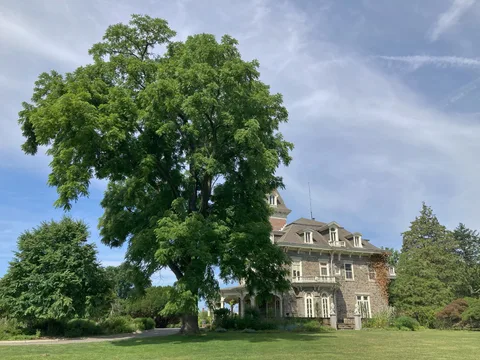
Black walnut's natural Ontario range is the southwest, but it has long been planted north and east of it, and squirrels now spread it too. Around Belleville and the Quinte area it is a familiar yard, fencerow and farmstead tree, valued for shade, nuts and wood, and less loved for the husks that stain driveways every fall and for what juglone does to vegetable gardens.
Black walnut's dark, strong, decay-resistant heartwood is used for high-quality furniture, veneer, cabinetry and panelling. A large, straight trunk can have real value, which matters at removal time: Wilsaw Tree Service's removal quotes note when a walnut trunk may be worth keeping long for a sawmill or wood buyer. Yard trees often hide nails, wire or old fencing, which buyers check for.
Full Tree
Identification
Leaves
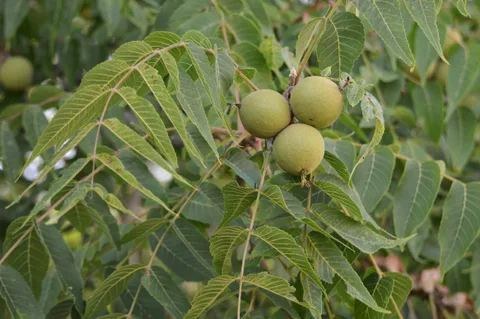
Long compound leaves with 14-22 leaflets, yellowish-green and smooth on top and faintly hairy underneath. The middle leaflets are the largest, and the leaflet at the tip is missing or much smaller than the rest; on butternut it is full size.
Leaves
Bark
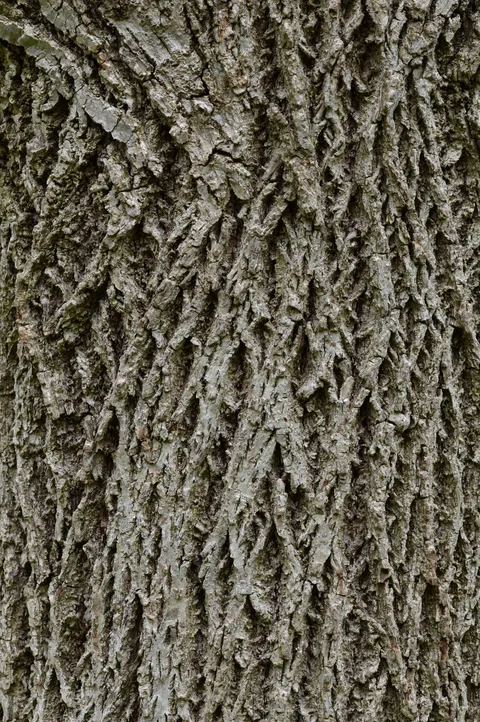
Scaly and light brown on young trees, becoming thick, dark brown to almost black and deeply furrowed, with rounded ridges that cross to form a diamond-like pattern. Butternut bark is greyer, with flat-topped ridges.
Bark
Flowers
Male and female flowers grow on the same tree in late May: long green pollen catkins 5-10 cm (2-4 in) long, and tiny female flowers in upright clusters of 1-4.
Fruit
Round fruit 4-6 cm (1.5-2.5 in) across, in drooping clusters of 1-3, with a green husk that is not sticky. The husks blacken as they rot and stain driveways, decks, hands and clothing dark brown. Inside is a deeply grooved nut with a sweet, strongly flavoured kernel. Squirrels bury the nuts, planting new walnuts around the neighbourhood.
Valuable wildlife food source
Growing Conditions
Climate
Hardy in Belleville's zone 5b and spreading north with planting. It grows best in deep, moist, well-drained, fertile soil in full sun and does not tolerate shade. It grows more slowly on heavy, wet clay in the Bay of Quinte lowlands and on thin soils over limestone or toward the Canadian Shield north of Highway 7. Strong wood and a deep taproot make mature trees fairly wind-firm, but long horizontal limbs can fail under ice.
Hardiness Zones: 4a, 4b, 5a, 5b
Light Requirements
Soil
Moisture: moist
Drainage: well-drained, moderate
pH Range: 6 - 8
Tolerance
Care & Maintenance
Pruning
Best Season: Winter
Frequency: Every 3-5 years for mature yard trees; structural pruning when young
- Heavy limbs over roofs, garages and driveways are the most common walnut job: reduce their end weight or remove them before ice storms load them
- Prune in the dormant season, late fall to winter, before the spring sap flow
- Train young trees to a single straight trunk and keep the lower trunk clear; a straight, knot-free trunk is what gives black walnut its timber value
- Remove dead branches promptly; they come down on cars and roofs along with the nuts
Avoid: Spring sap flow (March-May), when fresh cuts bleed sap; Wet weather as new leaves open, when anthracnose spores are spreading
Watering
Establishment: Deep watering every week through the first two summers
Mature: Deep-rooted; rarely needs watering
Seasonal Care Timeline
Spring
- Finish structural pruning before the sap starts flowing
- Anthracnose spores spread in wet weather as new leaves open
- Keep walnut leaves and husks out of garden beds and mulch before planting tomatoes
Summer
- Leaf spots and early yellowing from anthracnose (July-August)
- Walnut caterpillar colonies and fall webworm tents from late July
- Have any sudden mid-summer wilting with branch dieback checked
Fall
- Nuts drop from September into October; rake them up quickly before the husks stain driveways, decks and patios
- Heavy nut crops add weight to long limbs
- Plan limb reduction over roofs and driveways before winter
Winter
- Dormant season is the best time for pruning and removals
- Ice loading on long, heavy limbs over houses and wires
Common Issues
Walnut Anthracnose
ModerateFungal leaf disease (Ophiognomonia leptostyla) that overwinters in fallen leaves and nuts. Spring rains carry spores up to the new leaves, and summer spores spread it further.
Symptoms: Round reddish-brown to greyish-brown spots on leaflets, Spots merging, leaves yellowing and dropping early in late summer, Sunken dead spots on the husks and early nut drop, Sunken grey-brown lesions on new shoots
Treatment: Rake up and dispose of fallen leaves and husks, and prune out infected twigs where practical. Fungicide sprays are rarely worthwhile on a yard tree.
Prevention: Clean up leaves and nuts in fall and keep the crown open to air movement.
Walnut Caterpillar
LowNative caterpillar (Datana integerrima) that feeds in colonies, stripping a branch or a group of branches at a time in summer. It is seldom a threat to established trees, but several colonies can quickly defoliate a small tree.
Symptoms: Branches stripped bare except for the leaf stalks, Dark, hairy caterpillars feeding in a group, with no web, Fur-like patches of shed skins on the trunk and limbs where colonies moult together, Caterpillars raising their heads and tails together when disturbed
Treatment: On small trees, knock colonies off when they gather on the trunk to moult and destroy them. Established trees usually need nothing.
Prevention: Watch young trees in mid to late summer; natural enemies usually keep numbers in check.
Fall Webworm
LowCaterpillars that build silk nests at the ends of branches from late July into September and feed inside them. Walnuts growing in the open or at woodland edges are common hosts.
Symptoms: Silk tents enclosing leaves at branch tips, Skeletonized leaves and droppings inside the web, Webs growing largest in August and September
Treatment: Cut out small nests, or pull larger ones down with a pole and destroy them. Do not burn nests in the tree. On healthy, established trees the damage is usually cosmetic.
Prevention: None usually needed; keep young or stressed trees well watered.
Juglone Toxicity
ModerateBlack walnut roots, leaf litter and husks release juglone, a compound that stops many other plants from growing well near the tree.
Symptoms: Tomatoes and other sensitive plants wilting or stunted near the tree, Poor growth of blackberries and some conifers such as red pine nearby, Thin, struggling plantings under the canopy
Treatment: Move vegetable gardens well away from the root zone, or grow in raised beds, and keep walnut leaves and husks out of garden mulch.
Prevention: Plant juglone-tolerant species near walnuts; Ontario's Tree Atlas suggests maples, oaks, hickories and hemlock.
Thousand Cankers Disease (watch list, not in Canada)
HighA disease caused by the walnut twig beetle carrying the fungus Geosmithia morbida, which has killed black walnut in parts of the U.S. The Invasive Species Centre reports it is not yet present in Canada but occurs in U.S. states close to the border, so it is a threat to watch for, not a current problem in Ontario.
Symptoms: Leaves wilting and yellowing in mid-summer, Twig and branch dieback thinning the crown, Tiny beetle holes and small dark cankers under the bark of dying branches
Treatment: No effective control exists. Have a professional look at any unexplained, fast dieback, and do not move the wood until it has been checked.
Prevention: Never bring walnut firewood, logs or unfinished walnut lumber into Ontario from the U.S.
Professional arborist recommended
Sources & References
Information compiled from the following authoritative sources:
Quick Facts
When to Call an Arborist
Recommended inspection: Every 3-5 years for large yard trees, and after major ice or wind storms
- •Long, heavy limbs extending over the roof, garage or driveway
- •Dead branches or a thinning crown
- •Cracks, cavities or fungus at the base of the trunk
- •Mid-summer wilting with branch dieback
- •Planning a removal: ask whether the trunk has timber value
Free consultation for Belleville residents
Recommended Services
Based on Black Walnut characteristics