
Eastern Redcedar
Juniperus virginiana
Overview
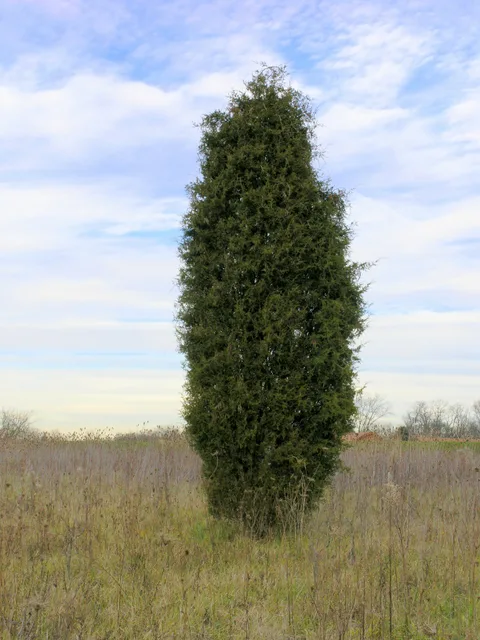
Despite its name it is a juniper, not a cedar, and it is one of the signature trees of the Quinte limestone country. Ontario's tree atlas places it in Eastern Ontario and notes it is often abundant on roadsides and abandoned fields, and the Prince Edward County Field Naturalists note that red cedars are typical of the county's woodland alvars. Around Belleville look for it in old pastures, fence rows and roadsides on the thin, dry soils over limestone south of Highway 7, and on the rocky ground of Prince Edward County. The atlas says it does best on alkaline soils, so it thins out on the acidic Canadian Shield to the north. It cannot stand shade, so as old fields grow back into forest the redcedars are eventually overtopped. Birds spread its berry-like cones, which feed cedar waxwings, wild turkeys and other wildlife, and deer browse it. In the Tree Atlas it is the alternate host of cedar-apple rust on Wild Crabapple and on orchard and ornamental apples and crabapples.
The aromatic, insect- and rot-resistant heartwood is bright purplish-red to dull red. The tree is relatively long-lived; the USDA reports individuals over 450 years old. It has long been used for chest and closet linings, fence posts, outdoor furniture and lumber, and the tree has been planted for windbreaks and hedges on dry limestone soils.
Full Tree
Identification
Leaves
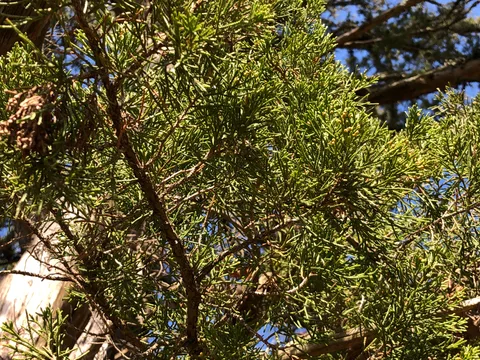
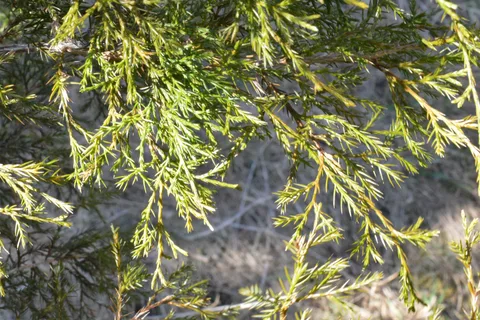
Two kinds of leaves, often on the same tree: tiny, pointed scale leaves pressed tightly against slender 4-sided twigs in overlapping pairs, and longer, sharp, needle-like leaves that are prickly to the touch and most common on young trees and vigorous shoots. Foliage is dark bluish-green and often turns yellowish-brown or bronzy in winter. Eastern white cedar, its look-alike, has soft, flat, fan-like sprays and is never prickly.
Leaves
Bark
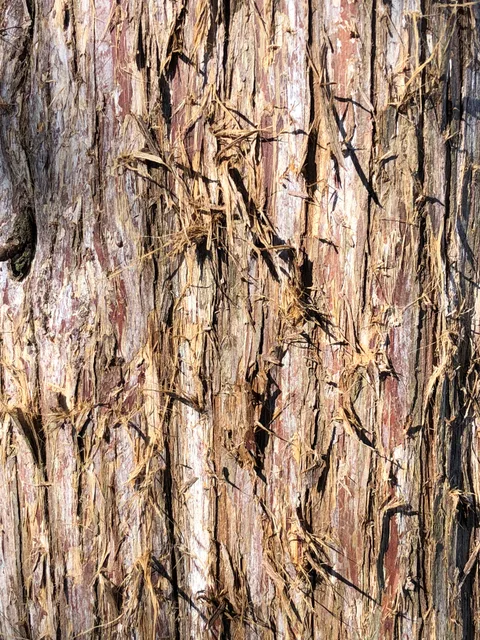
Thin, fibrous reddish-brown bark that peels away in long, narrow shreds, weathering ashy grey where exposed. The trunk tapers quickly and is often fluted or irregular in cross-section.
Bark
Flowers
Male and female cones are usually on separate trees. In early spring male trees carry masses of tiny yellow-brown pollen cones at the shoot tips, and female trees carry small greenish cones that become the 'berries'.
Fruit
Female trees bear firm, berry-like cones 3-6 mm (about 1/4 in) across, dark blue with a whitish, powdery bloom, each holding one or two seeds. They ripen in the first autumn and many hang on into winter. Cedar waxwings, wild turkeys, foxes and skunks eat them, and birds spread the seeds into fields and fence rows.
Valuable wildlife food source
Growing Conditions
Climate
Very cold-hardy and extremely drought tolerant, it does well in Belleville's zone 5b climate on the hot, dry, shallow soils that defeat most other evergreens. On rocky ground its fibrous roots spread widely and work into cracks in the limestone; where the soil is deeper it sends down a deep taproot. It needs full sun: even light shade starts a decline. It is a good windbreak tree for exposed fields on the Bay of Quinte and Prince Edward County shorelines.
Hardiness Zones: 3, 4a, 4b, 5a, 5b
Light Requirements
Soil
Moisture: dry, moist
Drainage: well-drained, moderate
pH Range: 5 - 7.8
Tolerance
Care & Maintenance
Pruning
Best Season: Winter, Spring
Frequency: Little needed on trees; hedges can be lightly clipped every year
- It takes clipping well, so it can be kept as a hedge or windbreak; shear lightly into green growth, because cuts back into bare brown wood do not regrow
- Remove cedar-apple rust galls in late winter or early spring, before the orange spore horns appear, cutting 10-15 cm (4-6 in) below each gall
- Prune out dead, blighted tips in dry weather and take the clippings away
- Keep lower branches cut back from buildings, decks and fire pits (see the fire note below)
Avoid: Wet weather in spring and late summer, when tip-blight spores spread; Hard pruning into old, needle-less wood at any time
Watering
Establishment: Water deeply every week or two for the first growing season
Mature: Very drought tolerant; established trees need no watering
Seasonal Care Timeline
Spring
- Orange cedar-apple rust horns appear on galls after spring rains
- Kabatina tip blight browning shows in late winter and early spring
- Remove rust galls before the spore horns form
Summer
- Phomopsis tip blight on new growth in wet weather
- Check hedges for bagworm bags and webworm
- Spider mites in hot, dry weather
Fall
- Blue berry-like cones ripen and attract waxwings and other birds
- Late-summer rust spores from apple leaves start new galls on redcedar
- Winter bronzing of the foliage is normal
Winter
- Foliage often turns yellowish-brown in winter and greens up in spring
- Heavy snow and ice can bend or split dense trees
- Good time to remove rust galls and cut hedges back from buildings
Common Issues
Cedar-Apple Rust
ModerateA rust fungus (Gymnosporangium juniperi-virginianae) that needs two hosts: eastern redcedar and apples or crabapples. Galls on the redcedar release spores in wet spring weather that infect nearby apple and crabapple leaves and fruit; in late summer spores from the apple leaves blow back to the redcedar and start new galls. Related cedar rusts also move between junipers and hawthorns or quince. On the redcedar the galls are mostly cosmetic; the real damage is to the apples.
Symptoms: Brown, round, wrinkled galls 0.5-5 cm (1/4-2 in) across on the twigs, Bright orange, jelly-like 'horns' bursting from the galls after spring rains, Bright yellow-orange spots on the leaves of nearby apples and crabapples from late May
Treatment: Cut off galls in late winter or early spring before the spore horns form. Fungicides are not used on the redcedar; protective sprays are timed for the apple or crabapple instead, from bud colour until a few weeks after petal fall.
Prevention: Keep redcedars and apples, crabapples and hawthorns apart where you can, and choose rust-resistant crabapple and apple varieties. Spores travel long distances, so removing one redcedar gives only partial control. The CFIA advises not planting eastern redcedar near apple orchards.
Kabatina and Phomopsis Tip Blight
LowTwo fungal tip blights of junipers. Kabatina infects wounded tips in the fall and shows up in late winter; Phomopsis attacks soft new growth in wet spring and late-summer weather. Phomopsis is worst on nursery seedlings and young trees and is not a serious problem once trees are a few years old.
Symptoms: Shoot tips turn yellow or brown, then ash-grey, Tiny black dots (spore cases) on the dead tips, Kabatina: browning in February-March, dead foliage drops by June, Phomopsis: dull brown new growth from mid-April to September
Treatment: Prune out and destroy blighted tips in dry weather. Fungicides are generally not needed for established landscape trees.
Prevention: Give plants room for air to move, avoid overhead and night-time watering, and avoid wounding the shoots.
Bagworm and Other Foliage Feeders
ModerateBagworm caterpillars (Thyridopteryx ephemeraeformis) and spruce spider mites can strip the foliage of eastern redcedar, and the juniper webworm and juniper scale also feed on it. Bagworm is easy to recognize: each caterpillar lives in a spindle-shaped bag of silk and bits of foliage that hangs from the branches.
Symptoms: Hanging, spindle-shaped bags of silk and foliage, Browned, webbed-together shoots (juniper webworm), Fine stippling and dull, bronzed foliage (spider mites), Small white scale insects crusted on the leaves
Treatment: Pick off bags by hand from fall to early spring, before the eggs inside hatch, and destroy them. Heavy infestations of any of these pests are worth having assessed.
Prevention: Check hedges and young trees each year; small infestations are easy to remove by hand.
Fire Risk Near Buildings
ModerateDense, resinous evergreen foliage that the USDA Forest Service's fire research describes as highly combustible. Low branches act as ladder fuels that carry fire up into the crown, and the thin bark means fire easily kills the tree. Around Quinte this mainly matters in grass and brush fires on dry fields, but a big redcedar or a redcedar hedge right against a house, deck or fire pit is a needless risk.
Symptoms: Dense branches touching siding, decks or eaves, Dead, dry foliage accumulated inside the crown, Grass and brush growing up into the lower branches
Treatment: Limb up or remove redcedars that crowd buildings, and clear dead material from inside dense hedges.
Prevention: Plant at least a few metres from the house, keep fire pits and barbecues well away, and keep dry grass mowed beneath the branches.
Sources & References
Information compiled from the following authoritative sources:
Quick Facts
When to Call an Arborist
Recommended inspection: Every few years; yearly where redcedars stand close to buildings or near home orchards
- •Browning spreading through the crown rather than just the tips
- •Large redcedars or hedges crowding the house, deck or fire pit
- •Heavy cedar-apple rust galls next to a home orchard
- •Hanging bags or webbing on a hedge
- •Trees split or bent by heavy snow or ice
Free consultation for Belleville residents
Recommended Services
Based on Eastern Redcedar characteristics