
Norway Spruce
Picea abies
Overview
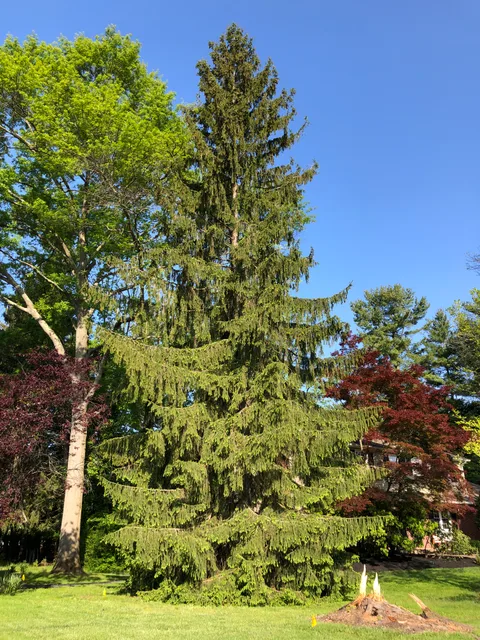
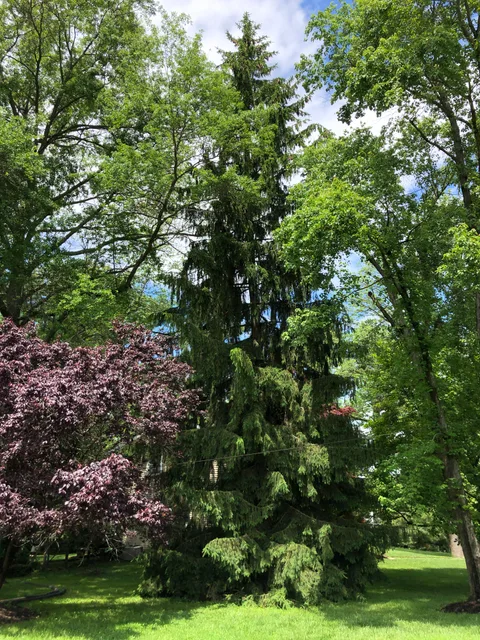
Norway spruce is the big, dark, weeping spruce of Belleville and Quinte yards, farmsteads and rural windbreaks, planted as a fast screen and windbreak. It is not native: it comes from northern and central Europe. Many were planted small beside houses and are now 15-25 m tall, which is why it is one of the spruces we are most often called about for removal or clearance pruning.
Norway spruce is a major timber tree in Europe and has been planted widely in eastern North America as an ornamental, windbreak and screen. It has become naturalized in parts of the northeastern United States and southeastern Canada, but in our area it is mainly found where people planted it.
Full Tree
Identification
Leaves
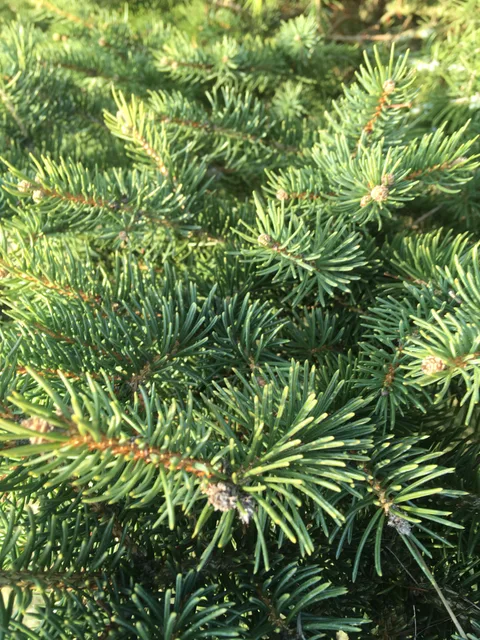
Short, stiff, four-sided needles, medium to dark green, set singly around the twig on small peg-like bases and pointing forward toward the shoot tip. Each needle stays on the tree for three to four years. Pulled off, a needle leaves its little peg behind on the twig, which is how you tell any spruce from a fir.
Leaves
Bark
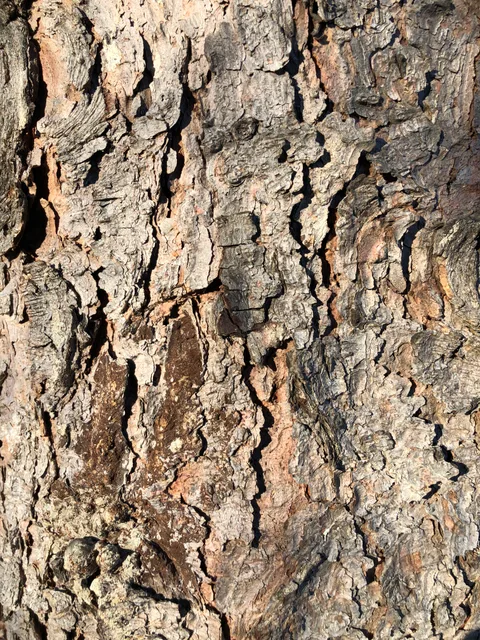
Thin and fairly smooth on young trees, becoming grey-brown and flaky with thin, rounded scales as the trunk ages. It never develops the deep furrows or plates of the pines.
Bark
Flowers
Separate male and female cones on the same tree. Upright pink to red female cones form at the branch tips high in the crown, and small yellowish to reddish pollen cones shed their pollen in spring.
Fruit
The biggest spruce cones you will find in a Belleville yard: long, narrow and cylindrical, 10-15 cm (4-6 inches) long and 4-5 cm (1.5-2 inches) wide, hanging from the branch ends. Green to purplish-green through the summer, ripening light to medium brown in fall. Our native white and black spruces have cones a fraction of that size. The fallen cones make a lot of litter on lawns and roofs.
Valuable wildlife food source
Growing Conditions
Climate
Fully hardy here (to zone 3). It prefers cool summers, full sun and well-drained, moist soil, and tolerates both acid and alkaline ground. On the heavy, wet clay of the Bay of Quinte lowlands its naturally shallow roots stay shallower still, so big trees on wet clay are more prone to tipping in wind on saturated soil. It is only moderately drought tolerant: Ontario's 2025 forest health survey recorded drought damage to trees along Highway 401 from Belleville to Napanee, and dry summers like that are when Cytospora canker gets started.
Hardiness Zones: 3, 4a, 4b, 5a, 5b
Light Requirements
Soil
Moisture: moist
Drainage: well-drained, moderate
pH Range: 5 - 8
Tolerance
Care & Maintenance
Pruning
Best Season: Winter, Spring
Frequency: Little needed; mostly dead-wood removal and clearance pruning
- Remove dead, broken and rubbing limbs in late winter or early spring before new growth starts
- Clearance pruning (lifting the lowest limbs off a driveway, roof or walkway) is fine, but take whole limbs back to the trunk rather than leaving stubs
- Never top a spruce to make it shorter: the cut leader is replaced by several weak, crowded new tops, and the tree loses its shape for good
- If the tree is simply too big for the lot, removal and replanting with a smaller tree is usually the better answer than repeated cutting
- Prune branches with cankers back to healthy wood and clean tools between cuts
Avoid: Wet weather in spring and summer, when Cytospora spores spread most easily into pruning wounds; Drought periods, when the tree is already stressed
Watering
Establishment: Water deeply every week or so through the first two growing seasons; a 7-10 cm (3-4 inch) mulch ring helps the shallow roots
Mature: Moderately sensitive to drought; the shallow root system dries out quickly in hot, dry summers
Seasonal Care Timeline
Spring
- Look for broken limbs and split tops left by winter ice and snow
- White pine weevil adults feed on leaders and lay eggs as the weather warms
- Spruce spider mites become active on warm spring days
- Spruce gall adelgids start forming new galls at the base of the new shoots
Summer
- Drought stress on the shallow roots; water deeply in long dry spells
- Lower limbs browning with white resin points to Cytospora canker
- Wilted, crooked leaders show white pine weevil damage
- Clip green adelgid galls before the insects emerge in late summer
Fall
- Spider mites return in cool weather
- Water deeply before freeze-up after a dry summer
- Normal shedding of the oldest inner needles; don't confuse it with disease
- Good season to plan removals of trees that have outgrown their space
Winter
- Freezing rain and heavy wet snow load the dense crown and can break limbs
- Strong winds on saturated or frozen-then-thawed clay can tip shallow-rooted trees
- Road salt spray on trees beside roads and driveways
- Winter is the best time for removal work, with frozen ground protecting lawns
Common Issues
Cytospora (Leucostoma) canker
HighA fungal canker (Leucostoma kunzei, also called Cytospora kunzei) of ornamental spruces, including Norway and Colorado blue spruce. It is a weak pathogen that takes hold in trees stressed by drought, heat or wounding and works its way up the tree from the bottom. Natural Resources Canada notes it is seen wherever spruce is planted as an ornamental but rarely in natural spruce forests.
Symptoms: Lower branches dying first, with the dieback climbing the tree over several years, Reddened or brown needles on single limbs while the rest of the tree stays green, Heavy white to bluish-white resin coating the bark or dripping from branches, Large cankers on the trunk in advanced cases
Treatment: No cure. Cut out dead and dying branches back to the trunk or a healthy side branch in dry weather, cleaning tools between cuts, and relieve water stress. A tree with cankers on the main trunk will usually decline and should be assessed for removal.
Prevention: Keep the tree watered and mulched through dry spells, avoid wounding the trunk and roots with mowers and construction, and give it enough room and light.
Professional arborist recommended
Eastern spruce gall adelgid
LowA tiny aphid-like insect from Europe, introduced to North America in the 19th century. In eastern Canada it does most of its damage on Norway spruce and white spruce. Feeding at the base of new shoots makes the tree form a small pineapple-shaped gall.
Symptoms: Pineapple-shaped galls 1.5-3 cm long at the base of new shoots, green at first and turning brown, Distorted shoot tips and some twig dieback where galls are dense, Old brown galls hanging on for years, making the tree look unkempt
Treatment: On a few trees, clip off and destroy the galls while they are still green, before the insects leave them in late summer. Heavy infestations on valued ornamentals can be treated with a registered product at the right life stage.
Prevention: Inspect new spruce before planting; pruning out green galls each year keeps numbers down. Infested trees are seldom killed.
White pine weevil
ModerateA native weevil whose main hosts are white pine and white spruce. Natural Resources Canada lists Norway spruce as a secondary host, attacked mostly in landscape and Christmas-tree plantings. Larvae tunnel down the previous year's leader and kill it.
Symptoms: The top shoot wilting and curling over into a shepherd's crook in early summer, Small resin drops on the leader in spring, Round exit holes in the dead leader in late summer, Two or more competing tops on trees attacked in earlier years
Treatment: Clip the dead leader off below the damaged section in summer, before the adults emerge, and destroy it. Then pick one strong side shoot to become the new leader.
Prevention: Check young trees under about 6 m tall each spring; the weevil mostly attacks vigorous young trees.
Spruce spider mite
ModerateA tiny cool-season mite that feeds on spruce and other conifers in spring and again in fall, sucking the contents out of the needles. Older, inner needles are hit first.
Symptoms: Needles stippled and dull, losing their rich green colour, Fine silk webbing between the needles, Needles turning rusty brown and dropping early, starting inside the crown
Treatment: Confirm by tapping a branch over white paper: the mites show as moving dark specks. Ten or more per tap justifies a registered miticide in spring or early fall; a strong spray of water knocks back light numbers.
Prevention: Avoid broad-spectrum insecticide sprays, which kill the predators that keep mites in check, and keep the tree watered.
Rhizosphaera needle cast
ModerateA fungal needle disease of spruces that kills older needles from the inside of the crown and the lower branches outward, leaving the branch tips green.
Symptoms: Older needles turning purplish-brown, Rows of tiny black dots on the needles under a hand lens, Thin, see-through lower branches with only the newest needles left
Treatment: Have the cause confirmed first, since drought, mites and canker look similar. Registered fungicides applied in spring as the new needles emerge protect them; prune out dead lower limbs.
Prevention: Give the tree space and air flow, keep sprinklers off the foliage and avoid planting spruce too close together.
Outgrowing the lot
ModerateNorway spruce grows fast when young and is commonly 12-18 m (40-60 ft) tall and 7-9 m (25-30 ft) wide in a yard, with taller trees reaching 25-30 m (80-100 ft). Planted as a cute little tree beside a house or under wires, it ends up over the roof, the driveway and the neighbour's yard, on a very shallow root system.
Symptoms: Branches over or against the roof, siding or hydro service line, Lower limbs blocking the driveway, sidewalk or sightlines, Lifted turf, heaving or a lean developing on the house side, Heavy cone and needle drop into gutters
Treatment: Clearance pruning can buy time, but topping or heavy crown cutting ruins a spruce. When the tree is simply in the wrong place, removal by a professional, ideally in winter, and replanting with a smaller tree is usually the lasting fix.
Prevention: Plant it at least 6-8 m (20-25 ft) from buildings and well clear of overhead lines, or choose a smaller conifer for a small lot.
Professional arborist recommended
Sources & References
Information compiled from the following authoritative sources:
Quick Facts
When to Call an Arborist
Recommended inspection: Every 2-3 years for large yard trees, and after any ice storm or major wind event
- •Lower branches dying one after another with white resin on the bark
- •Trunk cankers or resin streaming down the main stem
- •A new lean, lifted soil or exposed roots on one side after wind
- •Broken or hung-up limbs over the house, driveway or hydro lines after ice or snow
- •A tree that has grown into the roof, siding or service wires
- •Whole-crown browning or thinning that is not just old inner needles dropping in fall
Free consultation for Belleville residents
Recommended Services
Based on Norway Spruce characteristics