
Austrian Pine
Pinus nigra
Overview
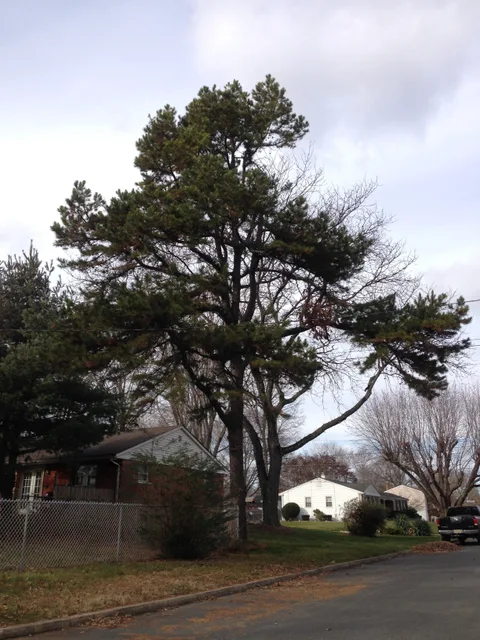
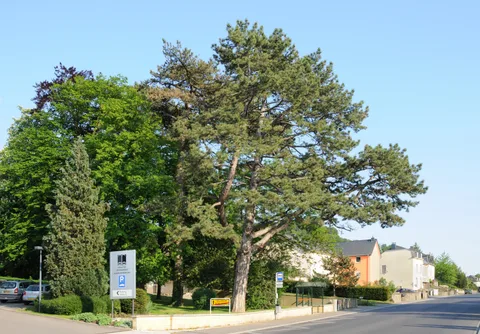
Austrian pine is the big, dark, long-needled pine along Belleville streets, in parks and on commercial lots and roadside screens, planted for decades because it shrugs off road salt, heat, clay and city air. Many of those trees are now mature, and Diplodia tip blight is killing them across Ontario, so it is one of the pines we most often assess for decline and removal. It is a European tree and is not considered native or invasive here.
Native to central and southern Europe, Austrian pine was widely planted across North America as a street, windbreak and highway tree for its tolerance of salt, drought and poor soil. Disease problems have since led the Morton Arboretum to stop recommending it for planting anywhere in the Midwest.
Full Tree
Identification
Leaves
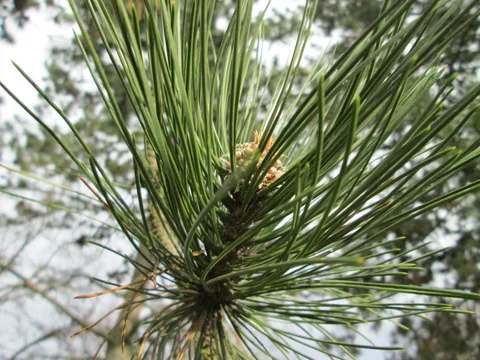
Stiff, sharp, very dark green needles in pairs, 7.5-15 cm (3-6 inches) long, held densely toward the branch tips for three to four years. Bend one in half: Austrian pine needles bend without breaking, while the similar-looking native red pine's needles snap cleanly (do the test on a mild day, since frozen needles snap).
Leaves
Bark
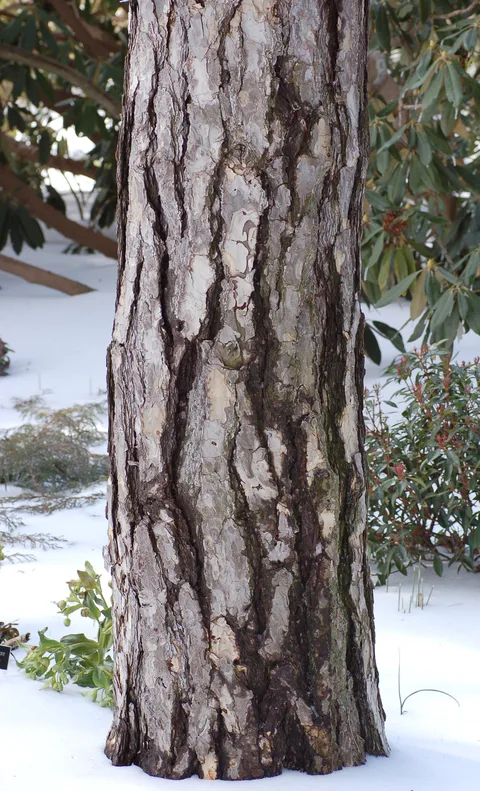
Striking on older trees: thick, irregular grey-brown to silvery plates separated by deep, dark brown to nearly black furrows, quite different from the orange flakes of Scots pine or the reddish plates of red pine.
Bark
Flowers
Clusters of yellowish pollen cones at the base of the new shoots shed pollen in spring, while small reddish seed cones form at the shoot tips.
Fruit
Woody, egg-shaped, stalkless cones 5-7.5 cm (2-3 inches) long and about 5 cm wide, shiny yellow-brown when ripe, and staying on the tree for about two years. Old cones on infected trees carry Diplodia spores, so it pays to clear them.
Valuable wildlife food source
Growing Conditions
Climate
Hardy here and adaptable: it tolerates clay, alkaline soils over limestone, dry sites, heat, air pollution and road salt, which makes it one of the few pines that copes with Belleville's heavy Bay of Quinte clay and salted streets. It needs full sun. Its weakness is disease, not climate: wet springs spread Diplodia and red band needle blight, and droughts such as the one Ontario recorded along Highway 401 from Belleville to Napanee in 2025 let latent Diplodia infections flare up. Pine wilt, which kills Austrian pines in the U.S. Midwest, is caused by the pinewood nematode; the nematode is native to North America, but Natural Resources Canada reports that pine wilt disease is not found in Canadian forests.
Hardiness Zones: 4a, 4b, 5a, 5b
Light Requirements
Soil
Moisture: dry, moist
Drainage: well-drained, moderate
pH Range: 5.5 - 8
Tolerance
Care & Maintenance
Pruning
Best Season: Winter
Frequency: As needed for dead wood and Diplodia sanitation; otherwise minimal
- Do structural and dead-wood pruning in late winter, in dry weather, while the tree is dormant
- Cut out shoots killed by tip blight and pick off old cones in dry weather to reduce Diplodia spores
- Disinfect pruning tools between cuts on infected trees
- Remove lower limbs gradually if you need clearance; the heavy lower branches are slow to replace
- Never top an Austrian pine
Avoid: Late spring to early summer, especially in wet weather, when expanding candles and fresh wounds are open to Diplodia infection; Wet weather during the growing season, which spreads needle blight spores
Watering
Establishment: Water deeply every 7-10 days through the first two growing seasons; it does not transplant well, so small balled-and-burlapped trees establish best
Mature: Drought-tolerant once established
Seasonal Care Timeline
Spring
- Diplodia infects the expanding candles in wet weather from bud break to full elongation; this is the fungicide window and the time not to prune
- Red band needle blight spores spread in wet weather from May
- Zimmerman pine moth larvae leave their winter shelters and start boring at the branch whorls
Summer
- Brown, stunted new shoots from Diplodia show by early summer
- Brown spot needle blight: older needles browning and dropping in June
- Drought stress lets latent Diplodia infections flare; water mature trees in long dry spells
- Second red band fungicide window in mid-July for treated trees
Fall
- Assess crown dieback and plan removals of failing trees
- Rake and remove old cones and fallen blighted shoots
- Water deeply before freeze-up after a dry summer
Winter
- Freezing rain and heavy snow load the dense, heavy limbs
- Red band needle blight shows as dead needle tips with green bases
- Dormant season is the best time for sanitation pruning and removals
Common Issues
Diplodia (Sphaeropsis) tip blight
SevereThe disease that is killing mature Austrian pines across Ontario. Natural Resources Canada ranks Austrian pine as the most susceptible host in Ontario and reports that in the Toronto and Ottawa areas severe infections have killed entire trees within two to three years. The fungus (Diplodia sapinea) infects the new candles only while they are expanding in wet spring weather, can sit latent until drought, hail, snow damage or insects stress the tree, and builds up on old cones. Trees over about 15 years old are affected most and trees over 30 most severely.
Symptoms: New shoots stunted with short, straw-coloured or brown needles, often glued with resin, Dieback beginning in the lower crown and moving upward year after year, Tiny black fruiting bodies at the needle bases under the sheath and on cone scales, Resinous cankers, dead branches and patches of dead foliage in an otherwise green crown
Treatment: Prune out blighted shoots and dead branches and remove old cones in dry weather, disinfecting tools between cuts. A registered fungicide program beginning at bud break can protect a high-value tree that is still mostly healthy. Badly infected trees rarely recover and are best removed before they become a hazard, and replaced with a less susceptible species.
Prevention: Water through drought, mulch, avoid wounds and late-spring pruning, and do not plant more Austrian pines; white pine (five needles) is highly resistant.
Professional arborist recommended
Dothistroma (red band) needle blight
HighA fungal needle disease to which Austrian pine is highly susceptible. Spores spread in wet weather from May onward; symptoms appear three to six months after infection, and infected needles drop early, worst on the lower branches.
Symptoms: Yellow to tan spots that become reddish-brown bands around the needles, Needle tips dead and brown while the bases stay green, from late fall into winter, Heavy needle drop from the lower and inner crown in late winter and spring, Thin, tufted branches carrying only the newest needles
Treatment: Have the disease confirmed, since Diplodia and winter injury can look similar. A protective fungicide in mid-May and again in mid-July protects needles of all ages on valued trees; remove severely infected trees, which are a major spore source.
Prevention: Plant with good spacing and air flow, remove lower branch whorls to dry out the canopy, and choose resistant species for new plantings.
Professional arborist recommended
Zimmerman pine moth
ModerateA native moth whose larvae bore under the bark at branch whorls of pines, most often Austrian, Scots and red pine. The tunnelling girdles stems and leaves weak points that snap in strong wind.
Symptoms: Soft, cream to white pitch masses mixed with sawdust at branch whorls on the trunk, Branches or tops above the pitch masses turning brown and dying, Limbs or tops breaking off at the whorls in wind
Treatment: Cut out infested limbs in mid-summer before adults emerge. Insecticide aimed at young larvae in spring is worthwhile only where damage is heavy and recurring. Heavily tunnelled trunks over a house or driveway should be assessed for removal.
Prevention: Prevent drought stress and trunk wounds, which attract egg-laying moths.
Professional arborist recommended
Brown spot needle blight
ModerateA native fungal needle disease (Lecanosticta acicola). Ontario's forest health program notes it affects pines of all ages, especially Scots and Austrian pine. Several years of infection slow growth and, with drought and insects, can kill branches.
Symptoms: Spots and bands on the needles, Previous years' needles turning brown and dropping in June, Only the current year's needles left on affected branches
Treatment: Have it confirmed; rake up fallen needles and open up crowded plantings. Fungicide is rarely practical on large trees.
Prevention: Good spacing and air flow; keep weeds and lower limbs from trapping moisture.
Professional arborist recommended
Pine tortoise scale
LowA native scale insect whose main host is jack pine but which also feeds on Scots, Austrian and red pine. Feeding females produce honeydew that turns twigs and needles black with sooty mould; heavy feeding can kill branches, and small trees suffer most.
Symptoms: Clusters of small, rounded, brown scale bumps on twigs and the main stem, Sticky honeydew and black sooty mould on needles and twigs, Thin, weak growth and branch dieback
Treatment: Light infestations can be scrubbed or pruned off; heavier ones can be treated with a registered product timed to the crawler stage.
Prevention: Inspect twigs on young and stressed pines, and keep trees watered.
Sources & References
Information compiled from the following authoritative sources:
Quick Facts
When to Call an Arborist
Recommended inspection: Every year for mature trees near the house, street or driveway, given how fast Diplodia can kill a tree; after every ice or wind storm
- •Brown, stunted new shoots in the lower crown, especially two years running
- •Dead branches and resin-soaked cankers in an otherwise green tree
- •More than about a third of the crown dead or thin
- •Pitch masses at the branch whorls, or limbs breaking at the whorls
- •Heavy dead limbs over a roof, sidewalk, driveway or road
- •Rapid browning of a whole tree within one season
Free consultation for Belleville residents
Recommended Services
Based on Austrian Pine characteristics