
Red Pine
Pinus resinosa
Overview
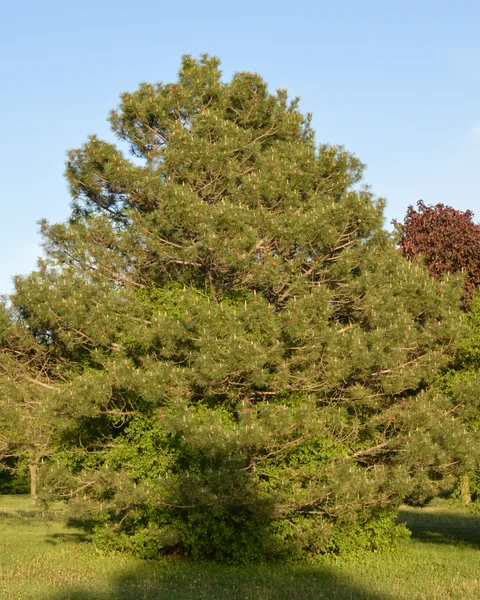
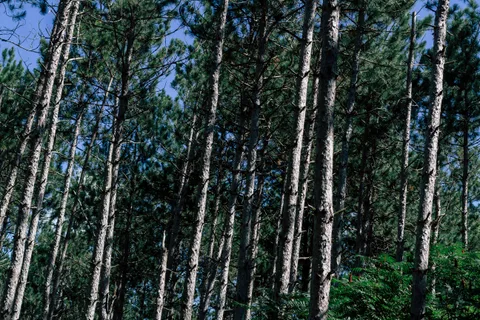
Most red pine in the Belleville area grows in straight-row plantations and windbreaks on rural, farm and conservation land, planted during Ontario's mid-1900s push to reforest worn-out, erosion-prone farmland. Many of those rows are now tall, crowded and overdue for thinning, and trees leaning over homes, lanes and hydro lines often need thinning or removal.
Red pine was a mainstay of Ontario reforestation. After the Woodlands Improvement Act of 1966, more than 213 million seedlings, including red pine, white pine and white spruce, were planted on over 137,000 hectares over 30 years. Its straight, strong wood is still used for utility poles, posts and structural timber.
Full Tree
Identification
Leaves
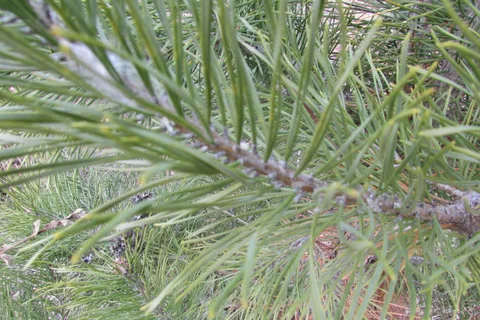
Glossy, dark green needles in pairs, 10-16 cm (4-6 inches) long. The quickest field test: bend a needle and it snaps cleanly in two. Austrian pine, the look-alike two-needle pine planted in town, has needles that bend without breaking (except when frozen, so try it on a mild day). Foliage can turn slightly yellowish-green in winter.
Leaves
Bark
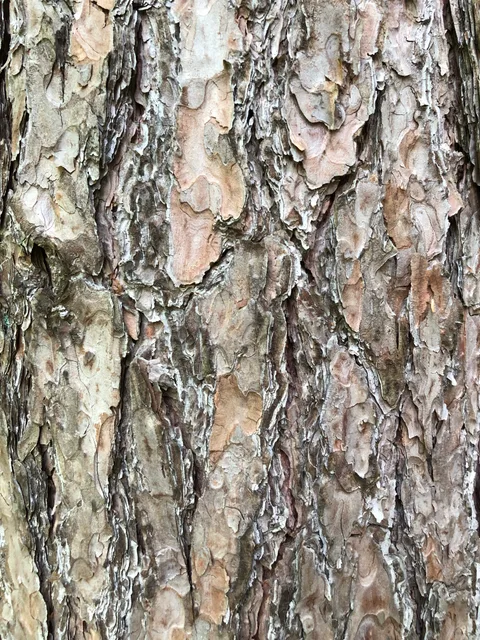
The bark gives the tree its name: orange-red and scaly on young stems, maturing to reddish-brown or pinkish-grey flat plates on a long, clear trunk.
Bark
Flowers
Small purplish-red seed conelets form at the tips of new shoots and clusters of yellowish pollen cones lower on the shoots in late spring. They have no ornamental value.
Fruit
Small, egg-shaped, stalkless brown cones 4-7 cm (1.5-2.75 inches) long with no prickles on the scales. Cones take two years to mature and trees usually start bearing 15-50 years after planting. The seed feeds songbirds and small mammals.
Valuable wildlife food source
Growing Conditions
Climate
Native across most of Ontario and fully hardy here. It is at home on sand plains and the thin, rocky soils of the Canadian Shield edge north of Highway 7, but needs excellent drainage and struggles on the heavy, wet clay of the Bay of Quinte lowlands. Sensitive to road salt and air pollution, so it does best on rural sites. Wind-firm on good ground, but brittle under ice loading.
Hardiness Zones: 3a, 3b, 4a, 4b, 5a, 5b
Light Requirements
Soil
Moisture: dry, moist
Drainage: well-drained
pH Range: 5 - 7.4
Tolerance
Care & Maintenance
Pruning
Best Season: Winter
Frequency: Little needed on single trees; plantations need periodic thinning
- Do structural work and dead-wood removal in late winter while the tree is dormant and the weather is dry
- Red pine drops its lower branches naturally; remove dead lower limbs rather than live ones
- Crowded plantation rows need thinning on a plan: the first thinning opens space, later ones remove weak and poorly formed trees
- Remove and dispose of blighted shoot tips and old cones from infected trees in dry weather to reduce Diplodia spores
- Never top a red pine; topping leaves weak, crowded new leaders
Avoid: Wet weather from bud break to full candle elongation (roughly May to June), when pruning wounds invite Diplodia infection; Periods of drought stress
Watering
Establishment: Water deeply every 7-10 days through the first two growing seasons; balled-and-burlapped stock establishes far better than bare-root
Mature: Drought-tolerant once established on well-drained ground; overly wet clay is a bigger risk than dry sand
Seasonal Care Timeline
Spring
- Diplodia infects new candles from bud break to full elongation in wet weather; do not prune then
- Pine false webworm adults emerge from the soil late April to early June
- Walk plantations and windbreaks for ice- and snow-broken stems before the leaves are out on nearby hardwoods
Summer
- Webworm larvae feed in silk tubes until late June or early July
- Brown, curled shoot tips from Diplodia or Sirococcus blight show by early summer
- Drought stress on shallow, sandy or rocky sites sets trees up for blight, bark beetles and root rot
Fall
- Good time to assess plantation density and plan thinning or removals
- Look for honey mushrooms at the base of declining trees (Armillaria)
- Rake and remove old cones and blighted tips under infected trees
Winter
- Freezing rain and heavy wet snow snap stems and tops, especially in crowded rows
- Road salt spray browning on roadside trees
- Dormant season is the preferred window for thinning and removals
Common Issues
Diplodia (Sphaeropsis) shoot blight
HighA fungus (Diplodia sapinea, formerly Sphaeropsis sapinea) that attacks the new shoots (candles) of two- and three-needle pines including red, Austrian and Scots pine. Older trees with a build-up of infected cones, and trees stressed by drought, hail, ice or pruning wounds, are hit hardest. Spores spread in wet spring weather.
Symptoms: New shoots brown, stunted and curled into a shepherd's crook, Needles on new growth die at half to three-quarters length, Tiny black fruiting bodies at needle bases and on cone scales, Resin-soaked cankers at the base of dead shoots, Dieback starting in the lower crown and working upward over several years
Treatment: Prune out blighted shoots and remove old cones in dry weather. Protective fungicide sprays at bud break, half candle and full candle can help high-value yard trees; severely infected trees are best replaced with a resistant species.
Prevention: Reduce stress: water in drought, avoid wounding and heavy fertilizing, and do not prune in wet spring weather.
Professional arborist recommended
Sirococcus shoot blight (red pine shoot blight)
ModerateA fungal shoot blight (Sirococcus conigenus) that infects young needles and then kills current-year shoots, shrinking the live crown. It favours cool, wet springs and low light, and is worst on young red pine growing under or beside older infected red pine.
Symptoms: Current-year shoots die and droop soon after they elongate, Brown needles on new growth while older needles stay green, Thinning lower crown on shaded or understory trees
Treatment: Prune out dead shoots in dry weather; a professional can confirm the cause, since it looks like Diplodia.
Prevention: Do not plant young red pine under or beside older red pine; keep plantations thinned so air and light reach the lower crown.
Professional arborist recommended
Pine false webworm
HighAn introduced European sawfly first found in Ontario in 1961. Since 1993 it has caused larger outbreaks in mature red and eastern white pine stands. Adults emerge from the soil in late April to early June; larvae feed until late June or early July, then drop to the soil for the winter.
Symptoms: Silk tubes along branches packed with frass (insect droppings), Older needles stripped first, leaving tufts of new growth, Thin, see-through crowns after several years of feeding
Treatment: On small open-grown trees, larvae can be removed by hand. Larger trees can be protected with an insecticide applied by a licensed applicator.
Prevention: Check crowns each June; severe defoliation (over 70%) in back-to-back years causes growth loss and can kill trees, and leaves them open to bark beetles and Armillaria root rot.
Professional arborist recommended
Armillaria root rot
HighA root and butt rot fungus that kills trees already weakened by defoliation, drought or crowding. In red pine it usually follows defoliation, drought or overcrowding, and can kill trees in patches.
Symptoms: Whole crown fades to yellow then red-brown, Resin flowing from the root collar, White, fan-shaped fungal mats under the bark at the base, Honey-coloured mushrooms at the base in fall, Groups of dead or dying trees spreading outward
Treatment: No cure. Infected trees near buildings, roads or lanes should be removed because decayed roots can let a healthy-looking crown fall.
Prevention: Keep trees vigorous: control defoliators, avoid soil compaction and grade changes over roots, and thin crowded stands.
Professional arborist recommended
Ice and snow breakage
HighRed pine holds up well to wind on good sites but is brittle under ice. After the late-March 2025 ice storm across central and eastern Ontario, provincial surveys found red pine plantations consistently among the worst damaged, with bent, snapped and broken stems, including in Hastings County.
Symptoms: Snapped tops and broken leaders, Stems bent over and not recovering, Broken limbs hung up in the crown, Trees leaning into neighbours after a storm
Treatment: Have hung-up limbs, snapped tops and leaning trees near buildings, lanes and wires removed promptly; these are the main hazards after a storm.
Prevention: Thin crowded plantations on schedule so trees develop sturdier stems; neglected, unthinned stands are more prone to storm damage.
Professional arborist recommended
Sources & References
Information compiled from the following authoritative sources:
Quick Facts
When to Call an Arborist
Recommended inspection: Every 2-3 years for yard trees and plantation edges, and after every ice storm or major wind event
- •Snapped tops, broken leaders or hung-up limbs after ice or wind
- •Trees leaning toward a house, lane or hydro line, especially in crowded rows
- •Brown, curled new shoots with black specks at the needle bases
- •Silk tubes and frass on branches in June
- •Resin at the root collar, white fungal mats under the bark or mushrooms at the base
- •Whole-crown yellowing or several trees dying in a patch
Free consultation for Belleville residents
Recommended Services
Based on Red Pine characteristics