
Scots Pine
Pinus sylvestris
Overview
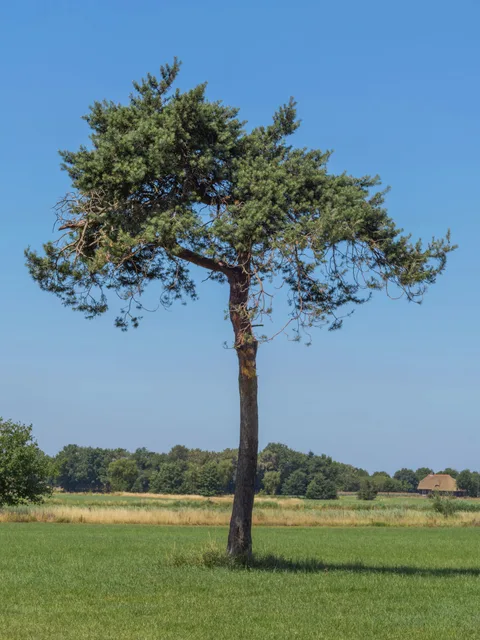
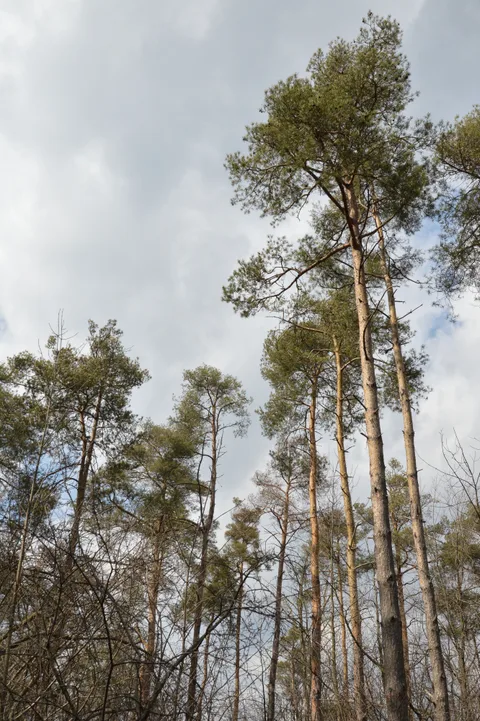
Scots pine is the pine with the orange upper trunk in old windbreaks, fencerows, abandoned Christmas-tree plantations and conservation-area plantings around Belleville and the Quinte area. Ontario's invasive plant council treats it as invasive because it spreads from these plantings into open land, and at nearby Presqu'ile Provincial Park it has invaded the open panne, one of only about 20 habitats of its kind in the world. Many of the old plantations are now overgrown, crooked and declining, so the realistic work on most properties is removal, thinning and replanting with native trees.
Scots pine was among the first European trees introduced to North America. In Ontario it was planted in the early 1900s to stabilize eroding, worn-out farmland, and from the 1950s to the 1980s it was one of the most popular Christmas trees: the former Midhurst forest station sold 3.3 million Scots pine seedlings in 1958 alone. When buyers switched to balsam fir, Fraser fir and Douglas fir, many plantations were left untended and grew past marketable size, and those are the stands found on rural properties today.
Full Tree
Identification
Leaves
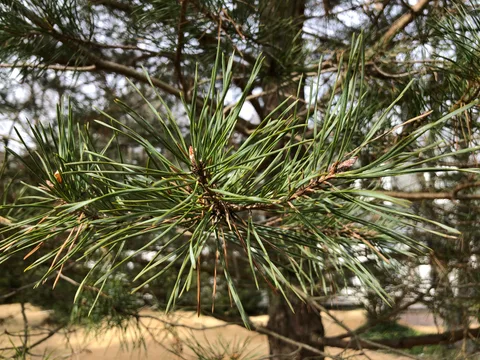
Short needles in pairs, 2.5-5 cm (1-2 inches) long and 1-2 mm wide, slightly twisted, with a grey papery sheath 5-10 mm long at the base. Dull greyish blue-green in summer, often turning a duller yellow-green in winter. Needles on young trees can be up to twice as long. Our native red pine has much longer needles (10-16 cm) that snap cleanly when bent; Austrian pine's are long, stiff and dark green.
Leaves
Bark
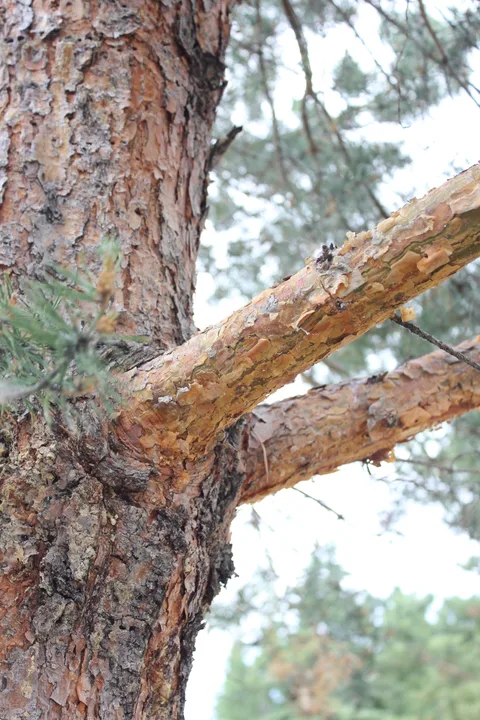
The giveaway at any distance: thin, flaky, bright orange-brown bark on the upper trunk and branches, above thick, scaly, dark grey-brown bark on the lower trunk.
Bark
Flowers
Separate male and female cones on the same tree. Yellow (sometimes pink) pollen cones 8-12 mm long cluster at the base of the new shoots and shed pollen in spring; tiny round red-purple female cones sit at the shoot tips and are pollinated by wind in early summer.
Fruit
Small, pointed, egg-shaped cones 3-7.5 cm (1.25-3 inches) long that take two to three years to mature; first-year cones are pea-sized green globes. Seeds ripen and cones begin to open in October, though most seed stays on the tree until spring. Each small black seed has a tan wing 12-20 mm long and travels on the wind; heavy seed crops come every 3-6 years.
Valuable wildlife food source
Growing Conditions
Climate
Extremely cold-hardy and drought-tolerant, it does best on light, well-drained sand and gravel and in full sun, and cannot grow in shade. Heavy, wet Bay of Quinte clay is not its preferred ground; it seeds most aggressively into sunny, open, disturbed land such as old fields, roadsides and fencerows. Its brittle tops break under ice and wet snow; Ontario's 2025 forest health survey recorded many roadside Scots pine with broken tops after snow storms. Pine wilt, which kills Scots pine in the U.S. Midwest, is caused by the pinewood nematode; the nematode is native to North America, but Natural Resources Canada reports that pine wilt disease is not found in Canadian forests.
Hardiness Zones: 3, 4a, 4b, 5a, 5b
Light Requirements
Soil
Moisture: dry, moist
Drainage: well-drained
pH Range: 4 - 7
Tolerance
Care & Maintenance
Pruning
Best Season: Winter
Frequency: Little pruning; management is mostly removal and keeping seedlings out of open land
- Remove dead and broken limbs in late winter in dry weather; dead-wood removal also cuts down on Diplodia spores
- Rake up and dispose of old cones and blighted shoot tips under infected trees
- Scots pine does not re-sprout from the stump, so cutting it at ground level, below the lowest live branch, kills it without herbicide
- Pull or clip seedlings and saplings while they are small, before they set seed
- Clean pruning tools between cuts on trees with tip blight
Avoid: Wet weather from bud break to full candle elongation (roughly May to June), when wounds and new shoots are open to Diplodia infection; Bird nesting season (spring to mid-summer) for removals in hedgerows and plantations
Watering
Establishment: Not recommended for new planting; existing young trees need little care
Mature: Very drought-tolerant once established, especially on sand
Seasonal Care Timeline
Spring
- Diplodia infects the new candles from bud break to full elongation in wet weather; do not prune then
- European pine sawfly larvae feed in groups on old needles in May and June
- Zimmerman pine moth larvae become active and start boring at branch whorls
- Pollen cones shed heavy yellow pollen
Summer
- Brown, stunted shoot tips from Diplodia show by early summer
- Brown spot needle blight: older needles browning and dropping in June
- Pull seedlings out of meadows and fencerows while the ground is soft
Fall
- Cones open from October and seed is released into winter and spring
- Good time to map spreading pines and plan removals before the next seed crop
- Rake up old cones and blighted tips under infected trees
Winter
- Freezing rain and heavy wet snow snap brittle tops and limbs
- Dormant season is the best window for removals and plantation thinning, outside bird nesting season
- Seed continues to drop onto snow and blow across open fields
Common Issues
Invasive spread into open habitats
ModerateThe Ontario Invasive Plant Council treats Scots pine as an invasive tree. Planted widely in Ontario from the early 1900s for erosion control and windbreaks and from the 1950s to the 1980s as a Christmas tree, it is now widely naturalized. Its wind- and animal-carried seed produces fast-growing seedlings that take over old fields, roadsides, fencerows, oak savannas, tallgrass prairies and sand dunes, shading out native plants. Close to home, its spread puts the rare open panne habitat at Presqu'ile Provincial Park at risk, and Scots pine has been removed there to protect it.
Symptoms: Dense thickets of young pines spreading out from the edge of an old plantation or windbreak, Scattered pine seedlings in meadows, pastures and fencerows, Open grassland or savanna filling in with pine and losing its wildflowers
Treatment: Pull or dig seedlings, and clip or cut saplings at ground level below the lowest live branch; because it does not re-sprout, a clean cut kills it. Remove isolated outlying trees first, then work in from the edges of the main stand. Larger trees are cut or removed in planned stages, and old plantations can be converted to native forest. Check for new seedlings for several years, since seed stays viable for years.
Prevention: Do not plant Scots pine. Replace it with native trees such as red pine, white pine, white spruce, red oak or bur oak suited to the site.
Diplodia (Sphaeropsis) tip blight
HighA fungus (Diplodia sapinea) that kills new shoots on two- and three-needle pines. Natural Resources Canada reports most Canadian cases come from Ontario, ranks Austrian pine as the most susceptible host and Scots pine a close second, and notes severe infections in the Toronto and Ottawa areas have killed entire trees within two to three years. Spores spread in wet spring weather and infect the expanding candles; drought, hail, snow damage and insect feeding make it worse.
Symptoms: Stunted new shoots with short, straw-coloured needles glued together with resin, Dieback starting in the lower crown, Tiny black fruiting bodies at needle bases and on cone scales, Resinous cankers and dead patches of branches in an otherwise green crown
Treatment: Prune out blighted shoots and remove old cones in dry weather, cleaning tools between cuts. Registered fungicides applied at bud break can protect a high-value yard tree; for a declining Scots pine, removal and replanting with a native species is usually the better investment.
Prevention: Reduce stress: water in drought, avoid wounding and heavy fertilizing, and never prune in wet spring weather.
Professional arborist recommended
Brown spot needle blight
ModerateA native fungal needle disease (Lecanosticta acicola) that affects pines of all ages, especially Scots and Austrian pine. Ontario's 2025 forest health survey mapped moderate to severe damage on Scots pine in several parts of southern Ontario, including Ottawa. Several years of infection slow growth, and with drought and insects can kill branches and trees.
Symptoms: Yellow to brown spots and bands on the needles, Previous years' needles browning and dropping in June, Branches left with only the current year's needles, giving a thin, tufted look
Treatment: Have the cause confirmed by a professional. Clear out heavily infected small trees, rake up fallen needles and improve air flow; fungicide is rarely practical on large trees.
Prevention: Avoid crowding, keep lower limbs and weeds from trapping moisture, and do not plant susceptible pines.
Professional arborist recommended
European pine sawfly
LowAn introduced insect first found in Canada at Windsor in 1939. Ontario reports that it prefers Scots pine but also feeds on red, jack and mugo pine, with the heaviest damage on plantation trees and isolated yard and urban pines. Infestations are occasional and local.
Symptoms: Groups of larvae feeding together on pine needles in late spring, Branches stripped of needles, worst on isolated yard trees and plantation pines
Treatment: On small trees, prune off or knock larval colonies into soapy water. Heavier infestations can be treated with a registered product while larvae are young.
Prevention: Check Scots and other two-needle pines for feeding larvae in late spring.
Zimmerman pine moth
ModerateA native moth whose larvae bore under the bark of pines, most often Scots, Austrian and red pine. Tunnelling at the branch whorls girdles the stem and leaves weak spots that break in strong wind.
Symptoms: Masses of soft, cream to white pitch mixed with sawdust at branch whorls on the trunk, Dead or broken tops and limbs above the pitch masses, Fish-hooked, yellowing shoot tips on young trees
Treatment: Cut out infested limbs in mid-summer before the adults emerge. Insecticide is aimed at young larvae in spring and is only worthwhile where damage is heavy and recurring. Trees with heavy trunk damage near targets should be assessed for removal.
Prevention: Keep trees free of drought stress and wounds, which attract egg-laying moths.
Professional arborist recommended
White pine weevil
LowA native weevil that Natural Resources Canada lists as attacking Scots pine as a secondary host, mostly in landscape and Christmas-tree plantings. Larvae kill the top leader, producing crooked, forked trees.
Symptoms: Leader wilting into a shepherd's crook in early summer, Small resin drops on the leader in spring, Two or more competing tops
Treatment: Clip and destroy the dead leader in summer, before the adults emerge.
Prevention: Inspect young trees under about 6 m tall each spring.
Sources & References
Information compiled from the following authoritative sources:
Quick Facts
When to Call an Arborist
Recommended inspection: Every 2-3 years for yard trees and plantation edges, and after every ice or snow storm
- •Broken tops or hanging limbs after freezing rain or wet snow
- •Pitch masses at branch whorls on the trunk
- •Brown, stunted new shoots with black specks at the needle bases
- •Old Christmas-tree or plantation rows leaning toward a house, lane or hydro line
- •Young pines spreading into a meadow, fencerow or naturalized area you want to keep open
- •Rapid browning of a whole tree in one season
Free consultation for Belleville residents
Recommended Services
Based on Scots Pine characteristics