
White Poplar
Populus alba
Overview
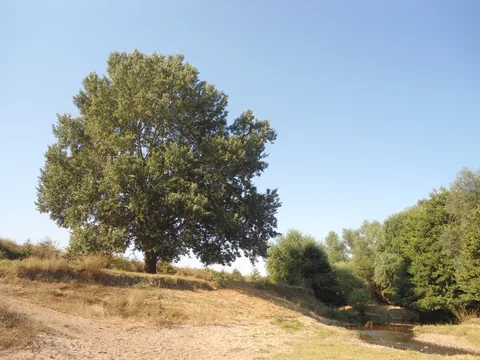
White poplar is a European and Asian tree that has escaped from planting across eastern Canada and the United States. The Database of Vascular Plants of Canada lists it as introduced and established in Ontario. Around Belleville and the Quinte area it shows up as an old yard, farmstead or windbreak tree and as clonal thickets along fencerows, roadsides and field edges that started from one planted tree. Canadian assessments have ranked it among the invasive plants affecting natural habitats, and Point Pelee National Park has made its removal a high priority, although a survey of Canadian botanists found most regard it as invasive only locally. The usual jobs on it are removing large, breaking trees and controlling suckers in lawns, gardens and over septic beds. Do not plant it; good native replacements are basswood, red oak, bur oak or hackberry for shade, and trembling aspen where a fast, pale-barked native is wanted on a site big enough for its suckers.
Introduced to North America as an ornamental and windbreak tree for its fast growth and striking silver foliage, white poplar now grows wild across much of the continent. It also hybridizes with Eurasian aspen (the hybrid is grey poplar) and with the native largetooth and trembling aspens.
Full Tree
Identification
Leaves
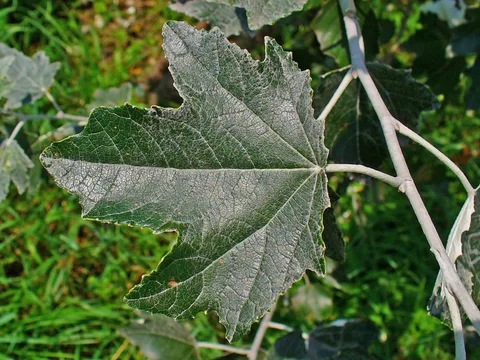
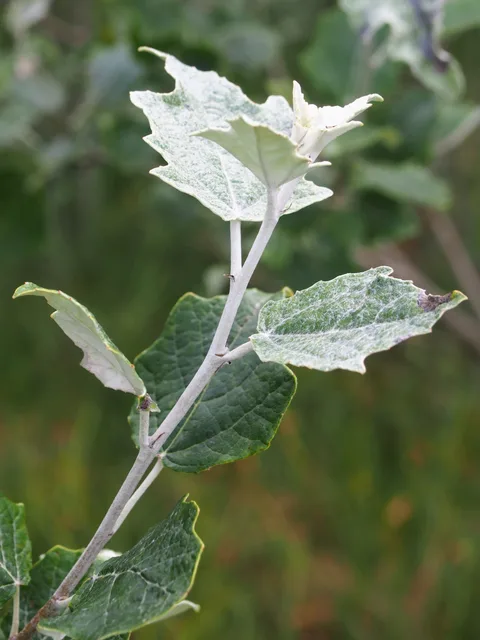
The easiest poplar to recognize: leaves are dark, glossy green above and bright white and densely felted with hairs underneath, so the whole tree flashes silver in a breeze. Leaves on fast shoots and root suckers are lobed like a small maple leaf, while those on short shoots are rounder with blunt teeth. Fall colour is poor; leaves often drop green or turn a dull yellow.
Leaves
Bark
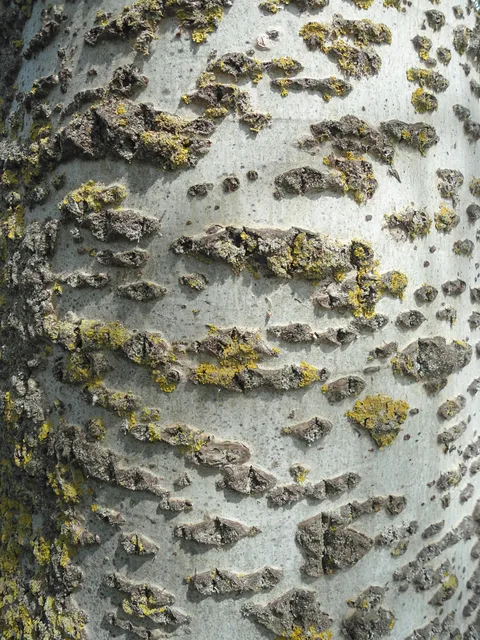
Smooth, whitish to greenish-white bark marked with dark diamond-shaped pores and rough patches, a look shared with the native aspens. With age the base of the trunk turns dark grey and becomes rough, ridged and furrowed while the upper trunk and limbs stay pale.
Bark
Flowers
Hanging catkins appear in early spring before the leaves, with male and female flowers on separate trees. Male catkins are slightly showier because of their red colour.
Fruit
Small capsules in hanging clusters 5-10 cm (2-4 in) long split to release cottony, wind-blown seed. In North America seed germination appears to be very low; white poplar spreads mainly by root suckers, and most seedlings that do appear come from hybrids with other poplars.
Growing Conditions
Climate
Very hardy and tolerant: it grows on the heavy, alkaline clay of the Bay of Quinte lowlands, on sandy and droughty ground, along salted roads and in places that flood briefly in spring. That tolerance is why it spreads so well. Its weakness is its wood, which breaks under ice and heavy wet snow.
Hardiness Zones: 3, 4a, 4b, 5a, 5b
Light Requirements
Soil
Moisture: dry, moist, wet
Drainage: well-drained, moderate, poor
pH Range: 5 - 8
Tolerance
Care & Maintenance
Pruning
Best Season: Winter
Frequency: Every 1-3 years on yard trees for deadwood and broken limbs; suckers need attention every season
- On a tree you are keeping, focus on deadwood and on reducing long, heavy limbs over roofs, driveways and lines before they break
- Avoid topping and heavy cuts: white poplar answers wounds with dense sprouts from the trunk and roots
- Cutting or damaging the roots, including trenching, rototilling and stump removal, triggers more suckering
- Mow, cut or pull suckers repeatedly through the season; each cut draws down the root reserves
- If the goal is to get rid of the tree, plan for follow-up sucker control for several years after removal
Avoid: Heavy pruning during leaf-out and early summer; Topping at any time of year
Watering
Establishment: Not recommended for planting; do not water or nurse suckers or volunteers
Mature: Needs no watering; it handles both damp ground and upland, droughty sites
Seasonal Care Timeline
Spring
- Suckers start coming up in lawns, beds and over septic systems
- Cottony seed from female trees, though few seedlings result
- Check for limbs damaged by late-winter ice and snow
Summer
- Keep cutting or mowing suckers; each cut weakens the roots
- Thunderstorm breakage of weak limbs
- Leaf spots and rust in wet summers
Fall
- Plan removal and replanting for the dormant season
- Map how far the sucker colony has spread before the leaves drop
- Choose a native replacement such as basswood, red oak or hackberry
Winter
- Ice storms and heavy wet snow break limbs and split forks
- Frozen ground makes removal of large trees easier on lawns
- Pale bark and hairy twigs make it easy to spot in winter
Common Issues
Root Suckering and Spread
HighWhite poplar spreads by suckers from an extensive network of shallow lateral roots. Sprouts can come up as far as 50 m (165 ft) from the parent tree, and over time a single tree becomes a dense clonal colony. Damage to the roots or the parent tree, including cutting it down, triggers even more suckering. On rural lots the suckers turn up in lawns, gardens, along foundations and over septic beds, and in natural areas the colonies crowd out native plants along woodland edges.
Symptoms: Silvery-white shoots coming up in lawns, beds and fencerows, sometimes many metres from the tree, A thicket of young poplars spreading out from an older tree, Shoots emerging along foundations, driveways or over the septic bed, A flush of new suckers after the tree is cut or the roots are disturbed
Treatment: Pull small suckers by hand, ideally after rain when the soil is loose, taking as much root as possible. Cut larger stems at ground level and keep re-cutting the resprouts until the roots are exhausted. Girdling a large tree with a deep cut through the bark about 15 cm (6 in) above the ground kills it slowly but still needs follow-up on sprouts. Herbicide treatment of cut stems or girdles is used where Ontario's pesticide rules allow, by a licensed applicator.
Prevention: Do not plant white poplar or move soil and root pieces from a colony; remove young trees before they form a colony and replant with a native species
Weak Wood and Storm Breakage
HighWhite poplar grows fast and its wood is weak, so limbs and whole stems break in windstorms, wet snow and ice. Large, spreading trees on rural lots can drop heavy limbs on houses, sheds, vehicles and lines.
Symptoms: Broken or hanging limbs after storms, Deadwood throughout the crown, Splits at narrow forks between large stems, Leaning trunks or heaving soil at the base
Treatment: Have broken limbs and hangers removed promptly; have a large, split or leaning tree assessed, and plan removal where the risk cannot be managed
Prevention: Regular deadwood removal on trees near buildings; do not plant new white poplars
Professional arborist recommended
Cytospora Canker
ModerateAn opportunistic fungal canker of poplars that kills bark on stressed or wounded trees and girdles branches. Drought is a major predisposing factor; healthy, vigorous branches and trunks are rarely affected.
Symptoms: Brown, sunken, roughly circular cankers on branches and trunk, Orange-brown to black, sour-smelling tissue under the bark, Pimple-like fruiting bodies on dead bark; yellowish spore threads in wet weather, Twig and branch dieback
Treatment: Remove infected branches well below the canker; remove severely infected trees
Prevention: Avoid trunk wounds and drought stress
Leaf Spots and Leaf Rust
LowFungal leaf spots and orange poplar leaf rusts show up on white poplar in wet summers. Penn State Extension notes that rust damage on poplars is minor and no control is recommended.
Symptoms: Brown spots or blotches on the leaves, Small orange-yellow powdery pustules on leaf undersides, Early leaf drop in late summer
Treatment: Usually cosmetic; rake and dispose of fallen leaves
Prevention: Good air flow; no treatment is normally warranted
Sources & References
Information compiled from the following authoritative sources:
Quick Facts
When to Call an Arborist
Recommended inspection: Every 1-2 years for large trees near houses, driveways or lines, and after every major wind or ice storm
- •Large dead or broken limbs, or hangers caught in the crown
- •Cracks or splits at forks between large stems
- •Cankers, cavities or fungal growth on the trunk
- •A lean toward a house, road or line
- •Suckers coming up along foundations, over septic beds or near drains
- •A spreading colony you want removed before it gets bigger
Free consultation for Belleville residents
Recommended Services
Based on White Poplar characteristics