
Balsam Poplar
Populus balsamifera
Overview
Balsam poplar grows throughout Ontario and is at home on the wet, low-lying ground common around Belleville: river flats along the Moira and Salmon rivers, swamp and marsh edges in the Bay of Quinte lowlands, wet ditches and fencerows, and moist hollows on the Canadian Shield edge north of Highway 7. In spring the sticky buds and unfolding leaves fill the air with a sweet balsam scent. Mature trees on residential lots are often short-lived and weak, so risk pruning, removal and sucker control are the usual requests.
Balsam poplar has been planted in rural Ontario as a fast-growing windbreak and as quick shelter for slower trees such as white pine and hemlock. Bees collect its resin and use it to disinfect their hives. It is often confused with hybrid poplars planted in windbreaks and yards; the round leaf stalk, resin-stained leaf undersides and fragrant sticky buds are the best clues.
Full Tree
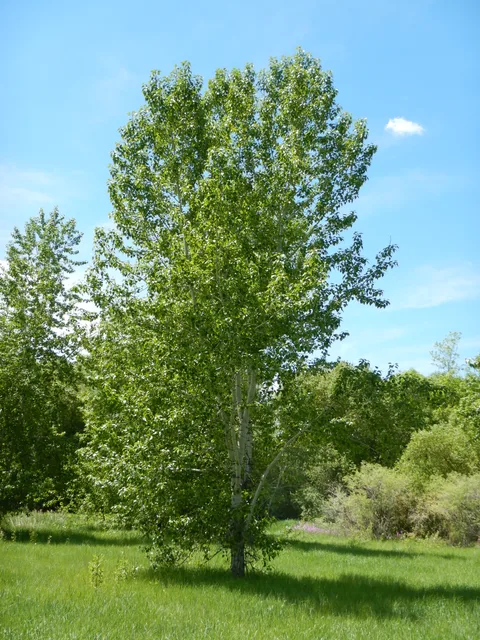
Identification
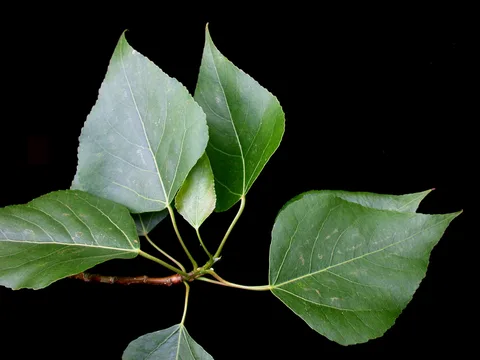
Leaves
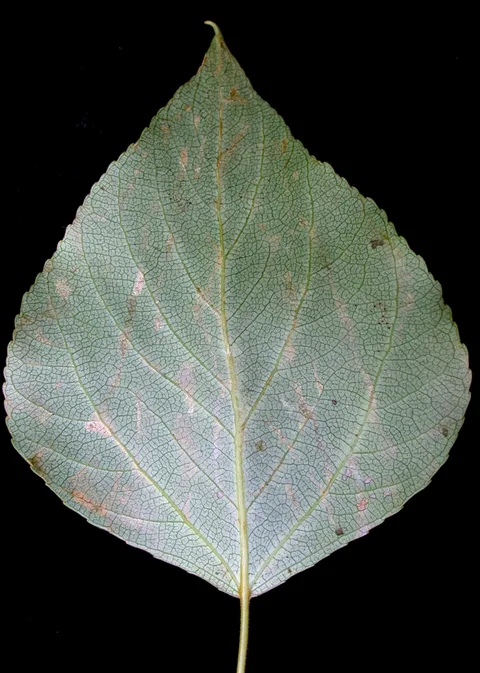
Shiny dark-green leaves above; the undersides are pale silvery-green and usually stained with rusty-brown resin blotches. The leaf stalk is round in cross-section, not flattened as in aspens and cottonwood, so the leaves do not tremble as much. Unfolding leaves have a strong balsam scent.
Leaves
Bark
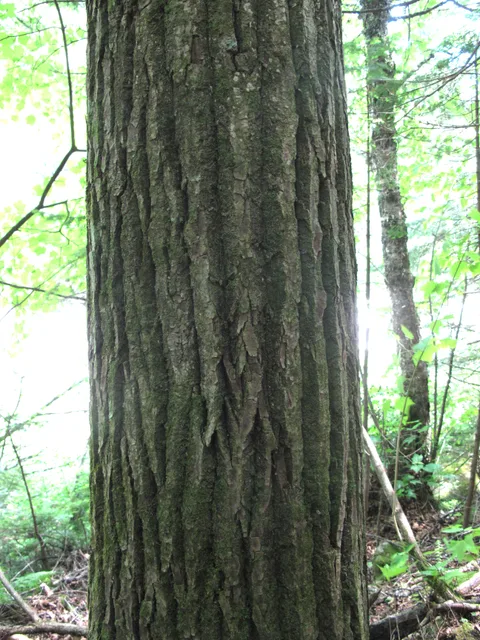
Young bark is smooth and greenish-brown with conspicuous horizontal lenticels. With age it turns grey and breaks into flat, scaly ridges separated by irregular V-shaped furrows.
Bark
Flowers
Long, hanging catkins appear in spring before the leaves: pollen catkins 7-10 cm (3-4 inches) and seed catkins 6-8 cm (2.5-3 inches) long.
Fruit
Seed catkins lengthen to 10-13 cm (4-5 inches), carrying many small egg-shaped capsules 6-7 mm long that split in two. In late spring they release fluffy, wind-borne seeds; most land within about 200 m of the parent and stay viable for only a few weeks.
Valuable wildlife food source
Growing Conditions
Climate
One of the hardiest deciduous trees in Canada, so cold is never a problem in the Quinte area. It is highly flood-tolerant and suits wet clays and floodplain soils, but it is short-lived in southern Ontario and does poorly on dry, shallow soils over limestone or Shield rock, where stress invites cankers and borers.
Hardiness Zones: 2, 3, 4a, 4b, 5a, 5b
Light Requirements
Soil
Moisture: moist, wet
Drainage: well-drained, moderate, poor
pH Range: 5.5 - 8
Tolerance
Care & Maintenance
Pruning
Best Season: Winter
Frequency: Every 3-5 years near targets; after major wind, snow or ice events
- Prune in the dormant season in dry weather; poplar wounds are an entry point for canker fungi
- Remove dead, broken and canker-damaged branches back to healthy wood outside the branch collar
- Cut unwanted root suckers at ground level regularly; do not dig or till around the roots, which stimulates more suckers
- Reduce or remove long limbs over roofs, driveways and lines rather than topping the tree
- Disinfect tools between trees when cutting out cankers
Avoid: Spring leaf-out, when bark tears easily; Wet weather, when canker spores spread
Watering
Establishment: Keep soil consistently moist for the first two growing seasons; seedlings and young trees need plenty of moisture
Mature: Usually self-sufficient on the wet and low-lying sites where it grows naturally
Seasonal Care Timeline
Spring
- Fragrant, sticky bud scales and resin drip onto cars, decks and siding
- Seed fluff from female trees in late spring
- New root suckers appear in lawns and beds
Summer
- Thunderstorm limb breakage
- Leaf spots and canker dieback in wet or drought years
- Watch for borer frass and swollen bark
Fall
- Good time for inspection and risk pruning after leaf drop
- Rake up fallen leaves to reduce leaf-spot carry-over
- Cut back the season's suckers
Winter
- Ice and wet snow break weak and decayed limbs
- Dormant season is the best time for pruning and removals
- Check for hanging limbs after storms
Common Issues
Storm Breakage and Trunk Decay
HighBalsam poplar grows fast and its wood is light and soft. Older trees, especially on drier or southern sites where it is shorter-lived, develop decay and break in wind, wet snow and ice.
Symptoms: Broken tops or hanging limbs after storms, Fungal conks or mushrooms on the trunk, Cavities or soft wood at old branch stubs, Thinning, dying crown in older trees
Treatment: Professional risk assessment; deadwood removal and limb reduction, or removal of decayed trees close to buildings, roads or lines
Prevention: Plant away from structures, avoid trunk wounds, and inspect regularly once trees pass 40-50 years
Professional arborist recommended
Root Suckering
ModerateBalsam poplar regenerates from root suckers and stump sprouts, and its suckers are more vigorous than those of aspen. Suckering increases when the parent tree is cut or the soil over the roots is disturbed, so cutting the tree down often leads to a thicket.
Symptoms: Shoots coming up in lawns and beds metres from the trunk, Dense thickets spreading into adjacent wet ground, Vigorous sprouts from the stump after removal
Treatment: Mow or cut suckers repeatedly at ground level; after removal, grind the stump and keep cutting new sprouts until the root system is exhausted
Prevention: Avoid planting near lawns, gardens and septic beds; avoid root damage from digging or tilling
Poplar Borer
ModerateNative longhorned beetle (Saperda calcarata) whose larvae tunnel into the trunk over a 3-4 year life cycle. Balsam poplar is one of its main hosts; it favours trees just over 10 cm in diameter on poor sites.
Symptoms: Swollen areas on the bark, Sap running from small slits or holes, Piles of frass at the base of the trunk and roots, Trunks or tops breaking at tunnelled sections
Treatment: No practical spray control; remove badly damaged stems and have an arborist assess structural safety
Prevention: Keep trees vigorous and avoid trunk wounds
Professional arborist recommended
Poplar-and-Willow Borer
ModerateSnout beetle (Cryptorhynchus lapathi) recorded in Ontario. Larvae mine under the bark and then into the wood of shoots and stems, weakening them so they break in wind and snow. Females prefer to lay eggs in wounds and scars.
Symptoms: Small holes in the bark with frass and sap bleeding, Swollen, broken or wilting shoots, Wood riddled with tunnels when a stem is split
Treatment: Prune out and destroy infested shoots; heavily attacked small stems are best removed
Prevention: Avoid wounding stems and remove infested material promptly
Septoria Leaf Spot and Canker
ModerateNative fungus (Sphaerulina musiva) that causes leaf spots on balsam poplar, usually as a minor host. It is far more damaging to susceptible hybrid poplars, and a high rate of cankers has been reported on balsam poplar and its hybrids in an Alberta plantation.
Symptoms: Yellow to reddish-brown leaf spots, sometimes with pale centres, Sunken, dark cankers on stems and branches (mainly hybrids), Branches breaking at cankers
Treatment: Rake and dispose of fallen leaves; prune out cankered branches in dry weather
Prevention: Avoid planting susceptible hybrid poplars nearby; keep trees vigorous
Cytospora Canker
ModerateFungal canker of poplars that attacks trees weakened by drought, flooding or wounds, killing bark and girdling branches.
Symptoms: Sunken or discoloured bark patches, Tiny black fruiting bodies on dead bark, Bark cracking at canker margins, Branch dieback
Treatment: Prune out infected branches in dry weather and disinfect tools; fungicides are not effective
Prevention: Reduce stress and avoid mower and trimmer wounds
Sources & References
Information compiled from the following authoritative sources:
Quick Facts
When to Call an Arborist
Recommended inspection: Every 2-3 years for mature trees near buildings, roads or lines, and after major storms
- •Broken or hanging limbs
- •Fungal conks, cavities or soft wood on the trunk
- •Cankers girdling major stems
- •Frass, sap bleeding or swollen bark from borers
- •Dying or thinning crown
- •Lean that has changed after a storm
Free consultation for Belleville residents
Recommended Services
Based on Balsam Poplar characteristics