
Eastern Cottonwood
Populus deltoides
Overview
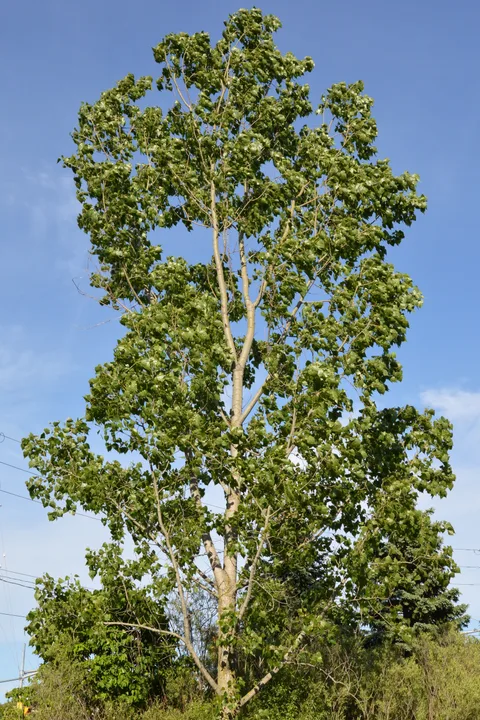
Eastern cottonwood is uncommon in Ontario overall, reaching its northern limit near the Lower Great Lakes and St. Lawrence. Around Belleville it grows on the low, moist ground it prefers: the Bay of Quinte shoreline, Moira River flats and wet ditches and fencerows. Its size, fast growth and weak wood make it one of the more frequent risk-pruning and removal jobs in the Quinte area, especially where a tree that started in a ditch now stands over a house or road.
The name comes from the cotton-like hairs attached to the seeds. Cottonwood hybridizes readily with other poplars, and many of the large 'cottonwoods' in older Belleville yards and farm windbreaks are planted hybrid poplars, which can make identification difficult. Although its weak wood keeps it out of most landscape plantings, its fast growth has made it a useful rural windbreak tree.
Full Tree
Identification
Leaves
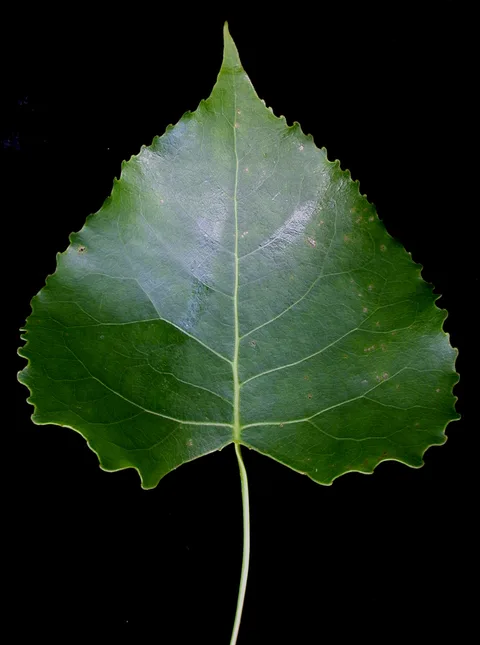
Shiny bright-green triangular leaves, slightly paler underneath, on long, flattened stalks that make the leaves flutter in a breeze. Usually 3-5 small warty glands sit where the blade meets the stalk. A narrow, translucent edge runs along the rounded teeth.
Leaves
Bark
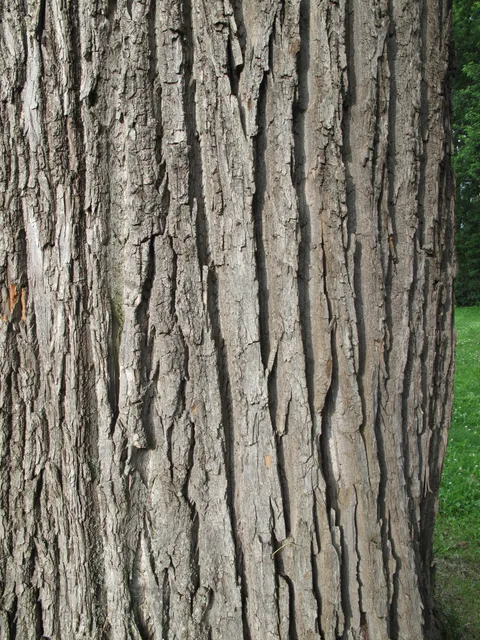
Young stems are smooth and yellowish-grey. On mature trees the bark becomes thick, dark grey and deeply furrowed, with broad flat-topped ridges, one of the heaviest-textured barks on any local tree.
Bark
Flowers
Hanging catkins 5-7 cm (2-3 inches) long appear in May before or as the leaves open. Male trees carry reddish catkins; female trees carry greenish-yellow catkins that ripen into the seed strings.
Fruit
Female trees produce 'necklaces' of seed catkins 15-25 cm (6-10 inches) long, strung with oval capsules 8-12 mm long that split into 3 or 4 parts. In late May and June they release tiny seeds attached to cotton-like hairs that drift in the wind, pile up along curbs, and clog screens, pool filters and air-conditioner coils.
Valuable wildlife food source
Growing Conditions
Climate
Fully hardy in the Quinte area and adapted to floodplains, tolerating periodic spring flooding as well as dry spells once established. It grows best on moist sandy and loamy soils but copes with the heavy clays of the Bay of Quinte lowlands. Its soft wood is the weak point in Eastern Ontario's freezing-rain and wet-snow events.
Hardiness Zones: 3, 4a, 4b, 5a, 5b
Light Requirements
Soil
Moisture: moist, wet
Drainage: well-drained, moderate, poor
pH Range: 5.5 - 8
Tolerance
Care & Maintenance
Pruning
Best Season: Winter
Frequency: Every 3-5 years for trees near homes, roads or play areas; after every major wind or ice storm
- Prune in the dormant season (late fall to late winter) in dry weather, when the branch structure is easy to see
- Focus on risk reduction: remove dead, cracked and hanging limbs and shorten long, heavy limbs that extend over roofs, driveways and lines
- Train young trees to a single strong leader; codominant stems with included bark are a common failure point
- Make clean cuts just outside the branch collar and leave them to dry; do not paint or tar wounds
- Never top a cottonwood: the flush of weakly attached sprouts that follows breaks easily within a few years
- Large limbs over targets should be removed or reduced by a professional arborist with rigging, not dropped
Avoid: Spring leaf-out, when bark tears easily; Wet weather, when canker fungi spread most readily
Watering
Establishment: Water deeply once or twice a week through the first two growing seasons unless the site is naturally wet
Mature: Mature trees reach groundwater on most low-lying sites and rarely need watering
Seasonal Care Timeline
Spring
- Check for limbs broken by winter ice and snow before leaf-out
- Spring flooding on river and shoreline lots can stress trees
- Catkins and early leaves drop on decks and driveways
Summer
- Cotton seed drift from female trees in late May and June clogs screens, pool filters and air-conditioner coils
- Thunderstorm downbursts break heavy limbs
- Watch for leaf spots, rust and canker dieback in wet or drought years
Fall
- Good time to book an inspection and risk pruning once leaves drop
- Rake fallen leaves to reduce leaf spot and rust carry-over
- Check for borer frass and woodpecker damage on the trunk
Winter
- Freezing rain and wet snow can split weak forks and snap large limbs
- Dormant season is the best time for pruning and removal work
- Look for hanging broken limbs after every storm
Common Issues
Limb Failure and Storm Breakage
HighCottonwood grows very fast and has soft, weak wood, so heavy limbs and codominant stems fail in wind, wet snow and ice. Large failures from a 25-30 m tree can do serious damage to houses, vehicles and lines.
Symptoms: Cracks or seams at the base of large forks, Hanging or broken limbs (hangers) in the crown, Long, heavy limbs extending far over roofs or roads, Dead branches high in the crown, Decay, cavities or fungal growth at old branch wounds
Treatment: Risk assessment by a professional arborist, followed by deadwood removal, end-weight reduction, cabling of suitable forks, or removal where the risk cannot be managed
Prevention: Structural pruning while young, regular inspection, and not planting cottonwood close to buildings
Professional arborist recommended
Roots in Sewers, Septic Systems and Hardscape
ModerateCottonwood's shallow, wide-spreading roots seek out water and are prone to invading sewer and septic lines; on large trees they also lift sidewalks and driveways.
Symptoms: Slow drains or recurring sewer backups, Roots found during drain camera inspection, Heaving sidewalks, patios or driveways near the tree, Soggy, lush patches over septic beds
Treatment: Have a plumber clear and repair the line; a professional arborist can assess whether root pruning is safe or whether removal is the better option
Prevention: Keep cottonwoods well away from sewer laterals, septic beds and foundations; choose a smaller tree near services
Professional arborist recommended
Cytospora Canker
ModerateFungal canker of poplars and cottonwoods that attacks stressed or wounded trees, killing bark and girdling branches. Drought and waterlogged roots are the main stresses that predispose trees.
Symptoms: Elongated, sunken or discoloured patches of bark, Orange-brown discolouration under the bark in spring and early summer, Tiny black fruiting bodies (pimples) on dead bark, Bark cracking along the canker edge, Branch dieback, often starting low in the crown
Treatment: Prune out infected branches in dry weather, cutting back to healthy wood outside the branch collar and disinfecting tools between cuts; fungicides are not effective
Prevention: Reduce stress: avoid trunk wounds from mowers and trimmers, water during droughts, avoid soil compaction
Septoria Leaf Spot and Canker
ModerateNative fungus (Sphaerulina musiva) of eastern cottonwood. On native cottonwood it mostly causes leaf spots of minor importance, but on hybrid poplars it causes serious stem and branch cankers, and outbreaks have been reported in plantations of susceptible hybrids from Quebec and Ontario westward.
Symptoms: Circular to angular yellow to reddish-brown leaf spots, sometimes with a pale centre, Spots appearing first on lower branches, On hybrids: sunken, blackened cankers on stems and branches, Stem breakage at cankers on hybrid poplars
Treatment: Usually none needed on native cottonwood; rake and dispose of fallen leaves. Cankered hybrid poplars should be assessed by a professional arborist, as stems often break at the canker
Prevention: Plant native cottonwood or resistant clones rather than susceptible hybrid poplars; give trees good air circulation
Poplar Borer and Other Wood Borers
ModerateNative beetles such as the poplar borer (Saperda calcarata) and the poplar-and-willow borer tunnel into the trunk and branches. The poplar borer has a 3-4 year life cycle; repeated attacks structurally weaken trees and make them prone to wind and snow breakage.
Symptoms: Swollen areas on the bark, Sap running from small holes, Piles of sawdust-like frass at the base of the trunk or roots, Heavy woodpecker work on the trunk, Branches or tops snapping at tunnelled sections
Treatment: No practical spray control in large trees; remove heavily attacked branches and have an arborist assess whether tunnelling has made the trunk unsafe
Prevention: Keep trees vigorous, avoid wounding the trunk (borers favour wounds and scars for egg-laying), and do not plant cottonwood on poor, dry sites
Professional arborist recommended
Leaf Rust (Melampsora)
LowRust fungi that alternate between poplars and conifers such as larch. They cause cosmetic to moderate leaf loss in late summer and rarely threaten a mature tree.
Symptoms: Small powdery yellow-orange pustules on leaf undersides, Leaves yellowing and dropping early in late summer, Orange-brown crusts on fallen leaves in fall
Treatment: Generally not required on established trees; rake and dispose of fallen leaves
Prevention: Good air circulation; choose rust-resistant clones when planting
Sources & References
Information compiled from the following authoritative sources:
Quick Facts
When to Call an Arborist
Recommended inspection: Every 2-3 years for large trees near buildings, roads or lines, and after every major wind or ice storm
- •Cracks, seams or included bark at large forks
- •Broken or hanging limbs in the crown
- •Dead or dying sections of the crown
- •Cankers, cavities or mushrooms on the trunk or root flare
- •Sawdust-like frass or heavy woodpecker activity on the trunk
- •Leaning trunk or soil heaving on one side after a storm
- •Roots damaging sewer lines, driveways or foundations
Free consultation for Belleville residents
Recommended Services
Based on Eastern Cottonwood characteristics