
Largetooth Aspen
Populus grandidentata
Active Threats to Largetooth Aspen
LDD Moth (Spongy Moth)
Formerly known as Gypsy Moth. Caterpillars defoliate trees in late spring, with periodic outbreak years causing severe damage.
Signs to watch for:
- •Visible caterpillars with blue and red spots
- •Skeletonized or completely eaten leaves
- •Egg masses on tree trunks (tan, fuzzy patches)
- •Frass (caterpillar droppings) under trees
Recommended Action: Healthy trees typically survive defoliation. Repeated years of heavy feeding may require professional intervention.
Free consultation available
Overview
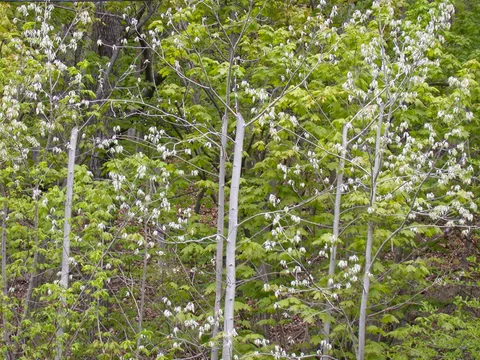
A native pioneer tree found throughout Southern Ontario. Around Belleville it comes up quickly on sandy and gravelly ground, old fields, roadsides and rocky Shield-edge sites north of Hwy 7, usually as a clump of stems from one root system, mixed with trembling aspen, white birch and white pine. It is easily mistaken for trembling aspen: look for the coarse, large-toothed leaves, the pale woolly new leaves in spring, the darker, often orange-tinged bark and the dull, downy buds.
Not a prized woodworking species, but used for pulp and paper, plywood and veneer. Its buds and leaves are an important food for ruffed grouse.
Full Tree
Identification
Leaves
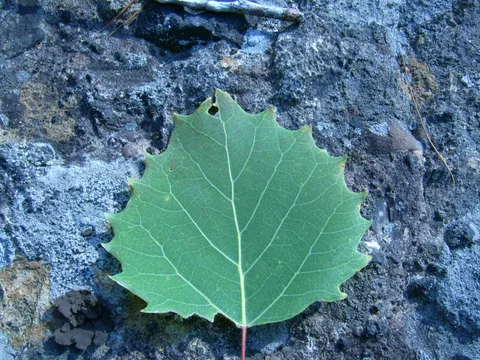
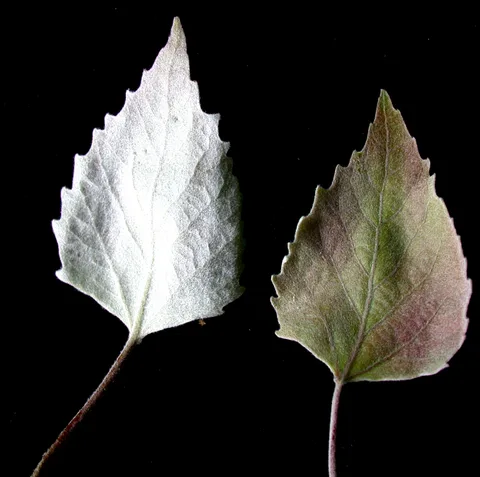
Round-ish leaves with big, coarse teeth, far fewer and larger than the fine teeth of trembling aspen. Like trembling aspen the leaf stalk is flattened, so the leaves flutter. In spring the unfolding leaves are covered underneath in white, woolly hairs, giving whole trees a pale, frosted look among other greening trees; the hairs wear off as the leaves mature.
Leaves
Bark
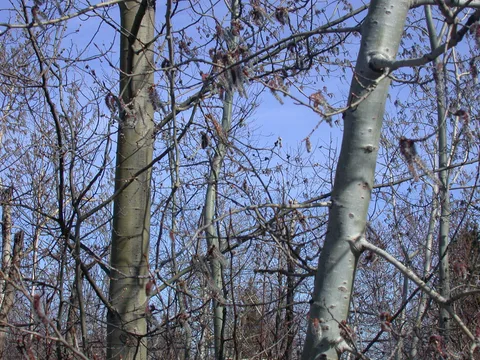
Smooth, pale greenish to yellowish-grey bark, often with an orange tinge and small diamond-shaped marks. It is darker than trembling aspen's chalky, greenish-white bark and becomes dark grey and deeply furrowed on older trunks.
Bark
Flowers
Long, drooping yellow-green catkins appear in early spring before the leaves. Male and female catkins are on separate trees. Largetooth aspen leafs out about 7-10 days later than trembling aspen.
Fruit
Female catkins lengthen to 10-12 cm and carry narrow, downy capsules 6-7 mm long that split in two about 4-6 weeks after flowering, releasing cottony seed in late spring. Grouse and other birds eat the buds and leaves, and deer and moose browse the young suckers.
Valuable wildlife food source
Growing Conditions
Climate
Cold-hardy and more tolerant of dry, sandy soil than trembling aspen, but shade-intolerant and short-lived. Hot droughts stress it: in 2025 Ontario's forest health survey recorded drought damage on largetooth aspen in the Kawarthas and widespread drought damage in Hastings County, and stressed trees are the ones that pick up Hypoxylon canker.
Hardiness Zones: 3, 4a, 4b, 5a, 5b
Light Requirements
Soil
Moisture: dry, moist
Drainage: well-drained, moderate
pH Range: 4 - 7
Tolerance
Care & Maintenance
Pruning
Best Season: Winter
Frequency: As needed for dead, broken or cankered wood
- Prune in winter when dormant
- Remove dead and broken branches promptly: the wood is soft and decays quickly
- On valued yard trees, cut out cankered branches before the infection reaches the trunk
- Cut unwanted root suckers at ground level; expect more to follow
Avoid: Spring and summer, when fresh wounds give canker fungi and insects an easy way in
Watering
Establishment: Water deeply during the first growing season
Mature: Tolerates drier, sandier ground than trembling aspen once established
Seasonal Care Timeline
Spring
- Forest tent caterpillar and spongy moth larvae from mid-May
- Cottony seed from female trees in late spring
- Ice-storm breakage to clean up and assess
Summer
- Drought stress on sandy and rocky sites
- New suckers coming up in lawns and beds
- Check trunks for orange or blackened cankers
Fall
- Yellow fall colour and quick leaf drop
- Look for spongy moth egg masses on trunks
- Assess any trunk cankers before winter storms
Winter
- Ice and wet snow break the brittle wood
- Best season to prune and remove declining stems
- Look for forest tent caterpillar egg bands on twigs
Common Issues
Hypoxylon Canker
HighFungal canker (Entoleuca mammata, formerly Hypoxylon mammatum) that is the most serious disease of aspen. It is less damaging on largetooth than on trembling aspen, but on largetooth it still forms branch cankers and can kill trees through trunk cankers. Trunks often snap at the canker.
Symptoms: Slightly sunken yellow to orange bark, often around an insect or woodpecker wound, Rough, cracked, blackened bark with grey-to-black crusts as the canker ages, Mottled black and cream wood under the bark, Dead leaves hanging on cankered branches (flagging)
Treatment: No cure. On yard and park trees, prune cankered branches before the fungus reaches the main stem; trees with trunk cankers should be assessed for removal because they break at the canker.
Prevention: Avoid wounding the bark and keep trees watered in drought
Professional arborist recommended
Forest Tent Caterpillar
ModerateNative defoliator. Ontario outbreaks come roughly every 10-12 years and last three to five years. In the north it feeds mostly on aspen; in southern Ontario mainly on sugar maple and oak, but aspens near those stands are also stripped.
Symptoms: Blue-and-white caterpillars with keyhole-shaped white spots clustering on trunks, Silk mats on bark but no tents in branch crotches, Large-scale leaf loss in late May and June, followed by a thin second flush of leaves
Treatment: Healthy trees normally refoliate; Btk spray on young larvae can protect individual high-value trees
Prevention: Destroy egg bands on twigs in winter on small trees; keep trees watered after heavy defoliation
Spongy Moth
ModerateInvasive defoliator (formerly LDD or gypsy moth). Aspen is among its preferred hosts, and in 2025 Ontario's forest health survey recorded light defoliation of largetooth aspen in the northeast.
Symptoms: Hairy caterpillars with paired blue and red spots, Leaves chewed from the edges to the midrib, Tan, fuzzy egg masses on bark in fall and winter
Treatment: Scrape and destroy egg masses; consult a professional during outbreak years
Prevention: Check trunks and outdoor items for egg masses each fall
Weak Wood, Decay and Ice Breakage
HighThe wood is soft, and aspen trunk rot and other decay fungi are common in older stems. The late-March 2025 ice storm broke and bent largetooth aspen in the Peterborough-Kawartha area, and moderate to severe ice damage was mapped in Hastings County near Ivanhoe and Cordova Mines.
Symptoms: Hoof-shaped conks on the trunk, Broken tops and hanging limbs after wind or ice, Dead, leafless sections of crown, Cracks or cavities at old branch stubs
Treatment: Have trees near houses, driveways and lines assessed; removal is often the realistic option for decayed or broken stems
Prevention: Do not plant close to buildings; remove declining stems before they fail
Professional arborist recommended
Poplar-and-willow Borer
LowWeevil whose larvae tunnel in the stems of poplars and willows, weakening young stems and suckers.
Symptoms: Wet, darkened spots and frass at holes in the bark, Swollen or cracked bark on young stems, Stems that break at the tunnel
Treatment: Cut out and destroy infested stems
Prevention: Keep trees vigorous; remove heavily infested suckers
Sources & References
Information compiled from the following authoritative sources:
Quick Facts
When to Call an Arborist
Recommended inspection: Every 2-3 years for trees within reach of buildings, driveways or lines
- •Orange or blackened cankers on the trunk
- •Conks (shelf fungi) on the trunk
- •Dead top or broken limbs after ice or wind
- •Lean that has recently changed
- •Suckers coming up in lawns, beds or foundations
Free consultation for Belleville residents
Recommended Services
Based on Largetooth Aspen characteristics