
Lombardy Poplar
Populus nigra 'Italica'
Overview
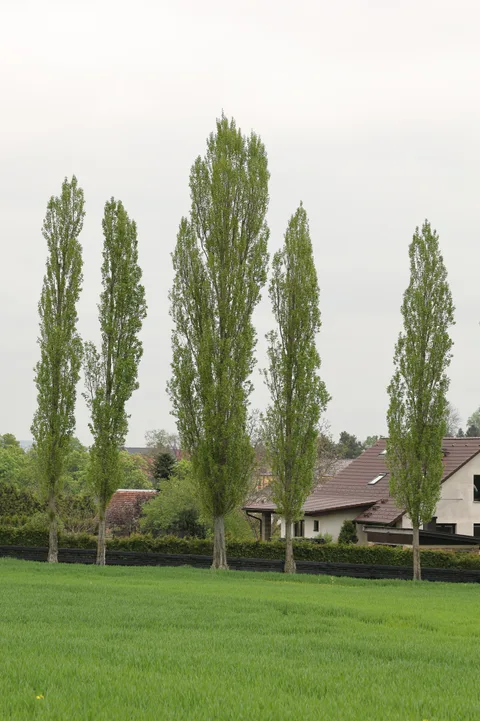
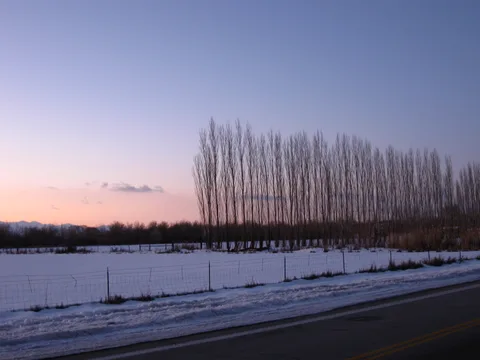
Lombardy poplar is not native and does not seed into the wild, but it is a familiar sight around Belleville and the Quinte area: rows planted as fast screens and windbreaks along farm lanes, rural lot lines, older subdivisions and fence lines. Because nearly every row is the same short-lived male clone, most of those plantings decline at about the same time, from the top down. The usual jobs on it are removing dead or dying rows and controlling suckers afterwards. The Morton Arboretum no longer recommends black poplar for planting because of its canker problems.
The Lombardy form traces back to a single male tree found in the Lombardy region of northern Italy in the 1600s. Because it is grown from cuttings, nearly every Lombardy poplar is a genetic copy of that one tree, which is part of why disease runs through whole rows. Its narrow shape made it a popular quick screen and windbreak across North America.
Full Tree
Identification
Leaves
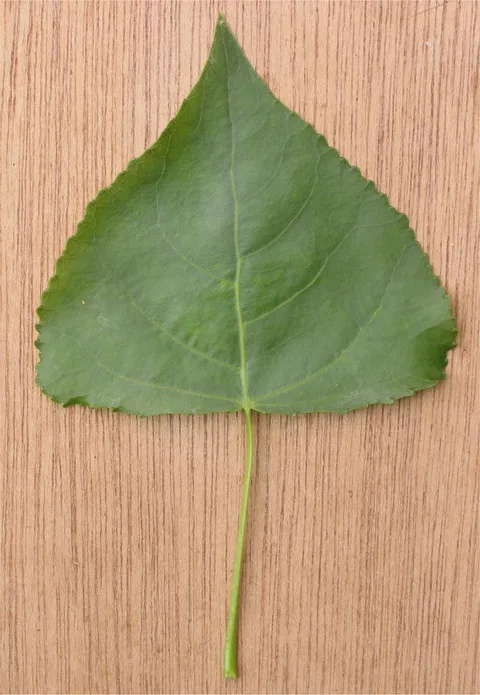
Shiny, dark green, triangular to diamond-shaped leaves, paler underneath, on long flattened stalks that make them flutter in the wind. The leaves look much like eastern cottonwood's, but lack cottonwood's small glands where the stalk meets the blade and the fine fringe of hairs along its edge. The shape of the whole tree, not the leaf, is what gives Lombardy poplar away.
Leaves
Bark
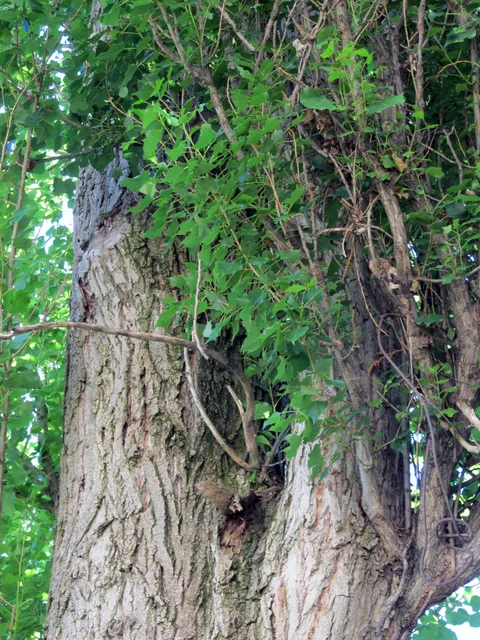
Smooth and grey-green on young stems, becoming dark grey to almost black and deeply, irregularly furrowed on old trunks. The thin bark of younger stems is easily damaged, and old trunks often carry knobs and clumps of thin sprouts.
Bark
Flowers
Lombardy poplar is a single male clone, so every tree carries only male flowers: slender, hanging reddish catkins 5-8 cm (2-3 in) long that open in early spring before the leaves and shed pollen.
Fruit
Produces no fruit and no cottony seed, because the cultivar is male. Any 'cotton' drifting across a row of Lombardy poplars is coming from a female cottonwood or hybrid poplar nearby. New Lombardy poplars come from cuttings and from root suckers.
Growing Conditions
Climate
Hardy to well below Belleville's winter lows and happy on the moist clay of the Bay of Quinte lowlands, but dry summers stress it and open the door to canker. Thin soils over rock north of Highway 7 dry out quickly, and rows there tend to fail sooner. Its brittle tops do poorly in ice storms and heavy wet snow.
Hardiness Zones: 3, 4a, 4b, 5a, 5b
Light Requirements
Soil
Moisture: moist, wet
Drainage: well-drained, moderate, poor
pH Range: 5.5 - 8
Tolerance
Care & Maintenance
Pruning
Best Season: Summer, Winter
Frequency: Deadwood checks every 1-2 years once the tops start dying back; little pruning is needed to keep the column shape
- The narrow shape needs no training; pruning on an established row is about removing dead tops, dead branches and hangers before they fall
- Cut out cankered branches back to healthy wood in dry weather. Natural Resources Canada advises pruning out Dothichiza canker only during the main growing season
- Do not top a declining Lombardy poplar to 'save' it: it sprouts weakly from the cut and the canker keeps moving
- Pull or cut root suckers every year so the row does not spread into lawns and beds
- When more than a third of the crown is dead, plan removal of the row and replanting rather than repeated pruning
Avoid: Wet spring weather, when canker spores spread most easily; Topping at any time of year
Watering
Establishment: Regular deep watering for the first 2 years; drought stress is the main trigger for canker
Mature: Needs steady soil moisture; not drought tolerant
Seasonal Care Timeline
Spring
- Check for winter breakage and dead leaders as the trees leaf out
- Canker spores spread in wet spring weather
- Suckers start coming up in lawns and beds along the row
Summer
- Drought stress, the main trigger for Cytospora canker
- Branches yellowing and dropping leaves early from girdling cankers
- Thunderstorm breakage of brittle tops
Fall
- Look up the row after leaf drop to count dead tops and gaps
- Plan removal and replanting for late fall or winter
- Choose a longer-lived screen such as eastern white cedar or white spruce
Winter
- Ice storms and heavy wet snow snap dead and cankered tops
- Frozen ground in winter makes removal easier on lawns and fields
- Mark suckering areas for treatment in spring
Common Issues
Cytospora Canker
SevereBlack poplar, and especially its Lombardy form, is extremely susceptible to Cytospora canker, and the disease is often fatal to Lombardy poplar. The fungus kills patches of bark on stressed trees, girdles branches and works down from the top of the tree. Drought is the main stress that sets it off.
Symptoms: Dead branches and a dead top while the lower crown is still green, Sunken, discoloured patches of bark, orange-brown to black underneath, Tiny black pimples on dead bark; orange spore tendrils in wet weather, Sour-smelling inner bark
Treatment: No cure. Prune out infected branches well below the canker in dry weather, and remove severely infected trees
Prevention: Avoid drought stress and trunk wounds from mowers and trimmers; do not plant new Lombardy poplars
Professional arborist recommended
Dothichiza (Cryptodiaporthe) Canker
HighA canker disease of European origin, caused by Cryptodiaporthe populea, recorded in Eastern Canada on Lombardy and hybrid poplars. It kills branches and sometimes whole trees, and cankered stems can break in snow or high wind.
Symptoms: Branches dying throughout the canopy from girdling cankers, Leaves on infected branches yellowing and dropping early, Brown to black tissue under the bark, with callus at the canker edges, Many thin, weak shoots sprouting around the affected area
Treatment: Prune out diseased parts during the main growing season; remove trees with trunk cankers
Prevention: Keep trees free of drought stress, space new plantings widely, and choose a different species
Professional arborist recommended
Top Dieback, Brittle Wood and Breakage
HighLombardy poplar grows very fast, its wood is weak and its twigs and branches break easily in windstorms. As cankers kill the upper trunk, a row turns into a line of tall dead spikes that shed limbs onto fences, lanes, roofs and lines.
Symptoms: Bare, dead leaders at the top of the column, Twigs and branches littering the ground after wind, Dead stubs and hanging limbs inside the column, Gaps in a windbreak row where trees have died
Treatment: Have dead tops and hangers removed; once decline is advanced, removal of the row is usually the safe and economical answer
Prevention: Inspect after storms; replace the row in stages before the trees become hazards
Professional arborist recommended
Root Suckers and Shallow Roots
ModerateThe shallow roots send up suckers that can be somewhat invasive, lift sidewalks, make mowing difficult and damage drainage systems. Removing the tree does not kill the roots, so suckers can keep appearing for a while afterwards.
Symptoms: Young poplar shoots coming up in lawns and beds along the row, Lifted walks, patios or driveway edges, Roots in weeping tiles, drains or septic lines, Suckers still coming up after a tree is cut down
Treatment: Cut or pull suckers repeatedly; grind stumps after removal and keep mowing or cutting the sprouts until the roots are exhausted
Prevention: Do not plant poplars near drains, septic beds, foundations or paving
Sources & References
Information compiled from the following authoritative sources:
Quick Facts
When to Call an Arborist
Recommended inspection: Every 1-2 years for rows near houses, lanes, roads or wires, and after every major wind or ice storm
- •Dead or bare tops on one or more trees in the row
- •Sunken, dark cankers on the trunk
- •Hanging or broken limbs inside the column
- •A lean toward a building, road or line
- •Fungal growth or soft, decayed wood at the base
- •Suckers coming up near the house, septic bed or drains
Free consultation for Belleville residents
Recommended Services
Based on Lombardy Poplar characteristics