
Pin Cherry
Prunus pensylvanica
Overview
Pin cherry grows throughout Ontario except the Far North, but it is a tree of open, recently disturbed ground: burns, cutovers, windthrow, clearings and roadsides. In the Belleville area you are most likely to meet it on the Canadian Shield edge north of Highway 7 and in cottage-country lots, hydro corridors and logged woodlots, rather than as a planted town tree. It is a nurse crop: it shades the ground and holds soil after a disturbance, then dies off after a few decades as maples, birches and other longer-lived trees take over.
Called fire cherry because it springs up after forest fires. Its seeds can stay alive in the forest floor for decades (an estimated 50 to 150 years), waiting for the next fire or clearing to trigger germination.
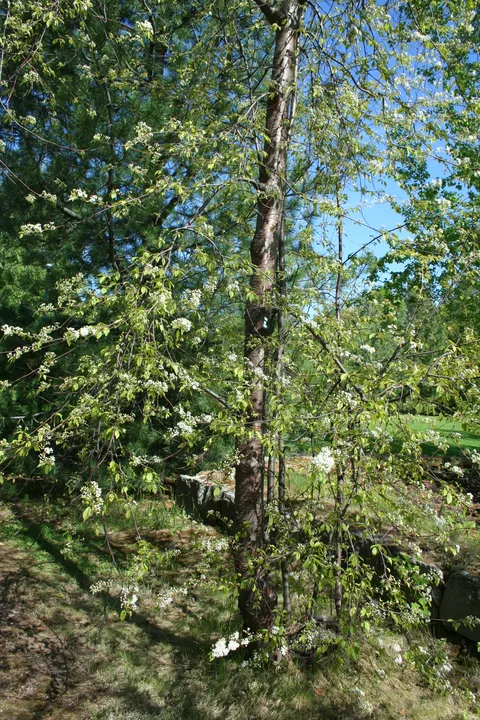
Full Tree
Identification
Leaves
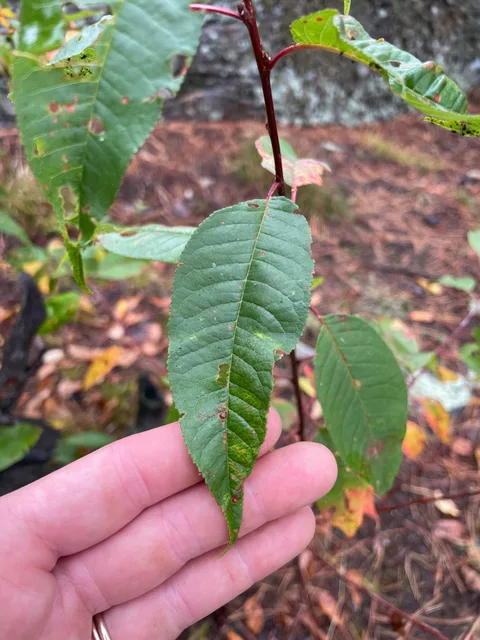
Thin, hairless, shiny yellowish-green leaves 8-15 cm (3-6 in) long, narrow and lance-shaped with a long fine tip and tiny uneven teeth. They often arch backward and fold up along the midrib, and turn bright purplish-red in fall.
Leaves
Bark
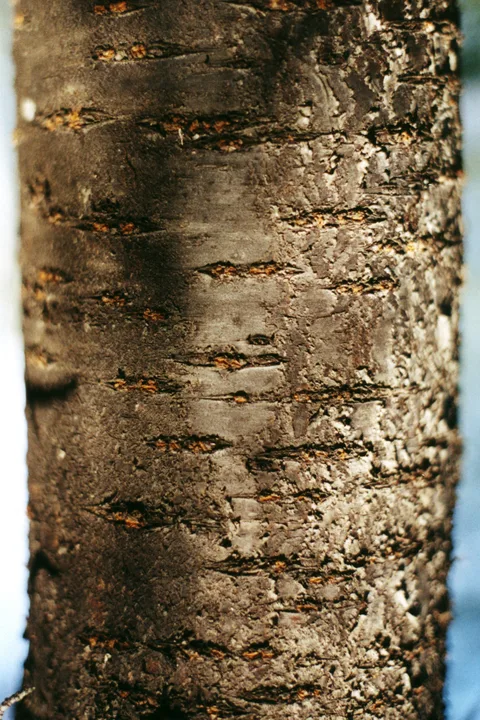
Smooth, shiny dark reddish-brown bark marked with large, widely spaced, horizontal orange lenticels. With age it peels in thin horizontal papery strips, a little like birch.
Bark
Flowers
White, long-stalked flowers in small tassel-like clusters of 4-7, opening in spring when the leaves are about half grown.
Fruit
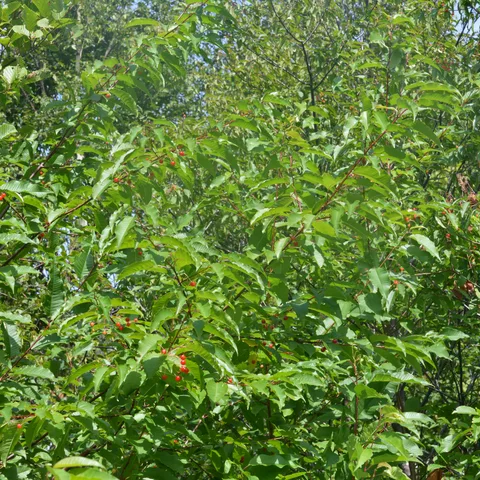
Bright red cherries 6-8 mm (about 1/4 in) across on long slender stalks, produced in abundance and ripening from late July to early September. The thin flesh is edible but sour and is used for jelly and syrup. More than 25 bird species eat them, which is why it is also called bird cherry.
Valuable wildlife food source
Growing Conditions
Climate
Very cold-hardy and comfortable in zone 5b. It needs full sun and grows on poor, sandy or rocky soils as well as better loams, which suits the thin soils over Shield bedrock. It is short-lived and its soft wood does not stand up well to ice loading.
Hardiness Zones: 2a, 2b, 3a, 3b, 4a, 4b, 5a, 5b
Light Requirements
Soil
Moisture: dry, moist
Drainage: well-drained, moderate
pH Range: 4.5 - 7
Tolerance
Care & Maintenance
Pruning
Best Season: Winter
Frequency: Little needed beyond removing black knots and dead wood
- Prune in late winter, when black knots are easy to see and before spring spore release
- Cut infected branches 15-20 cm (6-8 in) below each knot and disinfect tools between cuts
- Remove dead stems as the short-lived tree declines rather than waiting for them to fall
- Expect root suckers; cut them at the base if you want to keep a single stem
Avoid: Wet spring weather, when black knot spores infect new shoots
Watering
Establishment: Water through the first growing season
Mature: Tolerates dry, sandy and rocky ground once established
Seasonal Care Timeline
Spring
- White flower tassels as the leaves expand
- Tent caterpillar tents in branch forks
- Black knot spore release in wet weather
Summer
- Bright red cherries ripen from late July; birds strip them quickly
- Cherry leaf spot and early yellowing
- Uglynest caterpillar nests
Fall
- Purplish-red fall colour
- Look for dead tops on older stems before leaf drop
Winter
- Best time to cut out black knots
- Ice can break soft, aging stems
Common Issues
Black Knot
ModerateFungal disease (Apiosporina morbosa) described in the USDA silvics manual as the most widespread and commonly observed disease of pin cherry. Spores released from old knots in wet spring weather infect new shoots, and the black gall appears the following year.
Symptoms: Hard, rough, coal-black galls along twigs and branches, Olive-green swellings on one-year-old infections, Dieback of branches beyond a girdling knot
Treatment: Prune out knots in late winter, 15-20 cm (6-8 in) below the gall, and burn, bury or remove the prunings. Heavily knotted trees are usually not worth saving.
Prevention: Annual winter inspection and removal of knots; take out badly infected wild cherries close to garden plums and cherries.
Tent Caterpillars and Uglynest Caterpillar
LowThe uglynest caterpillar is a major leaf feeder on pin cherry, tying leaves together into messy nests, and the eastern tent caterpillar occasionally builds its silk tents in it in spring.
Symptoms: Silk tents in branch forks in May, Leaves tied together with silk and frass later in summer, Patchy defoliation
Treatment: Prune out or pull down nests and tents; damage is usually cosmetic.
Prevention: Remove tent caterpillar egg bands from twigs in winter.
Cherry Leaf Spot
LowFungal leaf spot (Coccomyces hiemalis), the most common leaf disease of pin cherry. Repeated attacks reduce vigour.
Symptoms: Purplish to brown spots that drop out, leaving shot holes, Yellowing leaves, Early leaf drop in summer
Treatment: Rake and remove fallen leaves; no treatment is usually needed.
Prevention: Good air flow and sanitation of fallen leaves.
Trunk Rot and Natural Decline
ModeratePin cherry rarely lives much past 30-40 years. Older stems develop trunk rot, including white spongy rot from the tinder conk, and decline as longer-lived trees overtop them.
Symptoms: Hoof-shaped conks on the trunk, Soft, stringy or discoloured wood at wounds, Thinning crown and dead tops in older stems
Treatment: Remove declining stems near buildings, paths and play areas.
Prevention: Plant longer-lived natives nearby so they are ready to take over.
Professional arborist recommended
Sources & References
Information compiled from the following authoritative sources:
Quick Facts
When to Call an Arborist
Recommended inspection: Every few years once trees pass 20 years old, or after storms
- •Conks or soft rot on the trunk
- •Dead tops or large dead limbs over a structure or path
- •Heavy black knot on main stems
- •Leaning stems on a cottage or lot clearing edge
Free consultation for Belleville residents
Recommended Services
Based on Pin Cherry characteristics