
Chokecherry
Prunus virginiana
Overview
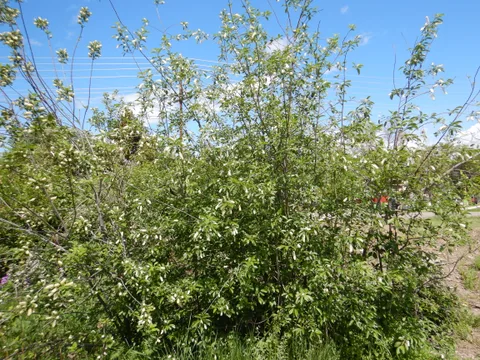
Chokecherry is found throughout southern Ontario and on the Canadian Shield. Around Belleville it is a familiar shrub-tree of fencerows, field edges, ditches, stream banks and the edges of woodlots, both on the clay and limestone of the Bay of Quinte lowlands and on rocky ground north toward the Shield. It is a good native wildlife plant, but around homes the usual calls are for black knot, thickets of suckers, weak stems over driveways, and branches along pasture fences where livestock could eat the leaves.
The very sour, astringent cherries have long been used for jelly and syrup, and early settlers used the plant medicinally. The common name probably comes from the puckering taste of the fruit.
Full Tree
Identification
Leaves
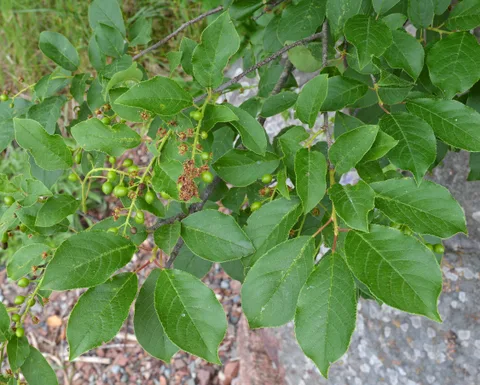
Thin, dull green oval leaves 5-10 cm (2-4 in) long, paler underneath, with fine sharp teeth that each end in a tiny hair-like point. One or two small glands sit at the base of the blade, and there may be small tufts of hair in the vein angles underneath. Bruised twigs and leaves give off a strong bitter-almond smell.
Leaves
Bark
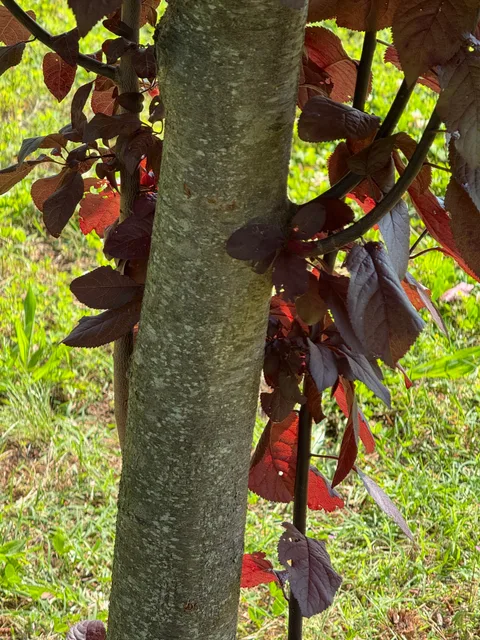
Dark greyish-brown bark that stays smooth or breaks into fine scales and becomes almost black on older stems. The lenticels are prominent but not drawn out horizontally, which helps separate it from pin cherry and black cherry.
Bark
Flowers
Small white flowers in dense, elongated clusters 8-15 cm (3-6 in) long at the ends of short leafy shoots, opening in late spring before the new leaves are fully grown. Showy for a week or two along roadsides and fencerows.
Fruit
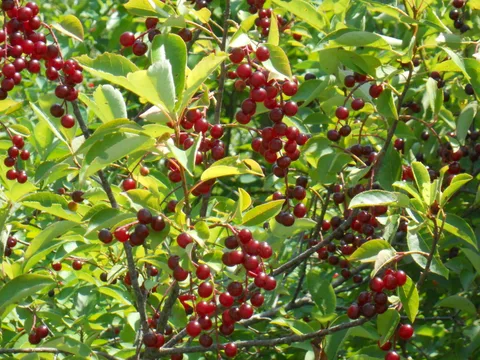
Drooping clusters of 6-12 cherries, each 8-10 mm (about 3/8 in) across, ripening in August or early September. Colour varies from tree to tree, from yellow through crimson to nearly black. The flesh is edible but very astringent and is used for jelly and syrup; the pits are toxic if eaten in quantity.
Valuable wildlife food source
Growing Conditions
Climate
Very cold-hardy and well suited to Belleville's zone 5b climate. It adapts to many soils, grows best in moist soil and full sun, and tolerates partial shade. It does well on heavy Quinte clays as long as they are not waterlogged. Its weak branches make it prone to snow, ice and wind breakage.
Hardiness Zones: 2a, 2b, 3a, 3b, 4a, 4b, 5a, 5b
Light Requirements
Soil
Moisture: moist, dry
Drainage: well-drained, moderate
pH Range: 6 - 8
Tolerance
Care & Maintenance
Pruning
Best Season: Winter
Frequency: Every winter where black knot is present; otherwise as needed
- Prune in late winter, when black knots are easy to see and before spores are released in spring
- Cut infected branches 15-20 cm (6-8 in) below the visible knot, since the fungus grows beyond its edge
- Disinfect pruners between cuts and burn, bury or remove the knots from the property; cut knots can still release spores
- Remove root suckers at the base to keep a single-stem tree and stop a thicket forming
- Do not leave trimmed branches where horses, cattle, sheep or goats can eat the leaves
Avoid: Wet spring weather, when black knot spores are released and new shoots are infected; Leaving brush piles with wilted leaves near livestock in any season
Watering
Establishment: Water weekly through the first two growing seasons
Mature: Tolerant once established; grows best in moist soils
Seasonal Care Timeline
Spring
- Eastern tent caterpillar tents in branch forks as buds open
- Black knot spores released in wet spring weather
- White flower clusters open before the leaves are fully grown
Summer
- Cherries ripen in August and early September and are quickly taken by birds
- New black knot swellings on twigs
- Keep cut branches away from livestock
Fall
- Leaves turn yellow before dropping
- Black knots become easy to spot once the leaves drop
- Suckers can be cut back after leaf fall
Winter
- Best time to prune out black knots
- Snip off tent caterpillar egg bands on twigs
- Weak stems can break under ice and heavy snow
Common Issues
Black Knot
ModerateFungal disease (Apiosporina morbosa) of cherries and plums. Chokecherry is a common host, and wild chokecherry and other wild cherries in fencerows are a source of spores that infect nearby plums and cherries. Infection happens in spring, but the knot only becomes obvious the following year, so the disease cycle takes about two years.
Symptoms: Soft olive-green swellings on young twigs in the first year, Rough, hard, coal-black elongated galls that can encircle the branch, Wilting and dieback of the branch beyond a knot, Old knots turning white or pink in late summer as other fungi colonize them
Treatment: Prune out knots in late winter, cutting 15-20 cm (6-8 in) below each gall and disinfecting tools between cuts. It can take two winters to catch infections that were too small to see. Badly infected or girdled trees are often better removed.
Prevention: Inspect every winter, remove knots before spring, destroy prunings and remove heavily infected wild cherries near valued fruit trees.
Eastern Tent Caterpillar
LowCaterpillars (Malacosoma americanum) hatch as cherry buds break in spring and build silk tents in branch forks. Wild cherry is a favoured host. There is one generation a year, and the eggs overwinter as shiny dark bands wrapped around small twigs.
Symptoms: White silk tents in branch crotches in May, Leaves eaten away as they emerge, so the tree can look as if it never leafed out, Hairy black caterpillars with a white back stripe and blue and gold markings, Dark, varnished egg bands around twigs in winter
Treatment: Pull tents down with a stick and destroy the caterpillars; never burn tents in the tree. Healthy trees usually re-leaf.
Prevention: Snip off and destroy the egg bands in winter, before they hatch.
Livestock Poisoning From Leaves
HighAll parts of the tree except the fruit flesh contain cyanogenic compounds. Fresh and wilted leaves are poisonous to livestock, and cattle have been poisoned by eating leaves on branches trimmed from chokecherry trees.
Symptoms: Sudden laboured breathing, salivation, muscle tremors or convulsions in animals that ate the leaves, Death can follow within minutes of eating a large amount
Treatment: Call a veterinarian immediately.
Prevention: Keep chokecherry out of pastures and paddocks, and never leave pruned or storm-broken branches where livestock can reach them.
Storm Breakage
LowOntario's Tree Atlas warns that chokecherry branches are weak and break easily in storms.
Symptoms: Split or torn stems after wind, snow or ice, Leaning or crooked stems over driveways and fences
Treatment: Cut broken stems back cleanly to a sound fork or to the ground; the plant will resprout.
Prevention: Keep stems thinned and away from roofs, lines and walkways.
Sources & References
Information compiled from the following authoritative sources:
Quick Facts
When to Call an Arborist
Recommended inspection: A winter look each year for black knot; arborist visit when stems overhang buildings, lines or paddocks
- •Black knots on large limbs or the main trunk
- •Stems leaning toward the house, driveway or power lines
- •A thicket spreading by suckers into beds or lawns
- •Chokecherry growing along a pasture or horse paddock fence
- •Storm-split stems
Free consultation for Belleville residents
Recommended Services
Based on Chokecherry characteristics