
White Oak
Quercus alba
Active Threats to White Oak
LDD Moth (Spongy Moth)
Formerly known as Gypsy Moth. Caterpillars defoliate trees in late spring, with periodic outbreak years causing severe damage.
Signs to watch for:
- •Visible caterpillars with blue and red spots
- •Skeletonized or completely eaten leaves
- •Egg masses on tree trunks (tan, fuzzy patches)
- •Frass (caterpillar droppings) under trees
Recommended Action: Healthy trees typically survive defoliation. Repeated years of heavy feeding may require professional intervention.
Free consultation available
Oak Wilt
Deadly fungal disease spreading north through Ontario. Red oaks are most susceptible and can die within weeks.
Signs to watch for:
- •Rapid wilting starting at leaf edges
- •Leaves turning bronze or brown
- •Defoliation from top of crown down
- •Fungal mats under bark with fruity odor
Recommended Action: Do NOT prune oaks from April through July. If oak wilt is suspected, contact an arborist immediately.
Free consultation available
Overview
Native across Southern Ontario, including the Quinte region, where it grows mainly in woodlots and on well-drained ground; it is planted far less often than red or bur oak in Belleville yards. Old open-grown white oaks on rural properties are often a century or more old and worth real effort to protect.
Also called stave oak: its waterproof, durable wood made the barrels, casks and ship timbers of 19th-century Ontario, and it is still prized for whisky barrels, flooring and furniture.
Full Tree
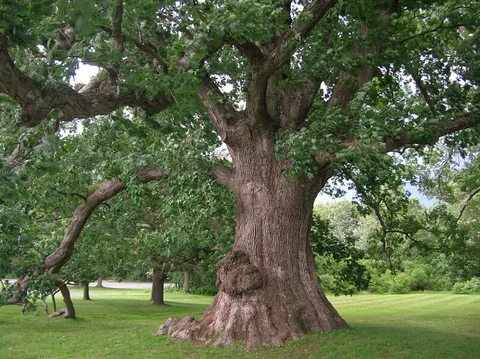
Identification
Leaves
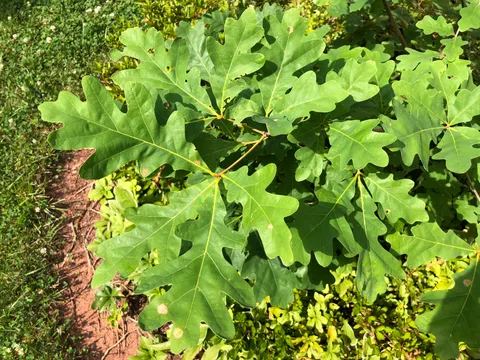
Bright green leaves with paler undersides and 7-9 rounded, finger-like lobes separated by notches that can be shallow or cut almost to the midrib. The lobes have no bristle tips, which separates white oak from red oak at a glance. New leaves are pinkish and downy when they unfold. Fall colour is inconsistent but often a deep red-purple, and dead brown leaves frequently hang on young trees into winter.
Leaves
Bark
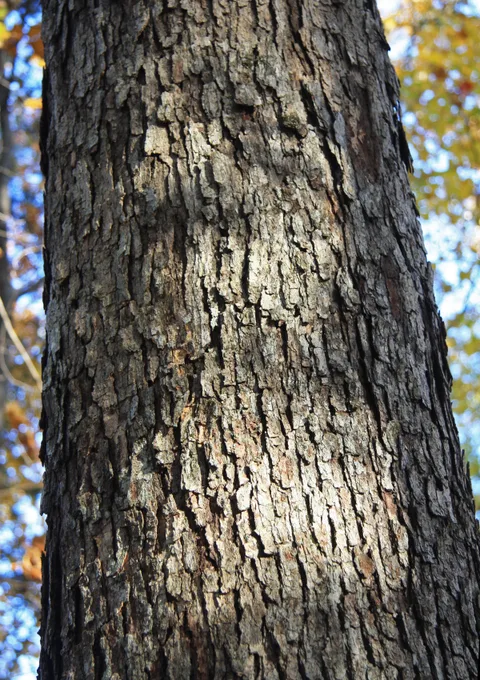
The palest bark of any native oak: whitish to light grey, often with a slight reddish cast, breaking into long, loose scales or squarish plates that flake at the edges. The shaggy, flaky look is the easiest way to pick out a mature white oak in a woodlot.
Bark
Flowers
Male flowers hang in long, slim, yellow-green to green-brown catkins that appear with the new leaves in May. Female flowers are tiny and inconspicuous, borne singly or in small clusters near the shoot tips. Wind pollinated.
Fruit
Oblong acorns 1.2-2.5 cm (1/2-1 in) long, sitting in a shallow, bowl-shaped cup with warty scales that covers about a quarter of the nut. Unlike red oak, white oak acorns ripen in a single season and drop in fall, and they are sweet enough that wildlife eat them first. Big trees can bear 10,000 acorns in a good year, with heavy crops only every few years.
Valuable wildlife food source
Growing Conditions
Climate
Hardy well beyond Belleville's zone 5b and adapted to its hot summers and cold winters. It prefers deep, well-drained, slightly acidic soil, so it tends to do better on the sandier ground toward the Canadian Shield edge north of Hwy 7 than on the wet, limestone-derived clays of the Bay of Quinte lowlands, where poor drainage and high pH can cause decline and yellowing leaves. Dense, strong wood generally holds up to wind and ice better than fast-growing trees, though long horizontal limbs on open-grown trees can still fail under ice.
Hardiness Zones: 3, 4a, 4b, 5a, 5b
Light Requirements
Soil
Moisture: moist, dry
Drainage: well-drained, moderate
pH Range: 5 - 7
Tolerance
Care & Maintenance
Pruning
Best Season: Winter
Frequency: Every 5-10 years for young trees; mature trees need only deadwood and hazard work
- Prune only between November and March while the sap beetles that carry oak wilt are inactive
- If an oak is wounded or must be cut between April and July, seal the wound with tree paint right away (oaks are the exception where wound paint is recommended)
- Shape young trees early so one central leader develops and wide-angled scaffold limbs are spaced along the trunk
- Avoid removing large amounts of live crown at once; old white oaks respond poorly to heavy cuts
- Keep firewood from oaks local; moving firewood is one of the ways oak wilt spreads
Avoid: April through July: high-risk period for oak wilt infection (Ontario guidance); Ideally avoid any pruning or wounding from April through November, when sap beetles are active (CFIA and Ontario guidance)
Watering
Establishment: Deep weekly watering for the first 2-3 years; the taproot makes white oak slow to establish after transplanting
Mature: Deep-rooted and moderately drought tolerant once established; does not tolerate wet, poorly drained sites
Seasonal Care Timeline
Spring
- April 1 marks the start of the oak wilt high-risk period: finish any oak pruning by the end of March
- Spongy moth eggs hatch from late April to mid-May; check trees with egg masses
- Late frosts can brown newly opened leaves (can be mistaken for oak wilt; frost damage is patchy, not top-down)
Summer
- Watch for leaves wilting or bronzing from the top of the crown and report suspected oak wilt
- Spongy moth caterpillars feed through June; burlap bands work from mid-May
- Deep-water young and recently disturbed trees during drought
Fall
- Acorns ripen and drop in a single season; heavy crops every few years
- Good time to plan construction protection before spring work
- Dormant-season pruning can begin once sap beetles are inactive (November)
Winter
- Best time for pruning and deadwood removal (November-March)
- Scrape off spongy moth egg masses from trunks and limbs
- Protect young trees from deer browse
Common Issues
Oak Wilt
SevereInvasive fungal disease (Bretziella fagacearum) that blocks the water-conducting sapwood. First confirmed in Canada in 2023 in Niagara Falls and since found in Springwater Township and Niagara-on-the-Lake; it has not been reported in Hastings County. All oaks are hosts. White oaks are less susceptible than red oaks and usually decline more slowly, but they are still hosts and the disease can spread between neighbouring oaks through grafted roots.
Symptoms: Leaves wilting or turning bronze from the tip toward the base, starting at the top of the crown, Early leaf drop in mid to late summer, Scattered branch dieback in the crown, Black streaking in the sapwood under the bark, Grey or black fungal mats under cracked bark with a fruity smell (more typical on red oaks)
Treatment: No cure. Suspected cases should be reported to the Canadian Food Inspection Agency. Confirmed trees are removed and chipped, burned or buried, and root connections to nearby oaks are cut.
Prevention: Do not prune or wound oaks from April through July (ideally April through November); paint any unavoidable wounds immediately; buy and burn firewood locally.
Professional arborist recommended
Spongy Moth (LDD Moth)
ModerateInvasive defoliating caterpillar (Lymantria dispar dispar, formerly gypsy moth) that favours oaks. Outbreaks come every 7-10 years; the outbreak that peaked in 2021 was the largest on record in Ontario. A healthy oak usually releafs, but repeated defoliation weakens it and invites borers and root disease.
Symptoms: Hairy caterpillars with paired blue then red spots on the back, May to early July, Holes in leaves or whole branches stripped bare by late June, Tan, fuzzy egg masses on trunks, limbs, fences and firewood from late July, Droppings (frass) under the tree
Treatment: Scrape egg masses into soapy water from August to mid-April; a biological insecticide (Btk) on young caterpillars from mid-April to mid-May; burlap bands to trap older caterpillars from mid-May through June.
Prevention: Check trunks for egg masses each winter, water trees during drought after defoliation, and have high-value trees assessed in outbreak years.
Construction and Root Zone Damage
HighWhite oak roots are very sensitive to soil compaction, grade changes and trenching. Damage from driveways, additions, septic work or heavy equipment often shows up as slow crown decline several years later, when it can no longer be reversed.
Symptoms: Thinning crown and small, pale leaves, Dieback of upper branches a few years after nearby work, Sprouts along the trunk or main limbs, Secondary borer or root rot problems
Treatment: Mulching, deep watering and deadwood pruning can slow decline; trees with major root loss may become hazardous and need assessment.
Prevention: Fence off the root zone (at least to the drip line) before any construction, never pile soil or park equipment under the crown, and route trenches around rather than through the roots.
Professional arborist recommended
Two-lined Chestnut Borer
ModerateNative beetle whose larvae tunnel under the bark of oaks already stressed by defoliation, drought or root damage, often finishing off a tree weakened by spongy moth.
Symptoms: Branch dieback starting in the upper crown, Leaves on affected limbs wilting and browning in summer, Small D-shaped exit holes in the bark, Winding galleries under loose bark
Treatment: Remove and destroy infested limbs or trees; keep the remaining tree watered and mulched.
Prevention: Reduce stress: protect roots, water in drought and manage spongy moth.
Professional arborist recommended
Anthracnose and Leaf Blister
LowFungal leaf diseases that blotch and curl oak leaves in cool, wet springs. Unsightly but rarely serious on established trees.
Symptoms: Irregular brown blotches along leaf veins, Raised, puckered yellowish blisters on leaves, Some early leaf drop
Treatment: Usually none needed; rake and remove fallen leaves.
Prevention: Thin the crown in the dormant season to improve airflow.
Sources & References
Information compiled from the following authoritative sources:
Quick Facts
When to Call an Arborist
Recommended inspection: Every 2-3 years for large or heritage trees, and before any construction near the root zone
- •Leaves wilting or bronzing from the top down in summer
- •Bark cracks, fungal mats or a fruity smell on the trunk
- •Dieback in the upper crown
- •Heavy spongy moth defoliation two years running
- •Planned digging, grading or paving within the drip line
- •Large limbs over the house with cracks, cavities or decay
Free consultation for Belleville residents
Recommended Services
Based on White Oak characteristics