
Bur Oak
Quercus macrocarpa
Active Threats to Bur Oak
LDD Moth (Spongy Moth)
Formerly known as Gypsy Moth. Caterpillars defoliate trees in late spring, with periodic outbreak years causing severe damage.
Signs to watch for:
- •Visible caterpillars with blue and red spots
- •Skeletonized or completely eaten leaves
- •Egg masses on tree trunks (tan, fuzzy patches)
- •Frass (caterpillar droppings) under trees
Recommended Action: Healthy trees typically survive defoliation. Repeated years of heavy feeding may require professional intervention.
Free consultation available
Oak Wilt
Deadly fungal disease spreading north through Ontario. Red oaks are most susceptible and can die within weeks.
Signs to watch for:
- •Rapid wilting starting at leaf edges
- •Leaves turning bronze or brown
- •Defoliation from top of crown down
- •Fungal mats under bark with fruity odor
Recommended Action: Do NOT prune oaks from April through July. If oak wilt is suspected, contact an arborist immediately.
Free consultation available
Overview
The most common oak in Ontario and one of the best large shade trees for Belleville yards, parks and boulevards. It grows naturally on the kind of ground found around the Bay of Quinte: limestone-derived clays, low spots that flood in spring and thin soils over limestone, where it stays smaller and gnarled.
Its very thick bark let bur oak survive the fires that kept prairies and savannas open, and remnant bur oaks 300-400 years old are still found in old savanna country. The wood has been used for furniture, cabinetry and flooring.
Full Tree
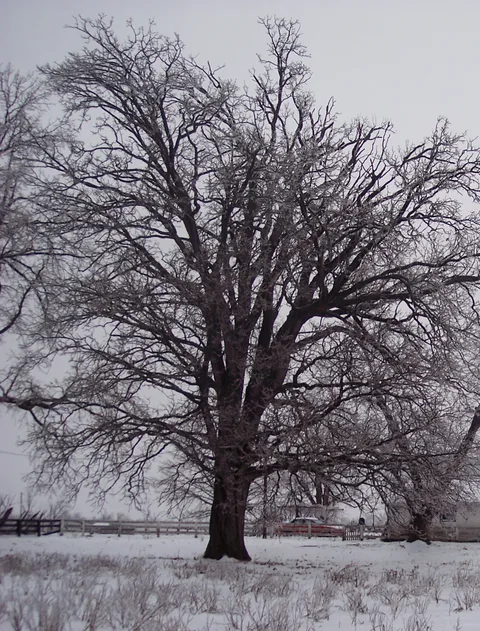
Identification
Leaves
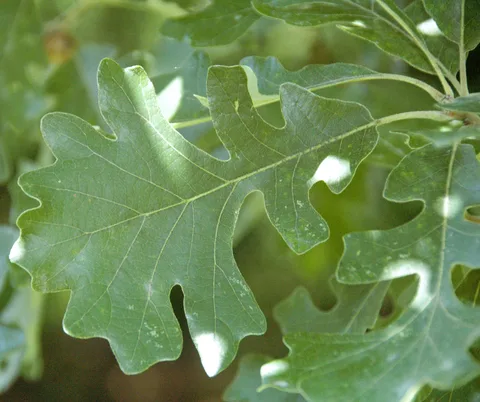
Large leaves, often the biggest of any native oak, shiny dark green above and pale and fuzzy underneath. The typical leaf is fiddle-shaped: two deep notches near the middle split a wide, wavy-lobed upper half from a narrower base with a few short rounded lobes. Some leaves look more like white oak, with 7-9 deep lobes. Lobes are rounded with no bristle tips. Fall colour is a muted yellow-brown.
Leaves
Bark
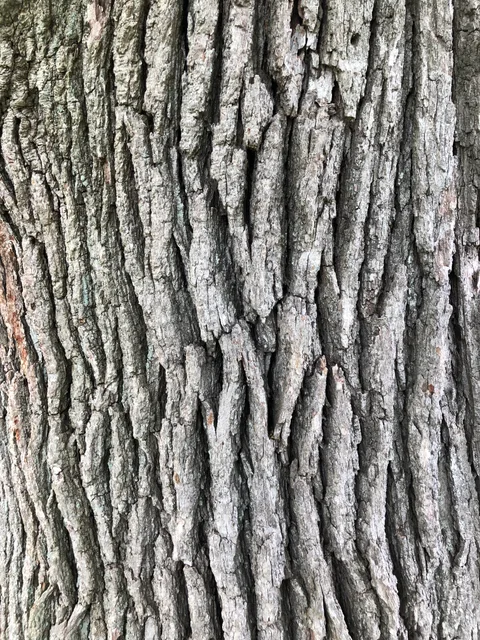
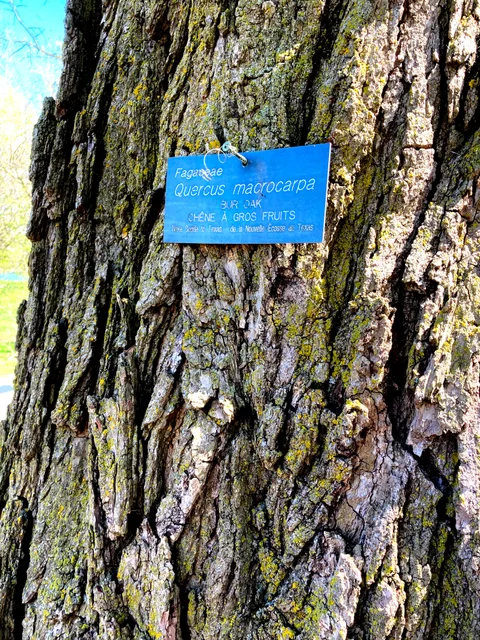
Thick, dark grey bark with deep furrows and rough, irregular ridges, one of the thickest barks of any eastern tree. It helps bur oaks survive fires, which is how they held their ground in prairies and oak savannas.
Bark
Flowers
Long, green to yellow-green male catkins hang from the twigs as the leaves open in May; the female flowers are tiny and borne singly or in small clusters near the shoot tips. Wind pollinated.
Fruit
The largest acorns of any native Canadian oak, 1.5-3 cm (5/8-1 1/4 in) long, set deep in a cup that covers half to two-thirds of the nut. The cup's upper scales end in long, loose bristles, giving the 'mossy' or 'burred' fringe that names the tree. Acorns ripen in one season and drop in early fall; heavy crops come every 2-3 years and feed squirrels, deer, wild turkeys and bears.
Valuable wildlife food source
Growing Conditions
Climate
One of the toughest native trees for Eastern Ontario: hardy to zone 2-3, tolerant of drought, heavy alkaline clay, compacted city soil and air pollution, and of both wet and dry sites. Its deep taproot anchors it well against wind. Strong wood holds up to ice better than fast-growing species, though long horizontal limbs on old open-grown trees can still fail under heavy ice.
Hardiness Zones: 2, 3, 4a, 4b, 5a, 5b
Light Requirements
Soil
Moisture: dry, moist, wet
Drainage: well-drained, moderate, poor
pH Range: 5.5 - 8
Tolerance
Care & Maintenance
Pruning
Best Season: Winter
Frequency: Structural pruning every 3-5 years while young; mature trees need only deadwood and clearance work
- Prune only between November and March, outside the oak wilt high-risk period
- If an oak is wounded or must be cut between April and July, paint the wound right away (oaks are the exception where wound paint is recommended)
- Train young trees to one strong leader; bur oak's low, heavy limbs grow wide and are hard to correct later
- Raise the lower crown gradually over several years for driveway, sidewalk or roof clearance rather than in one heavy cut
- Keep oak firewood local to avoid spreading oak wilt
Avoid: April through July: high-risk period for oak wilt infection (Ontario guidance); Ideally avoid any pruning or wounding from April through November, when sap beetles are active (CFIA and Ontario guidance)
Watering
Establishment: Deep weekly watering for the first 2-3 years; plant small nursery stock, since the fast-growing taproot makes large trees hard to move
Mature: Very drought tolerant once the taproot is established; also tolerates occasional flooding but not standing water for long periods
Seasonal Care Timeline
Spring
- Finish any oak pruning by the end of March, before the oak wilt high-risk period
- Spongy moth eggs hatch late April to mid-May
- Low-lying trees can sit in spring meltwater; short flooding is tolerated
Summer
- Watch for wilting or bronzing from the top of the crown and report suspected oak wilt
- Spongy moth caterpillars feed through June
- Galls on leaves are common and usually harmless
Fall
- Heavy acorn drops every 2-3 years; large acorns can be a nuisance on patios and driveways
- Good time to plan root-zone protection for spring construction
Winter
- Prune between November and March
- Scrape spongy moth egg masses off bark
- The corky twigs and fringed acorn cups make winter identification easy
Common Issues
Oak Wilt
SevereInvasive fungal disease (Bretziella fagacearum) confirmed in Ontario since 2023 (Niagara Falls, Springwater Township and Niagara-on-the-Lake; not reported in Hastings County). It is less serious in bur oak than in red oaks, but it does infect bur oak and can move tree to tree through grafted roots, so groups of bur oaks have been lost where the disease is established.
Symptoms: Leaves wilting or bronzing from the tip inward, starting at the top of the crown, Scattered branch dieback and early leaf drop in summer, Dark streaking in the sapwood, Bark cracks over fungal mats on dead trees
Treatment: No cure. Report suspected cases to the Canadian Food Inspection Agency. Infected trees are removed and chipped, burned or buried, and root grafts to nearby oaks are cut.
Prevention: No pruning or wounding from April through July (ideally April through November); paint unavoidable wounds immediately; do not move firewood.
Professional arborist recommended
Spongy Moth (LDD Moth)
ModerateInvasive caterpillar (Lymantria dispar dispar, formerly gypsy moth) for which oaks are a favoured host. Outbreaks cycle every 7-10 years; the one that peaked in 2021 was the largest on record in Ontario. Bur oaks usually releaf, but repeated defoliation saps reserves and opens the door to borers.
Symptoms: Hairy caterpillars with paired blue then red spots, May to early July, Ragged or stripped foliage by late June, Tan, fuzzy egg masses on bark, fences and firewood from late July, Frass dropping from the crown
Treatment: Remove egg masses August to mid-April; biological insecticide (Btk) on young caterpillars mid-April to mid-May; burlap bands mid-May through June.
Prevention: Winter egg mass checks, and watering trees through drought in defoliation years.
Oak Galls and Kermes Scale
LowMany small gall wasps make round or fuzzy galls on bur oak leaves and twigs, and kermes scales (round, bead-like insects) settle on twigs. Galls are almost always cosmetic; heavy scale or twig-gall loads can cause tip dieback on young or stressed trees.
Symptoms: Round, fuzzy or bead-like growths on leaves or petioles, Woody swellings on twigs, Small round scales at twig forks, Flagging (browned) twig tips in summer
Treatment: Usually none; prune out heavily infested twigs in the dormant season.
Prevention: Keep trees vigorous with mulch and drought watering.
Root Zone Disturbance
ModerateBur oak copes with compacted urban soil better than most oaks, but it still resents grade changes, trenching and paving over its roots. Its deep roots also mean it should not be planted close to septic beds, drain tiles or underground pipes.
Symptoms: Thinning crown or dieback a few years after nearby construction, Small, sparse leaves, Sprouts along the trunk
Treatment: Mulch, water in drought and remove deadwood; assess large trees with major root loss for stability.
Prevention: Fence off the root zone to at least the drip line before work, and site new trees well away from buried services.
Professional arborist recommended
Anthracnose and Powdery Mildew
LowFungal leaf diseases that brown or dust the foliage in cool, wet springs or humid summers. Cosmetic on established trees.
Symptoms: Brown blotches along the veins, White powdery coating on leaves, Some early leaf drop
Treatment: None needed on established trees; clean up fallen leaves.
Prevention: Plant in full sun with good airflow.
Sources & References
Information compiled from the following authoritative sources:
Quick Facts
When to Call an Arborist
Recommended inspection: Every 3-5 years for mature yard trees, and before any construction near the roots
- •Leaves wilting or bronzing from the top down in summer
- •Dieback in the upper crown
- •Heavy spongy moth defoliation two years running
- •Cracks, cavities or decay in large horizontal limbs over buildings
- •Planned digging, grading or paving within the drip line
Free consultation for Belleville residents
Recommended Services
Based on Bur Oak characteristics