
Pin Oak
Quercus palustris
Active Threats to Pin Oak
LDD Moth (Spongy Moth)
Formerly known as Gypsy Moth. Caterpillars defoliate trees in late spring, with periodic outbreak years causing severe damage.
Signs to watch for:
- •Visible caterpillars with blue and red spots
- •Skeletonized or completely eaten leaves
- •Egg masses on tree trunks (tan, fuzzy patches)
- •Frass (caterpillar droppings) under trees
Recommended Action: Healthy trees typically survive defoliation. Repeated years of heavy feeding may require professional intervention.
Free consultation available
Oak Wilt
Deadly fungal disease spreading north through Ontario. Red oaks are most susceptible and can die within weeks.
Signs to watch for:
- •Rapid wilting starting at leaf edges
- •Leaves turning bronze or brown
- •Defoliation from top of crown down
- •Fungal mats under bark with fruity odor
Recommended Action: Do NOT prune oaks from April through July. If oak wilt is suspected, contact an arborist immediately.
Free consultation available
Overview
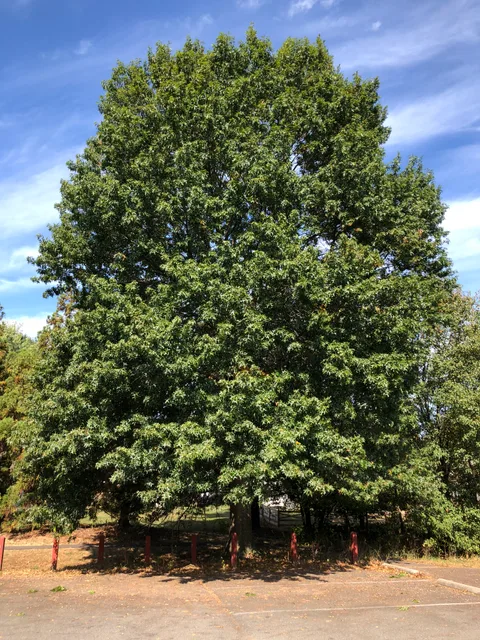
Pin oak is native to Ontario only in the Carolinian zone in the far south-west of the province. The pin oaks in Belleville and the Quinte area are planted: it has long been used as a street, park and yard tree beyond its natural range because it grows fast, transplants easily and has a neat pyramidal shape when young.
Also called swamp oak. In its native range it forms nearly pure stands on wet, poorly drained 'pin oak flats'. The wood is hard and strong and is used for flooring, cabinetry, trim and veneer.
Full Tree
Identification
Leaves
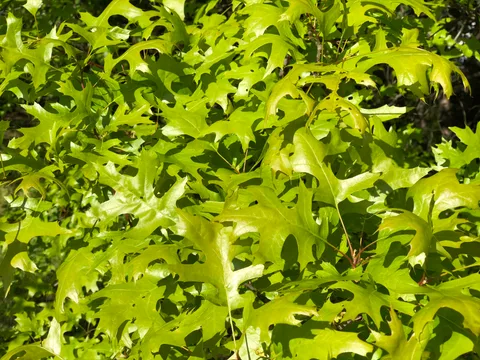
Glossy dark green leaves with 5 to 7 slender, bristle-tipped lobes cut almost to the midrib by wide, rounded notches. They are smaller and more deeply cut than red oak leaves. In fall they turn russet to red, or bronze. On alkaline soil the leaves often turn pale yellow between dark green veins in summer (iron chlorosis), which is the most common problem with this tree in Belleville.
Leaves
Bark
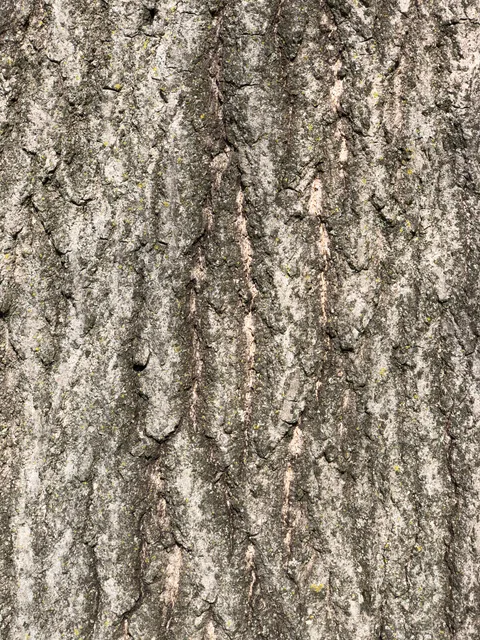
Bark is thin, smooth and greyish-brown on young trees and develops low ridges with age; the inner bark is reddish. The thin bark is easily wounded by mowers, string trimmers and construction, and wounds are entry points for decay and, from April to July, for oak wilt.
Bark
Flowers
Hanging yellow-green male catkins and tiny female flowers open with the new leaves in spring. They are wind-pollinated and easy to miss.
Fruit
Small, nearly round acorns 9-13 mm (about 1/2 inch) long with a short point at the tip and a thin, saucer-like reddish-brown cap covering about a quarter of the nut. Like all red-group oaks it takes two growing seasons to ripen its acorns. Deer, wild turkey, squirrels and ducks eat them. Open-grown trees start producing at about 15-20 years.
Valuable wildlife food source
Growing Conditions
Climate
Hardy in Belleville's zone 5b and comfortable with hot, humid summers. The limit here is soil, not climate: pin oak wants acidic, moist soil, and the limestone-derived clays of the Bay of Quinte lowlands are often alkaline, so many local pin oaks show yellow, chlorotic leaves. It tolerates the wet, poorly drained clay and occasional flooding that many trees dislike. Trees on more acidic, sandy ground toward the Canadian Shield edge north of Hwy 7 usually have fewer chlorosis problems.
Hardiness Zones: 4a, 4b, 5a, 5b, 6a, 6b
Light Requirements
Soil
Moisture: moist, wet
Drainage: moderate, poor, well-drained
pH Range: 5 - 6.5
Tolerance
Care & Maintenance
Pruning
Best Season: Winter
Frequency: Every 3-5 years on street and yard trees to lift drooping lower limbs; otherwise deadwood only
- Prune only from November to the end of March; Ontario advises against pruning or wounding oaks from April through July, and ideally through November, because of oak wilt
- Plan for regular crown raising: the lower branches naturally droop and die and will hang over sidewalks, driveways and roofs
- Remove dead lower limbs back to the trunk collar rather than leaving stubs
- Train young trees to a single central leader; the natural form is strongly pyramidal
- If a branch is torn during the high-risk period, have the wound painted right away
Avoid: April through July (oak wilt high-risk period); Ideally avoid any oak wounding from April through November
Watering
Establishment: Water deeply once a week for the first two to three growing seasons; pin oak transplants easily but dislikes drying out
Mature: Prefers consistently moist soil and tolerates seasonally wet ground, but not standing water through the growing season
Seasonal Care Timeline
Spring
- April 1 marks the start of the oak wilt high-risk period: finish oak pruning by the end of March
- Watch new leaves for yellowing between the veins (iron chlorosis); early is the best time to plan treatment
- Spongy moth eggs hatch from late April to mid-May
Summer
- Chlorosis symptoms peak: yellow leaves, scorched edges
- Watch for leaves wilting or bronzing from the top of the crown and report suspected oak wilt
- Sawfly larvae skeletonizing leaves in some years
- Deep-water during dry spells
Fall
- Small acorns drop; two-year cycle means good and poor crops alternate
- Russet to red fall colour, or bronze
- Plan winter pruning to lift drooping lower limbs
Winter
- Best time to prune (November-March), including raising lower limbs over walks and drives
- Check for limbs broken by ice or snow after winter storms
- Scrape off spongy moth egg masses
Common Issues
Iron Chlorosis
HighPin oak cannot take up enough iron from alkaline soil (pH above about 7 to 7.5), even when iron is present. It is the main reason extension services no longer recommend pin oak for high-pH sites, and it is common on the limestone-derived clays around the Bay of Quinte.
Symptoms: Pale yellow leaves with dark green veins, Brown spots and scorched, curled leaf edges in summer, Leaves fading to almost white in severe cases, Small leaves and twig and branch dieback over several years
Treatment: Trunk injection of iron works fastest but is temporary (often 1-3 years) and wounds the trunk, so it is best kept for high-value trees and done before April for oaks. Soil treatments with iron chelates or sulfur last a few years but do not permanently change soil pH. Badly declining trees on very alkaline sites may be better replaced.
Prevention: Do not plant pin oak on alkaline or limy clay soil; test soil pH first. On high-pH sites choose bur oak, white oak or another species that tolerates alkaline soil.
Professional arborist recommended
Oak Wilt
SevereInvasive fungal disease (Bretziella fagacearum) that blocks the water-conducting sapwood. Pin oak is in the red oak group, which is the most susceptible: red oaks can die within one season. Confirmed in Ontario since 2023 in Niagara Falls, Springwater Township and Niagara-on-the-Lake; it has not been reported in Hastings County. Sap beetles carry spores to fresh wounds, and it spreads between neighbouring oaks through grafted roots.
Symptoms: Leaves wilting or turning bronze from the tip toward the base, starting at the top of the crown, Early leaf drop in mid to late summer, Black streaking in the sapwood, Grey or black fungal mats under cracked bark with a fruity smell
Treatment: No cure. Report suspected trees to the Canadian Food Inspection Agency. Infected trees are removed and disposed of, and root connections to nearby oaks are cut.
Prevention: No pruning or wounding of oaks from April through July (ideally through November); paint unavoidable wounds immediately; do not move oak firewood.
Professional arborist recommended
Spongy Moth (LDD Moth)
ModerateInvasive defoliating caterpillar (Lymantria dispar dispar, formerly gypsy moth). Oaks are favoured hosts. Outbreaks come and go: Ontario mapped about 58,000 hectares of defoliation in 2022, falling to about 2,500 hectares in 2023.
Symptoms: Hairy caterpillars with paired blue then red spots on the back, May to early July, Holes in leaves or branches stripped bare by late June, Tan, fuzzy egg masses on trunks, limbs and fences from late July
Treatment: Scrape egg masses into soapy water from August to mid-April; a biological insecticide (Btk) on young caterpillars from mid-April to mid-May; burlap bands to trap older caterpillars from mid-May through June.
Prevention: Check trunks for egg masses each winter and water trees during drought after defoliation, especially if they are already chlorotic.
Pin Oak Sawfly and Oak Slug Sawflies
LowNative sawflies whose slug-like larvae feed in groups on the undersides of oak leaves, including pin oak. They eat everything except the veins and upper skin, leaving skeletonized, papery leaves. Outbreaks are sporadic and healthy trees usually recover without treatment.
Symptoms: Glistening, slimy, pale green larvae on leaf undersides, Leaves with whitish windows that turn brown and fall out, leaving a lacy vein skeleton, Browned patches in the crown in mid to late summer
Treatment: Usually none needed. On small or already stressed trees in a heavy year, an arborist can advise on a targeted treatment.
Prevention: Keep trees vigorous with mulch and watering in drought; natural enemies normally keep populations in check.
Sources & References
Information compiled from the following authoritative sources:
Quick Facts
When to Call an Arborist
Recommended inspection: Every 2-3 years, and promptly if leaves yellow or the crown thins
- •Yellow leaves with green veins, or scorched leaf edges, by early summer
- •Leaves wilting or bronzing from the top of the crown in summer (possible oak wilt; report it)
- •Dead lower limbs hanging over sidewalks, driveways or roofs
- •Branch dieback in the upper crown
- •Bark wounds, cracks or fungal growth on the trunk
- •Construction, trenching or grade changes planned near the tree
Free consultation for Belleville residents
Recommended Services
Based on Pin Oak characteristics