
Black Oak
Quercus velutina
Active Threats to Black Oak
LDD Moth (Spongy Moth)
Formerly known as Gypsy Moth. Caterpillars defoliate trees in late spring, with periodic outbreak years causing severe damage.
Signs to watch for:
- •Visible caterpillars with blue and red spots
- •Skeletonized or completely eaten leaves
- •Egg masses on tree trunks (tan, fuzzy patches)
- •Frass (caterpillar droppings) under trees
Recommended Action: Healthy trees typically survive defoliation. Repeated years of heavy feeding may require professional intervention.
Free consultation available
Oak Wilt
Deadly fungal disease spreading north through Ontario. Red oaks are most susceptible and can die within weeks.
Signs to watch for:
- •Rapid wilting starting at leaf edges
- •Leaves turning bronze or brown
- •Defoliation from top of crown down
- •Fungal mats under bark with fruity odor
Recommended Action: Do NOT prune oaks from April through July. If oak wilt is suspected, contact an arborist immediately.
Free consultation available
Overview
Native to Southern Ontario north of Lakes Erie and Ontario, mainly in the southwest and on dry, sandy or gravelly ground; it is not a common tree around Belleville. The best-known stands nearest the Quinte area are on the sand plains south of Rice Lake (the Rice Lake Plains, home of the Alderville First Nation Black Oak Savanna). Locally it is most likely to turn up on dry, sandy or rocky, sun-exposed sites. Because it hybridizes with the much more common red oak, Wilsaw Tree Service can help confirm whether a tree is black oak, red oak or a cross; all of them need the same oak wilt precautions.
Its inner bark holds a yellow pigment, quercitron, used to make yellow dye; black oak products were traded commercially as early as 1800. The hard, strong wood is used for furniture, flooring, veneer and interior trim.
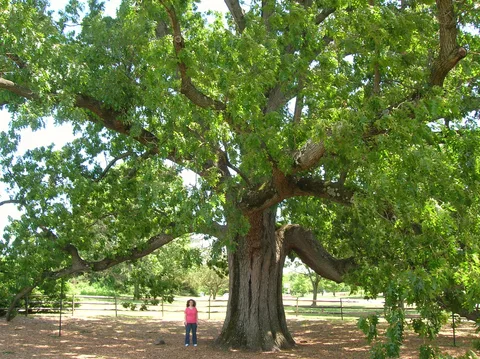
Full Tree
Identification
Leaves
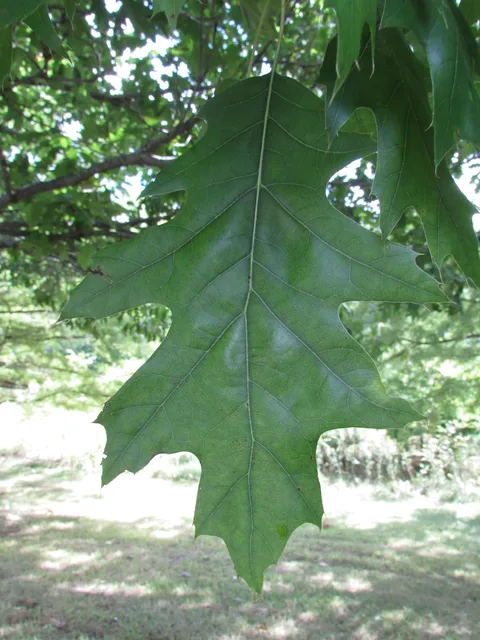
Leaves with 5-7 bristle-tipped lobes separated by U-shaped notches; the lobes are often wider at the tip than at the base. The upper surface is a shiny dark green and the underside is yellowish to yellowish-brown. The bristle tips put it in the red oak group alongside red oak, so check the buds and inner bark to tell the two apart.
Leaves
Bark
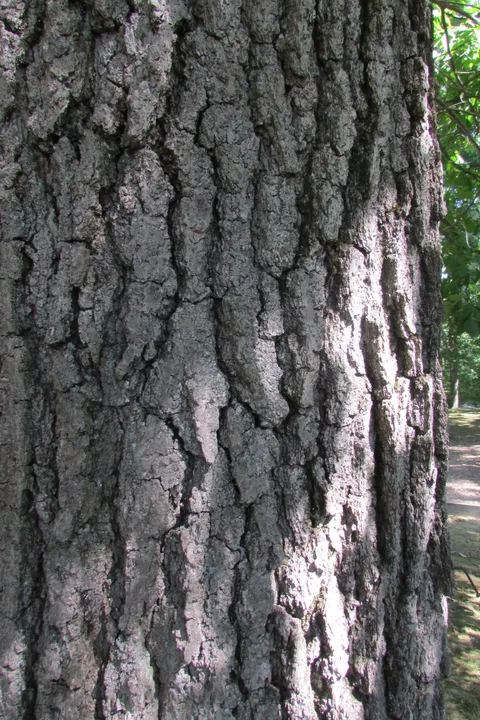
Smooth and dark grey when young, becoming nearly black and deeply furrowed, with rough ridges broken crosswise into squarish blocks. The inner bark, exposed by a shallow cut, is a distinctive yellow to orange-yellow; it holds a yellow pigment (quercitron) once used as a dye. Red oak bark is lighter, with long, smooth, flat-topped stripes on the ridges.
Bark
Flowers
Male flowers hang in slender yellow-green catkins as the leaves unfold in May; female flowers are tiny and borne in the leaf axils. Wind pollinated.
Fruit
Small acorns 12-20 mm (1/2-3/4 in) long in a dull brown, deep, bowl-shaped cup with loose scales that covers about half the nut, slightly fringed at the rim. Like all red-group oaks they take two growing seasons to ripen. Production begins at about 20 years, with good crops every 2-3 years. Squirrels, deer and wild turkeys eat them.
Valuable wildlife food source
Growing Conditions
Climate
Hardy in Belleville's zone 5b. It is very drought tolerant and does best on well-drained sand, gravel or rocky ground, so it suits dry ridges better than the wet clays of the Bay of Quinte lowlands. It is shade intolerant and needs full sun. Like other oaks its hard wood generally stands up to wind and ice, though big horizontal limbs can still fail under heavy ice, as in the 2025 ice storm, which caused moderate to severe tree damage near Ivanhoe and Cordova Mines in Hastings County.
Hardiness Zones: 4b, 5a, 5b
Light Requirements
Soil
Moisture: dry, moist
Drainage: well-drained
pH Range: 5 - 7.5
Tolerance
Care & Maintenance
Pruning
Best Season: Winter
Frequency: Every 5-10 years for young trees; mature trees need only deadwood and hazard work
- Prune only between November and March, when the sap beetles that carry oak wilt are inactive
- If an oak is wounded or must be cut between April and July, paint the wound right away (oaks are the exception where wound paint is recommended)
- Train young trees early to one leader with well-spaced scaffold limbs
- Keep oak firewood local; moving firewood is the main way oak wilt travels long distances
Avoid: April through July: high-risk period for oak wilt infection (Ontario guidance); Ideally avoid any pruning or wounding from April through November, when sap beetles are active
Watering
Establishment: Water deeply every week for the first 2-3 summers; the long taproot makes it hard to transplant, so plant small
Mature: Very drought tolerant once established; does poorly on wet, poorly drained ground
Seasonal Care Timeline
Spring
- April 1 marks the start of the oak wilt high-risk period: finish any oak pruning by the end of March
- Spongy moth eggs hatch from mid-April to mid-May
- Late frosts can brown new leaves (frost damage is patchy, not top-down like oak wilt)
Summer
- Watch for leaves wilting or bronzing from the top of the crown and report suspected oak wilt
- Spongy moth caterpillars feed until early July; burlap bands work from mid-May
- Water young or stressed trees in drought to keep two-lined chestnut borer out
Fall
- Acorns take two seasons to ripen; heavy crops come every 2-3 years
- Dormant-season pruning can begin once sap beetles are inactive (November)
- Plan root-zone protection before spring construction
Winter
- Best time for pruning and deadwood removal (November-March)
- Scrape off spongy moth egg masses on trunks and limbs
- The velvety, angled buds make winter a good time to tell black oak from red oak
Common Issues
Oak Wilt
SevereInvasive fungal disease (Bretziella fagacearum) that blocks the water-conducting sapwood. Black oak is in the red oak group, which is the most vulnerable: red-group oaks can die within 2 to 12 months of infection. First confirmed in Canada in 2023 in Niagara Falls, Springwater Township and Niagara-on-the-Lake; no new Ontario occurrences were confirmed in 2025 and it has not been reported in Hastings County. It spreads through sap beetles visiting fresh wounds, through grafted roots between neighbouring oaks, and in moved firewood.
Symptoms: Leaves wilting and turning bronze or brown from the edges inward, starting at the top of the crown, Rapid leaf drop in early to mid summer, often with green leaves falling, Cracks in the bark over grey fungal mats with a sweet, fruity smell, Neighbouring oaks dying one after another
Treatment: No cure. Report suspected trees to the Canadian Food Inspection Agency. Confirmed trees are removed and the wood chipped, burned or buried, and root connections to nearby oaks are cut.
Prevention: Do not prune or wound oaks from April through July (ideally April through November); paint unavoidable wounds immediately; buy and burn firewood locally.
Professional arborist recommended
Spongy Moth (LDD Moth)
ModerateInvasive defoliating caterpillar (Lymantria dispar dispar, formerly gypsy moth) and potentially the most damaging insect for black oak: two or three defoliations in a row can kill a tree. Outbreaks come about every 7-10 years; the 2021 outbreak was the largest on record in Ontario, while 2025 was quiet with no defoliation mapped.
Symptoms: Hairy caterpillars with paired blue then red spots on the back, May to early July, Leaves chewed full of holes or whole branches stripped by late June, Tan, fuzzy egg masses on trunks, limbs and firewood from late July, Droppings (frass) under the tree
Treatment: Scrape egg masses off between August and mid-April; a biological pesticide on young caterpillars from mid-April to mid-May; burlap bands to trap older caterpillars from mid-May through June.
Prevention: Check trunks for egg masses each winter, water defoliated trees in drought and have high-value trees assessed in outbreak years.
Two-lined Chestnut Borer
HighNative beetle whose larvae tunnel under the bark of oaks already weakened by defoliation, drought or root damage. It is the usual finishing blow in oak decline: in coastal New England, 46% of black oaks died between 1911 and 1921 after spongy moth defoliation and drought, followed by this borer and root rot.
Symptoms: Branch dieback starting in the upper crown, Leaves on affected limbs wilting and browning in mid-summer, Small D-shaped exit holes in the bark, Winding galleries under loose bark
Treatment: Remove and destroy infested limbs or trees; keep the remaining tree watered and mulched.
Prevention: Reduce stress: protect the roots, water during drought and manage spongy moth.
Professional arborist recommended
Oak Leaf Galls
LowSmall wasps and mites cause bumps, balls and blisters on oak leaves and twigs. They are common on black oak and almost always harmless.
Symptoms: Round or irregular growths on leaves or twigs, Some leaf distortion
Treatment: None needed.
Prevention: None needed.
Sources & References
Information compiled from the following authoritative sources:
Quick Facts
When to Call an Arborist
Recommended inspection: Every 2-3 years for large trees, after heavy defoliation, and before any construction near the root zone
- •Leaves wilting or bronzing from the top down in summer (possible oak wilt)
- •Bark cracks, fungal mats or a fruity smell on the trunk
- •Heavy spongy moth defoliation two years running
- •Dieback in the upper crown or D-shaped holes in the bark
- •Planned digging, grading or paving within the drip line
- •Large limbs over the house with cracks or decay
Free consultation for Belleville residents
Recommended Services
Based on Black Oak characteristics