
Common Buckthorn
Rhamnus cathartica
Overview
Common buckthorn grows throughout southern Ontario and is one of the most familiar invasive shrubs around Belleville and the Quinte area, filling old fencerows, woodlot edges, ravines, roadsides, hydro corridors and the back edges of yards. Ontario lists it as a noxious weed under the Weed Control Act because it affects agricultural crops: it hosts oat crown rust and overwinters the soybean aphid, both relevant to Quinte-area farms. It is not on Ontario's list of plants regulated under the Invasive Species Act, 2015.
Brought from Eurasia to North America in the 1880s as an ornamental and planted for fencerows and windbreaks; many of the buckthorn hedges and fencerow thickets in older rural properties date from that use. Cut buckthorn makes good firewood once any berries are removed.
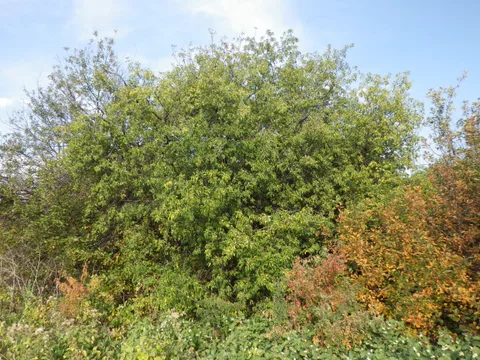
Full Tree
Identification
Leaves
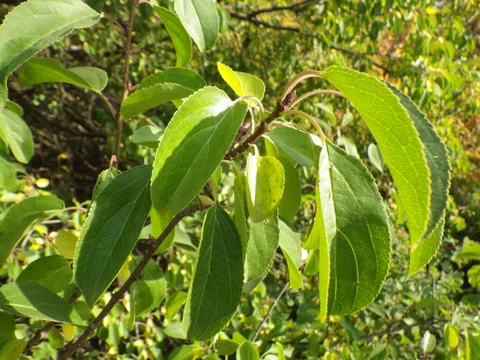
Smooth, dark green, finely toothed leaves in opposite or nearly opposite pairs, with 3-5 strongly curved veins on each side that sweep toward the tip. Buckthorn is usually the first shrub to leaf out in spring and the last to drop its leaves in fall, so a green understory in November is a good clue.
Leaves
Bark
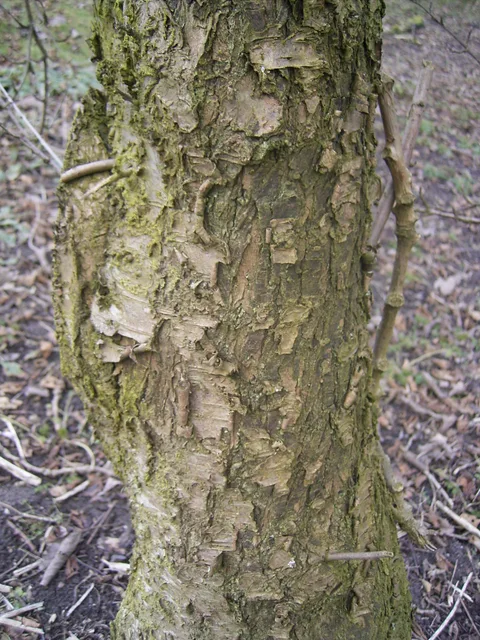
Greyish-brown bark with prominent small lenticels, becoming rough and flaky on older trunks. Scrape a branch or cut a stem and two give-aways appear: yellow-green inner bark and orange heartwood.
Bark
Flowers
Tiny yellowish-green flowers with 2-6 small petals in clusters along the twigs, in full bloom in early June in Ontario. Male and female flowers are usually on separate plants, so only female plants produce berries.
Fruit
Clusters of round black berry-like fruit along the twigs, green at first and turning black in September in Ontario, often hanging on into December or later. The seeds have a laxative effect, which is how birds scatter them so widely. Do not eat them.
Growing Conditions
Climate
Extremely hardy and adaptable: it grows on heavy Bay of Quinte clays, thin soils over limestone, and wet or dry ground, in sun or shade. Long leaf season (first to leaf out, last to drop) gives it an edge over native shrubs in our climate.
Hardiness Zones: 3, 4a, 4b, 5a, 5b
Light Requirements
Soil
Moisture: dry, moist, wet
Drainage: well-drained, moderate, poor
pH Range: 5.5 - 8.5
Tolerance
Care & Maintenance
Pruning
Best Season: Summer, Fall
Frequency: Do not maintain: remove it and monitor the site for seedlings for several years
- Remove isolated plants and berry-bearing (female) plants first to stop further spread
- Seedlings and small plants up to about 1 m can be hand-pulled any time of year, easiest after rain when the soil is soft; plants 1-5 cm (0.5-2 in) thick can be pulled with a weed-wrench type tool. Get as much root as possible
- Where you can, cut off berry-laden branches in summer before the fruit ripens, then come back in fall to pull or cut the stems
- Late fall is a good time to work: buckthorn stays green after native plants go dormant, so it is easy to spot, and manual control can continue until the ground freezes
- Stems thicker than about 5 cm (2 in) resprout hard when cut; they need the stump treated with a systemic herbicide right after cutting, or girdling, to stop multi-stem regrowth
- Tamp down or mulch the disturbed soil after pulling to reduce new seedlings, and replant with native shrubs and trees
Avoid: Cutting without treating the stump at any time of year: it comes back as a thicket of sprouts; Fall cleanup of fruiting plants without bagging the berries, which spreads the seed
Watering
Establishment: Not applicable: do not plant
Mature: Thrives without care in dry to wet sites
Seasonal Care Timeline
Spring
- Pull seedlings while the soil is moist after rain
- Check last year's cut stumps for resprouts
- Replant cleared areas with native shrubs and trees before buckthorn seedlings fill the gap
Summer
- Late spring to early summer is an effective time to cut and stump-treat larger stems
- Cut off berry-bearing branches before the fruit ripens in September
- Do not chip or compost berry-laden branches unless the fruit is removed
Fall
- Easiest time to find it: still green after natives drop their leaves
- Manual pulling until the ground freezes
- Bag berries and solarize them (sealed black bags in the sun for 1-3 weeks) before landfill, or send them to a municipal composting facility; do not home-compost seed
Winter
- Berries hanging on into winter keep feeding the birds that spread it
- Thorny stems are easier to see and cut once leaves drop; stumps still need treatment
Common Issues
Invasive Spread and Thickets
HighCommon buckthorn forms dense thickets that shade out native plants, changes soil nitrogen to favour its own growth, and produces many quickly germinating seeds that prevent native trees and shrubs from regenerating. Birds carry the seeds from yards into woodlots, ravines, fencerows and hydro corridors.
Symptoms: Dense, dark understory of one shrub species, Few native wildflowers or tree seedlings under it, Green leaves still on the shrubs in November, Black berries along fencerows and woodlot edges
Treatment: Pull small plants, cut and stump-treat larger stems, and replant the cleared area with native trees and shrubs. Plan on follow-up removal of seedlings for several years.
Prevention: Remove fruiting plants first, never plant buckthorn, and check hedges and fencerows each fall for new plants.
Resprouting After Cutting
HighCutting buckthorn without treating the stump triggers vigorous multi-stemmed regrowth, so a single cut often leaves a worse thicket than before. Stems can also regenerate from root sprouts.
Symptoms: Clusters of new shoots from old cut stumps, Hedges and fencerows that get denser after each cutting, Multi-stemmed shrubs where single trunks were cut
Treatment: Treat freshly cut stumps or girdled stems with a systemic herbicide, or use the registered bioherbicide on fresh cuts when the plant is in full leaf. In Ontario, herbicide use for invasive plants falls under the Pesticides Act and the cosmetic pesticides ban exceptions, and most control programs need a licensed exterminator.
Prevention: Do not cut large stems unless stump treatment or girdling follows. Monitor cut stumps for at least three years.
Professional arborist recommended
Oat Crown Rust (alternate host)
LowCommon buckthorn is the alternate host for oat crown rust (Puccinia coronata), a fungus that reduces oat yield and quality. The rust does little harm to the buckthorn itself but matters for nearby oat fields.
Symptoms: Orange rust spots on buckthorn leaves in spring, Crown rust in nearby oat fields
Treatment: No treatment for the buckthorn; removing it near oat fields removes the rust's spring host.
Prevention: Remove buckthorn from fencerows and woodlot edges next to oat crops.
Soybean Aphid (overwintering host)
LowBuckthorn is the winter host of the soybean aphid, which moves to soybean fields in summer and damages the crop.
Symptoms: Little visible effect on the buckthorn itself, Aphid pressure in nearby soybean fields
Treatment: No treatment for the buckthorn; removal near soybean fields is the practical response.
Prevention: Clear buckthorn from fencerows bordering soybean fields.
Sources & References
Information compiled from the following authoritative sources:
Quick Facts
When to Call an Arborist
Recommended inspection: Check yearly for seedlings and resprouts for at least 3-5 years after removal
- •Buckthorn trunks thicker than about 5 cm (2 in) that need cutting and stump treatment
- •Large thickets or old buckthorn hedges along property lines
- •Buckthorn crowding or growing into desirable trees
- •Cut stumps that keep resprouting
- •Thorny thickets blocking access, trails or sightlines
Free consultation for Belleville residents
Recommended Services
Based on Common Buckthorn characteristics