
Peachleaf Willow
Salix amygdaloides
Overview
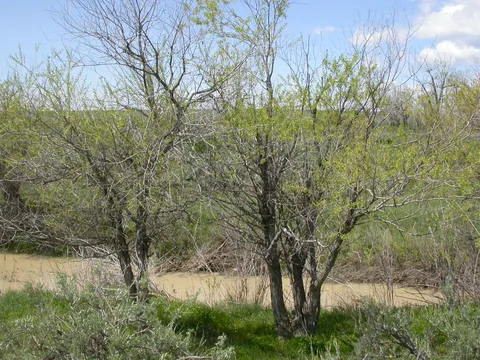
Peachleaf willow is the most common tree willow of the Great Plains but is rare in Ontario, at the eastern edge of its range. Where it does occur it grows with cottonwoods and other willows on streambanks, lakeshores, marsh edges and wet floodplains. In the Quinte area most tree willows on shorelines and creeks are black willow or planted and hybrid willows, and willows hybridize readily, so a peachleaf willow is worth confirming: look for the whitish undersides of the leaves. It is valued for stabilizing banks and is rarely planted in yards.
Willow bark tea was a traditional remedy for pain and fever across the species' range, and peachleaf willow twigs were favoured as chew sticks. Willow bark's salicin is the natural forerunner of aspirin. Willows root so easily from cuttings that dormant peachleaf willow poles are planted to stabilize streambanks.
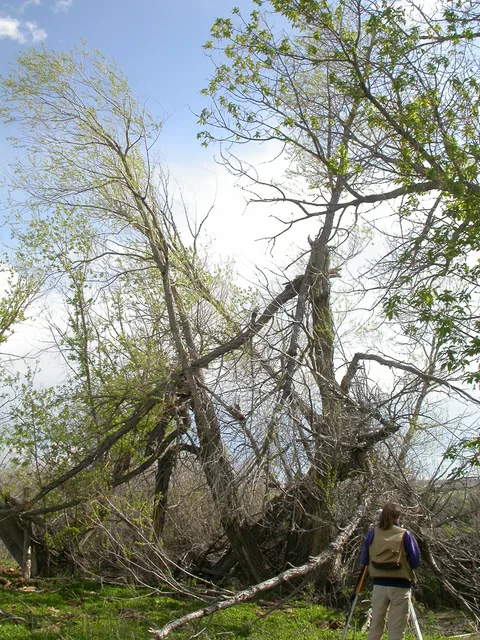
Full Tree
Identification
Leaves
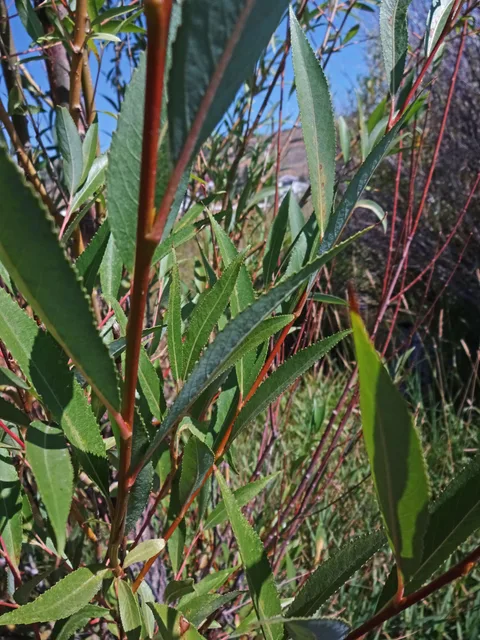
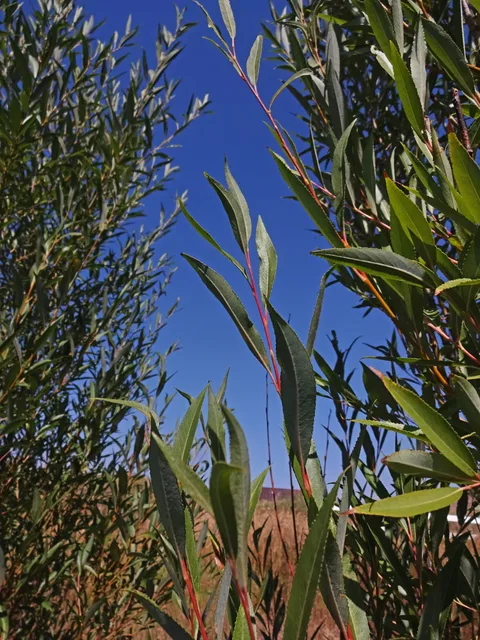
Leaves look like peach leaves: yellowish-green above and pale, whitish or bluish (glaucous) underneath, hairless, with fine teeth and a long, slender point. The leaf stalks have no glands. The whitish underside is the quickest way to tell it from black willow, whose leaves are only light green underneath.
Leaves
Bark
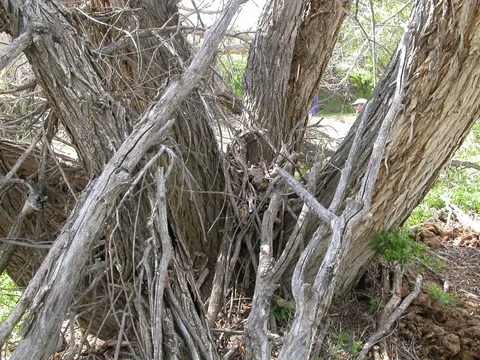
Smooth on young stems, becoming fairly thick, brown to reddish-brown and ridged on older trunks, with flat, intertwining ridges.
Bark
Flowers
Catkins open with the leaves in May. Female catkins are 3-8 cm (1-3 inches) long on short leafy side shoots, with the flowers loosely spaced, giving the catkin an open look.
Fruit
Small hairless capsules 3-5 mm long ripen in June and split to release tiny seeds with silky hairs. The seeds are carried by wind and water and stay alive only a few days, so seedlings appear only on freshly exposed wet mud and sand.
Growing Conditions
Climate
Very cold-hardy and adapted to floods: it tolerates poor drainage and long periods of standing water, and its roots track the water table. It is not drought tolerant and does not tolerate shade, so it is replaced as other trees close the canopy. Like other willows, its soft wood breaks under the freezing rain and wet snow common in Eastern Ontario winters.
Hardiness Zones: 2, 3, 4a, 4b, 5a, 5b
Light Requirements
Soil
Moisture: moist, wet
Drainage: moderate, poor
pH Range: 6 - 8
Tolerance
Care & Maintenance
Pruning
Best Season: Winter
Frequency: Every 3-5 years where the tree overhangs paths, docks or buildings; after major storms
- Prune in the dormant season, when leaning stems and weak forks are easy to see
- Remove dead, broken and rubbing stems first; on multi-stemmed trees, take out stems that lean heavily toward buildings or paths
- Cut out branches killed by willow blight during the dormant season and dispose of them
- Make clean cuts outside the branch collar; do not paint or tar wounds
- Do not top: the flush of weakly attached sprouts breaks easily
Avoid: Wet spring weather, when willow scab and canker fungi spread most readily; Spring leaf-out, when bark tears easily
Watering
Establishment: Keep soil consistently moist for the first two growing seasons; peachleaf willow follows the water table and fails where it drops sharply in summer
Mature: Trees on shorelines and streambanks reach groundwater and rarely need watering
Seasonal Care Timeline
Spring
- Check for limbs broken by winter ice and snow
- Spring flooding can undercut streambanks and loosen leaning stems
- Wet springs bring willow scab on new shoots
Summer
- Thunderstorm winds break brittle limbs
- Leaf-feeding insects and willow blight dieback
- Drought stress on sites where the water table drops
Fall
- Good time to book pruning once leaves drop
- Rake up fallen leaves and dead twigs to reduce disease carry-over
- Check lower stems for borer holes
Winter
- Freezing rain and wet snow can split stems
- Beaver damage on shoreline trees
- Dormant season is the best time for pruning
Common Issues
Brittle Wood and Storm Breakage
ModeratePeachleaf willow's wood is soft and weak, and its branches are brittle at the base. Leaning stems split and limbs snap in wind, wet snow and freezing rain.
Symptoms: Twigs and small branches littering the ground after wind, Cracks or seams at the base of forks between stems, Broken or hanging limbs, Stems leaning further after a storm
Treatment: Have a professional arborist remove broken limbs and assess leaning stems near buildings, docks or paths; removing individual failing stems often keeps the rest of the clump
Prevention: Early structural pruning and regular checks after storms
Professional arborist recommended
Willow Blight (Willow Scab and Black Canker)
ModerateTwo fungi that often attack willows together. Willow scab infects new shoots in wet spring weather, and black canker forms cankers on older stems later in the season. Repeated severe infections cause defoliation, branch dieback and sometimes death.
Symptoms: New leaves and shoots suddenly browning and wilting in a wet spring, Olive-brown velvety spore masses on dead leaves and leaf stalks, Dark brown to black cankers at the base of leaf stalks and on twigs, Pinkish spore masses on stem cankers in wet weather
Treatment: Prune out and destroy diseased branches during the dormant season. Agriculture and Agri-Food Canada notes that no products are registered in Canada for either disease
Prevention: Good air circulation, removing dead twigs, and reducing drought stress
Poplar-and-Willow Borer
ModerateAn introduced weevil (Cryptorhynchus lapathi) whose larvae tunnel through lower stems and branches of willows, its preferred host, weakening them so they break in high winds or ice storms.
Symptoms: Small holes with boring dust on lower stems, Dead bark patches that crack open and ooze sap, Fading foliage and dying branches, Stems breaking at tunnelled sections
Treatment: No pesticides are registered for this borer in Canada. Remove and destroy infested stems before May or June so larvae cannot mature
Prevention: Keep trees vigorous and avoid trunk wounds
Cytospora Canker and Wood Decay
ModerateStressed or wounded willows are attacked by canker fungi such as Cytospora, and old wounds and broken stubs let decay fungi into the soft wood.
Symptoms: Sunken, discoloured patches of bark, Tiny pimple-like black fruiting bodies on dead bark, Scattered branch dieback, Mushrooms or soft, punky wood at old wounds
Treatment: Prune out cankered branches in dry weather, cutting back to healthy wood; have decayed stems near targets assessed by an arborist
Prevention: Avoid wounding, water during droughts, and prune broken stubs back cleanly after storms
Roots Near Water Lines and Septic Beds
ModerateLike other tree willows, peachleaf willow has a spreading root system that follows the water table and is drawn to moist soil around drains and septic beds.
Symptoms: Slow drains or recurring backups, Roots found during a drain camera inspection, Septic bed not draining properly
Treatment: Have a plumber or septic contractor clear and repair the line; an arborist can advise whether root pruning or removal is appropriate
Prevention: Keep willows well away from septic beds, sewer laterals and wells
Professional arborist recommended
Sources & References
Information compiled from the following authoritative sources:
Quick Facts
When to Call an Arborist
Recommended inspection: Every 3 years for trees near buildings, docks or paths, and after major wind or ice storms
- •Cracks or seams at the base of forks between stems
- •Stems leaning further than before
- •Broken or hanging limbs
- •Large dead sections of the crown
- •Cankers, cavities or mushrooms on stems
- •Boring dust or oozing holes on lower stems
Free consultation for Belleville residents
Recommended Services
Based on Peachleaf Willow characteristics