
Black Willow
Salix nigra
Overview
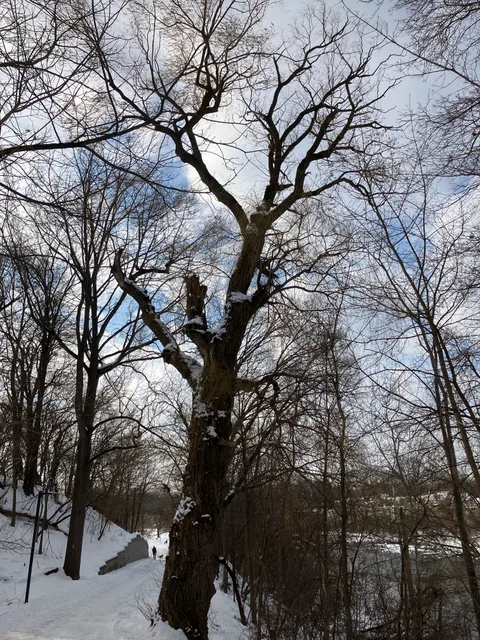
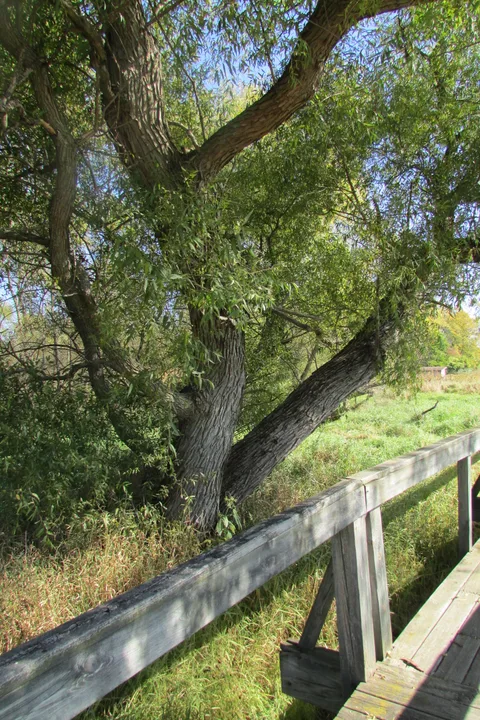
Black willow is the largest native willow in Ontario and is common on moist sites across Southern Ontario. Around Belleville it lines the Moira and Trent rivers, Bay of Quinte shorelines, creek banks, wet ditches and farm drains, usually as clumps of leaning trunks over the water. Its dense roots help hold eroding banks, which makes it valuable on waterfront properties, but its weak wood and constant limb drop make it a frequent pruning and removal job where it grows beside cottages, docks, roads and houses.
The light, soft wood was used for baskets, crates and rough construction, and willow bark was a traditional pain remedy because of its salicin, the compound behind aspirin. Willow cuttings root very easily in moist soil, which is why black willow stakes are still used to stabilize stream banks.
Full Tree
Identification
Leaves
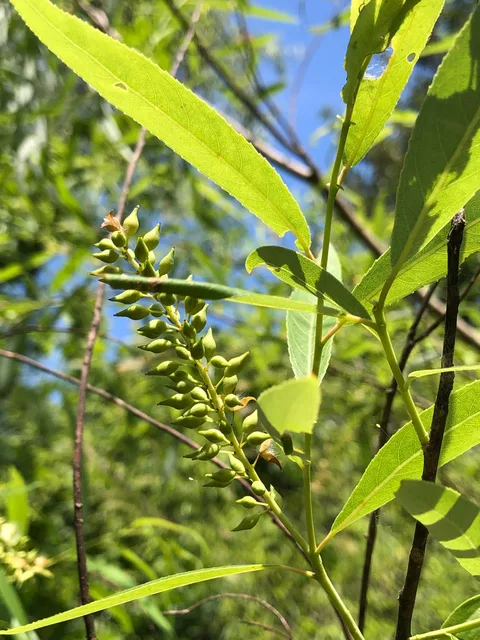
Long, narrow, pointed leaves, dark and shiny above and light green underneath, with a finely toothed edge. A pair of small leaf-like stipules usually sits at the base of each leaf stalk, which helps separate black willow from many other willows.
Leaves
Bark
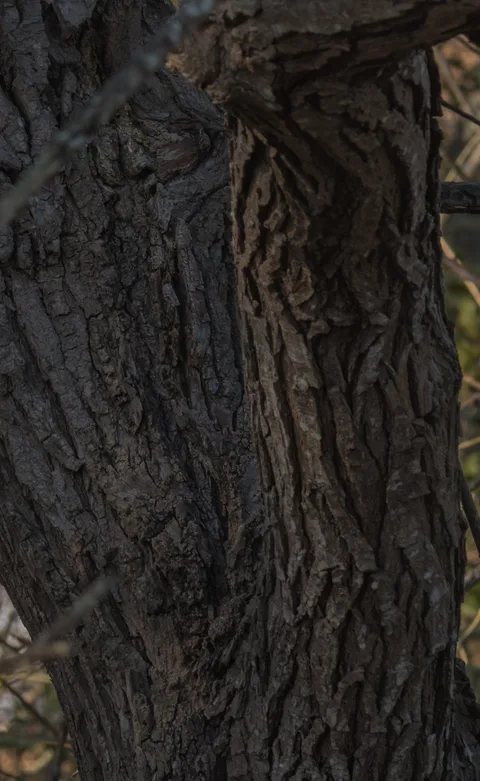
Smooth and dark brown on young stems. On mature trunks the bark becomes brown to nearly black, thick and deeply furrowed, with scaly, flat-topped ridges that give the tree its name.
Bark
Flowers
Slender yellow-green catkins 2.5-7.5 cm (1-3 inches) long open with the new leaves in late spring. Male and female catkins grow on separate trees.
Fruit
Female catkins ripen into strings of small cone-shaped capsules that split in early summer to release tiny seeds with fluffy white hairs. The seeds travel on wind and water and only live a short time, so new trees start on bare, wet mud along shorelines and river bars.
Valuable wildlife food source
Growing Conditions
Climate
Fully hardy in the Quinte area and built for floodplains: it tolerates seasonal flooding and silt deposits and grows on heavy Bay of Quinte lowland clays as long as moisture is steady through the summer. It does not tolerate shade or dry sites. Its weak point is Eastern Ontario's freezing rain and wet-snow storms, which split its forks and snap its brittle limbs.
Hardiness Zones: 4a, 4b, 5a, 5b
Light Requirements
Soil
Moisture: moist, wet
Drainage: well-drained, moderate, poor
pH Range: 5.5 - 8
Tolerance
Care & Maintenance
Pruning
Best Season: Winter
Frequency: Every 2-4 years for trees near homes, docks, roads or play areas; after every major wind or ice storm
- Prune in the dormant season (late fall to late winter), when the leaning stems and weak forks are easy to see and the ground along the shore is often frozen and firmer for equipment
- Focus on risk reduction: remove dead, cracked and hanging limbs and reduce long, heavy limbs leaning over roofs, decks, docks and driveways
- Train young trees to fewer, well-spaced stems; tight forks between leaning trunks are the most common failure point
- Cut out and dispose of branches killed by willow blight while the tree is dormant to reduce next spring's infection
- Do not top black willow: the mass of fast, weakly attached sprouts that follows breaks easily
- Large leaning stems over water or buildings should be taken down by a professional arborist with rigging, not felled
Avoid: Wet spring weather, when willow scab and canker fungi spread most readily; Spring leaf-out, when bark tears easily
Watering
Establishment: Keep the soil consistently moist for the first two growing seasons unless the site is naturally wet; black willow needs steady moisture
Mature: Trees on shorelines, ditches and floodplains reach groundwater and rarely need watering
Seasonal Care Timeline
Spring
- Check for limbs broken by winter ice and snow before leaf-out
- Spring flooding on river and shoreline lots can undercut banks and loosen leaning trees
- Wet springs bring willow scab: watch for new shoots suddenly turning brown
Summer
- Cotton-like seed drift from female trees in early summer
- Thunderstorm downbursts break heavy limbs and split leaning trunks
- Leaf beetles, sawflies and aphid honeydew
Fall
- Good time to book an inspection and risk pruning once leaves drop
- Rake up fallen leaves and dead twigs to reduce willow blight carry-over
- Check lower stems for borer holes and boring dust
Winter
- Freezing rain and wet snow can split forks and snap brittle limbs
- Dormant season is the best time for pruning and removal, especially on frozen shorelines
- Beavers fell and girdle willows along the Moira, Trent and Bay of Quinte shoreline
Common Issues
Limb Drop and Storm Breakage
HighBlack willow has light, soft wood that is weak in bending, and its twigs and branches snap easily in wind and rain. Leaning multi-stemmed trees regularly split at the base or drop large limbs, especially when loaded with wet snow or freezing rain.
Symptoms: Constant litter of twigs and small branches under the tree, Cracks or seams at the base of forks between leaning trunks, Hanging or broken limbs in the crown, Trunks leaning further after a storm, or soil lifting on one side, Decay, cavities or mushrooms at old wounds
Treatment: Risk assessment by a professional arborist, followed by deadwood removal, weight reduction, removal of individual failing stems, or removal of the tree where the risk cannot be managed
Prevention: Structural pruning while young, regular inspection, and not planting black willow near buildings
Professional arborist recommended
Roots in Septic Beds and Sewer Lines
ModerateBlack willow's dense, fibrous, shallow roots follow water and can damage septic beds and sewer lines. Ontario's Tree Atlas advises planting it well away from them.
Symptoms: Slow drains or recurring sewer backups, Roots found during a drain camera inspection, Septic bed not draining, or soggy patches over the bed, Root suckers coming up in lawns
Treatment: Have a plumber or septic contractor clear and repair the line or bed; a professional arborist can assess whether root pruning is safe or whether removal is the better option
Prevention: Keep black willow well away from septic beds, sewer laterals, wells and foundations
Professional arborist recommended
Willow Blight (Willow Scab and Black Canker)
ModerateTwo fungi, willow scab (Venturia saliciperda) and black canker (Glomerella miyabeana), often attack together. Both overwinter on dead twigs. Scab infects new shoots in wet spring weather; black canker shows up later in the season on older stems. Repeated severe years cause defoliation, branch dieback and sometimes death.
Symptoms: New leaves and shoots suddenly browning and wilting in a wet spring, Olive-brown velvety spore masses on dead leaves and leaf stalks, Dark brown to black cankers at the base of leaf stalks and on twigs, Peach- or pink-coloured spore masses on stem cankers in wet weather, Shoot-tip dieback and thinning crown
Treatment: Prune out and destroy diseased branches during the dormant season. Agriculture and Agri-Food Canada notes that no products are registered in Canada for either disease
Prevention: Good air circulation, removing dead twigs, and reducing drought stress
Poplar-and-Willow Borer
ModerateAn introduced weevil (Cryptorhynchus lapathi) whose larvae tunnel through the lower stems and branches of willows, its preferred host. Tunnelling severely weakens limbs and trunks, which then break in high winds or ice storms.
Symptoms: Small holes in the bark, often on lower stems, Boring dust pushed out of holes, Dead bark patches that crack open and ooze sap, Fading foliage and dying branches, Limbs breaking at tunnelled sections
Treatment: No pesticides are registered for this borer in Canada. Remove and destroy infested wood before May or June so larvae cannot mature; have an arborist assess whether tunnelling has made large stems unsafe
Prevention: Keep trees vigorous and avoid trunk wounds from mowers and trimmers
Professional arborist recommended
Cytospora Canker
ModerateFungal canker of willows and poplars that attacks stressed or wounded trees, killing patches of bark and girdling branches. Drought, root damage and wounds make trees more susceptible.
Symptoms: Sunken, discoloured patches of bark, Tiny pimple-like black fruiting bodies on dead bark, Bark cracking along the canker edge, Scattered branch dieback
Treatment: Prune out infected branches in dry weather, cutting back to healthy wood outside the branch collar; fungicides are not effective
Prevention: Reduce stress: avoid trunk wounds, water during droughts on dry sites, avoid soil compaction
Leaf-Feeding Insects
LowBlack willow is fed on by a long list of leaf-eaters, including the imported willow leaf beetle, willow sawflies, forest tent caterpillar and spongy moth, along with aphids that drip sticky honeydew. Healthy trees usually releaf, but repeated defoliation adds to stress and dieback.
Symptoms: Skeletonized or chewed leaves, Patches of the crown stripped bare in early summer, Sticky honeydew and black sooty mould on leaves, cars and decks below, Clusters of larvae or caterpillars on leaves and twigs
Treatment: Usually none needed on large trees; small trees can be hosed off or hand-picked. Consult an arborist if a tree is heavily defoliated several years in a row
Prevention: Keep trees vigorous; encourage natural predators by avoiding broad-spectrum sprays
Sources & References
Information compiled from the following authoritative sources:
Quick Facts
When to Call an Arborist
Recommended inspection: Every 2-3 years for trees near buildings, docks, roads or lines, and after every major wind or ice storm
- •Cracks or seams at the base of forks between trunks
- •A trunk that is leaning more than before, or soil heaving on one side
- •Broken or hanging limbs in the crown
- •Dead or dying sections of the crown
- •Cankers, cavities or mushrooms on the trunk or root flare
- •Boring dust or oozing holes on lower stems
- •Roots in septic beds or sewer lines
Free consultation for Belleville residents
Recommended Services
Based on Black Willow characteristics