
American Mountain-ash
Sorbus americana
Overview
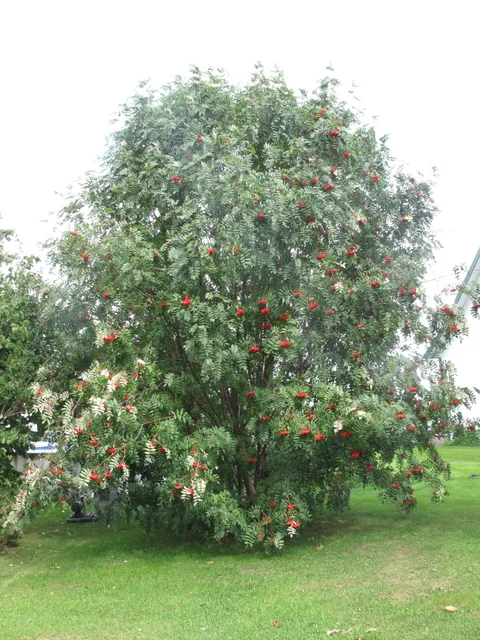
American mountain-ash is a northern native: Ontario's Tree Atlas places it across the boreal forest and south only into the northernmost parts of Southern Ontario, so Belleville sits near its southern edge. Wild trees are more likely on the cooler, rockier Canadian Shield country north of Hwy 7 (rock outcrops, swamp edges, forest openings) than in the Bay of Quinte lowlands. Despite the name it is not an ash at all: it is in the rose family, so it is NOT a host of emerald ash borer, which attacks only true ashes (Fraxinus). A mountain-ash in a Belleville yard is more often the planted European mountain-ash (rowan); check the buds (sticky and nearly hairless on the native, densely grey-hairy on the European) before deciding which one you have.
Ontario's Tree Atlas notes that pioneer doctors reportedly used the bark as an anti-malarial medicine. It has long been valued for its winter-persistent fruit, which feeds robins, waxwings and grouse.
Full Tree
Identification
Leaves
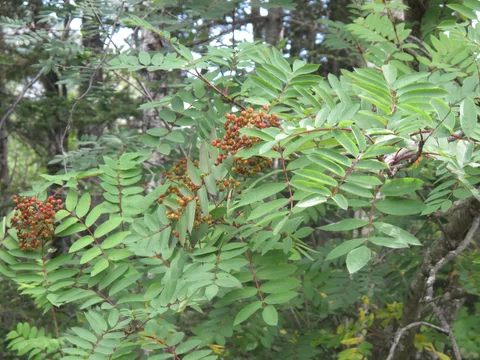
Feather-like compound leaves of 13-17 thin, narrow leaflets, light green above and paler and essentially hairless below. The leaf looks like an ash leaf, which is where the name comes from, but it is arranged alternately on the twig (true ashes are opposite). Leaflets are more than three times as long as wide, which helps separate it from the planted European mountain-ash.
Leaves
Bark
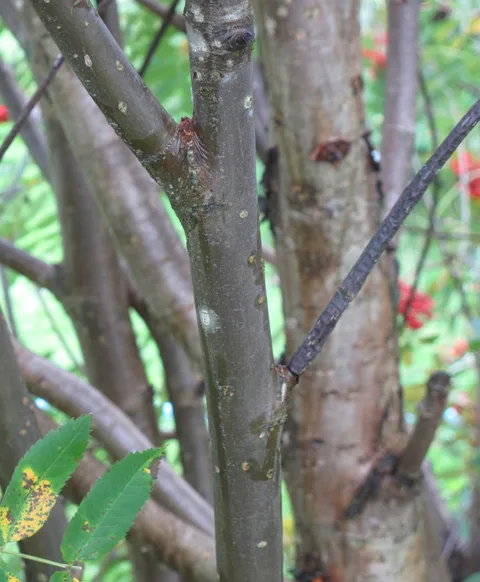
Thin, smooth, light greyish-brown bark on young stems that becomes rough with age. The thin bark is easily wounded by mowers, string trimmers and winter sun, and those wounds are where cankers and borers get in.
Bark
Flowers
Small white five-petalled flowers, 3-4 mm across, in dense flat-topped clusters in May and June after the leaves are out. They attract bees and other pollinators. Flowers are also where fire blight often enters the tree.
Fruit
Heavy bunches of bright orange-red, berry-like fruit 4-6 mm across ripen in August and often hang on into winter. Robins, waxwings, thrushes, catbirds and ruffed grouse eat them and spread the seeds; moose and deer browse the twigs.
Valuable wildlife food source
Growing Conditions
Climate
Very cold-hardy (to USDA zone 2) but heat-averse. Our hot, humid Bay of Quinte summers, compacted clay and drought periods such as 2025 (when Ontario's forest health survey recorded widespread drought damage in Hastings County) stress it, shorten its life and invite borers and cankers. It does best in a cool, moist, sunny-to-partly-shaded spot.
Hardiness Zones: 2, 3, 4a, 4b, 5a, 5b
Light Requirements
Soil
Moisture: moist
Drainage: well-drained, moderate
pH Range: 4.7 - 6
Tolerance
Care & Maintenance
Pruning
Best Season: Winter
Frequency: Light structural pruning every few years; remove dead or blighted wood promptly
- Prune in late winter while dormant and dry, when fire blight bacteria are not spreading
- Cut fire blight strikes well below the visibly blackened wood and disinfect tools between cuts
- Keep one or a few well-spaced stems; remove crossing, rubbing and suckering shoots
- Avoid large cuts on the thin bark, which heals slowly and invites canker fungi and borers
Avoid: Bloom time and warm, wet weather in spring and early summer, when fire blight spreads most easily; Late summer, which can push soft regrowth before winter
Watering
Establishment: Water deeply once a week for the first two growing seasons and keep a wide mulch ring (not touching the trunk)
Mature: Needs reliably moist, well-drained soil; it has low drought tolerance and is not suited to hot, dry sites
Seasonal Care Timeline
Spring
- Watch for fire blight after bloom (blackened, wilted shoot tips)
- Avoid pruning during bloom and wet weather
- Check young trunks for sunscald cracks once wraps come off
Summer
- Sawfly larvae on the leaflets
- Drought stress on hot or shallow sites: water deeply
- Look for borer holes and sap on the trunk
Fall
- Fruit ripens from August and draws flocks of robins and waxwings
- Rake fallen leaves where scab is a problem
- Install trunk guards on young trees
Winter
- Best time to prune out fire blight cankers (dry, dormant weather)
- Deer and moose browse twigs
- Ice storms can split narrow forks
Common Issues
Fire Blight
HighBacterial disease (Erwinia amylovora) of the rose family that can be severe on mountain-ash. It enters mainly through flowers and young shoots and can run down into branches and the trunk.
Symptoms: Flowers and shoot tips wilt and turn black or brown as if scorched, Shoot tips bend over into a 'shepherd's crook', Dead leaves stay attached, Sunken, darkened cankers on branches, sometimes oozing in wet weather
Treatment: Prune out infected branches in dry, dormant weather, cutting well below visible symptoms and disinfecting tools. Heavily cankered trunks usually mean removal.
Prevention: Avoid high-nitrogen feeding and heavy pruning that forces soft growth; plant away from heavily infected apples, pears, hawthorns and crabapples
Professional arborist recommended
Borers
ModerateWood-boring beetle and moth larvae attack mountain-ash, especially trees weakened by drought, sunscald or trunk wounds.
Symptoms: Sawdust-like frass or sap at holes in the bark, Bark that is cracked, sunken or loose over tunnels, Thinning crown and branch dieback
Treatment: Remove badly infested stems; a professional arborist can assess whether a tree is worth keeping
Prevention: Keep trees watered in drought, protect the trunk from mower and trimmer damage, and plant in a cool site
Professional arborist recommended
Sunscald and Heat Stress
ModerateMountain-ashes have thin bark, and young trees can suffer sunscald on the south and southwest side of the trunk. American mountain-ash is a northern tree that is intolerant of hot, humid summers.
Symptoms: Long vertical cracks or dead, sunken bark on the sunny side of the trunk, Leaf scorch and early leaf drop in hot spells, Gradual decline on hot, paved or reflective sites
Treatment: Keep damaged areas clean and let the tree wall them off; do not paint or seal wounds
Prevention: Plant in a cool spot with morning sun and moist soil; wrap young trunks with a light-coloured guard over winter and remove it in spring
Mountain-ash Sawfly and Pear Sawfly
LowSawfly larvae feed on the leaflets in summer. Mountain-ash sawfly larvae can strip branches; pear sawfly ('pear slug') larvae skeletonize the leaf surface.
Symptoms: Groups of green caterpillar-like larvae eating leaflets from the edges, Leaflets skeletonized to a brown lace, Patches of the crown defoliated by midsummer
Treatment: Hand-pick or prune off small colonies; healthy trees tolerate occasional defoliation
Prevention: Check foliage in early summer and act while colonies are small
Scab, Cankers and Rust
ModerateScab can cause significant leaf drop, and canker fungi, rust and powdery mildew may also appear, mostly on stressed trees.
Symptoms: Olive to black spots on leaves and fruit, Early yellowing and leaf drop, Sunken, discoloured patches of bark, Orange rust spots on leaves
Treatment: Rake up fallen leaves; prune cankered branches in dry dormant weather
Prevention: Good air circulation, full sun to part shade, and steady moisture
Sources & References
Information compiled from the following authoritative sources:
Quick Facts
When to Call an Arborist
Recommended inspection: Every 2-3 years, and promptly after any fire blight symptoms
- •Blackened, wilted shoots after bloom (possible fire blight)
- •Sunken or cracked cankers on the main trunk
- •Holes, sap or frass in the bark
- •Dieback over a third of the crown
- •Splitting at narrow forks between stems
Free consultation for Belleville residents
Recommended Services
Based on American Mountain-ash characteristics