
Slippery Elm
Ulmus rubra
Active Threats to Slippery Elm
Dutch Elm Disease
Fungal disease spread by bark beetles that has killed millions of elm trees across North America.
Signs to watch for:
- •Wilting and yellowing leaves in summer
- •Brown streaking in sapwood
- •Branch flagging (dead branches with leaves attached)
- •Rapid crown death
Recommended Action: Early detection is critical. Infected branches may be pruned to save the tree if caught early.
Free consultation available
Overview
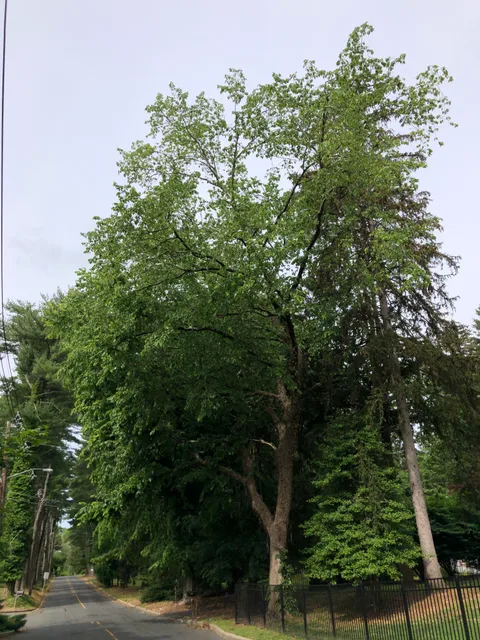
A native elm that Ontario describes as uncommon in Canada. It grows across southern Ontario north to the southern edge of the Canadian Shield, so around Belleville it turns up in moist, rich soils along streams and on the slopes beside them, in hedgerows and woodlot edges, and now and then on rocky limestone ridges. It is often mistaken for American elm, but the sandpaper-rough leaves, rusty-hairy buds and slippery inner bark give it away. Like American elm it is killed by Dutch elm disease, so around Quinte most slippery elms are young or mid-sized trees, and big old ones are now rare. Over 100 insect species feed on it, birds eat its buds and seeds, and Baltimore orioles nest in elms.
The tree is named for its fragrant, mucilage-filled inner bark. Its hard, durable wood has been used for furniture, panelling and fence posts, and was often sold mixed with American elm as 'soft elm'. The USDA Forest Service notes that Dutch elm disease and elm yellows are so widespread that slippery elm now seldom reaches full size as a forest tree.
Full Tree
Identification
Leaves
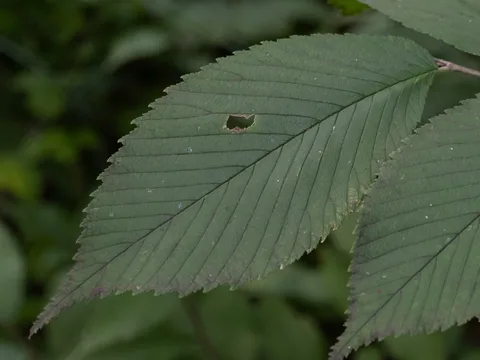
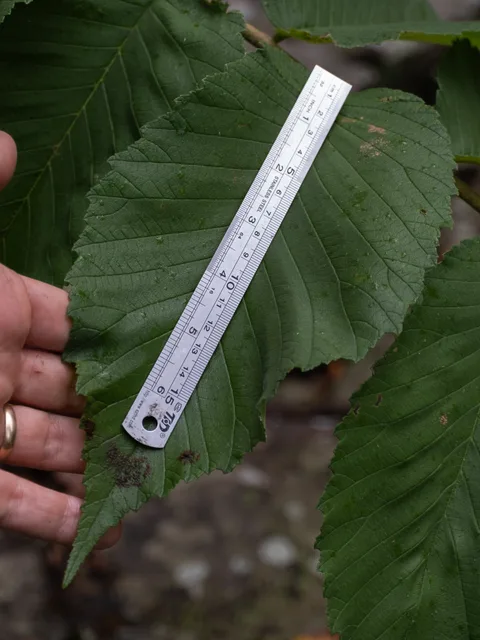
Large, thick leaves that feel like sandpaper on top when you stroke them in either direction, and are hairy underneath. The base is clearly lopsided and the edges are coarsely double-toothed. The leaves are fragrant. American elm leaves are usually smaller, about 8-13 cm (3-5 in), and smooth or only slightly rough on top.
Leaves
Bark
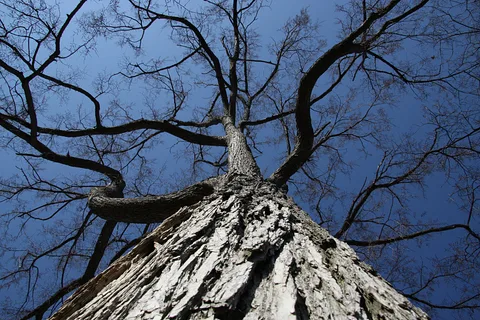
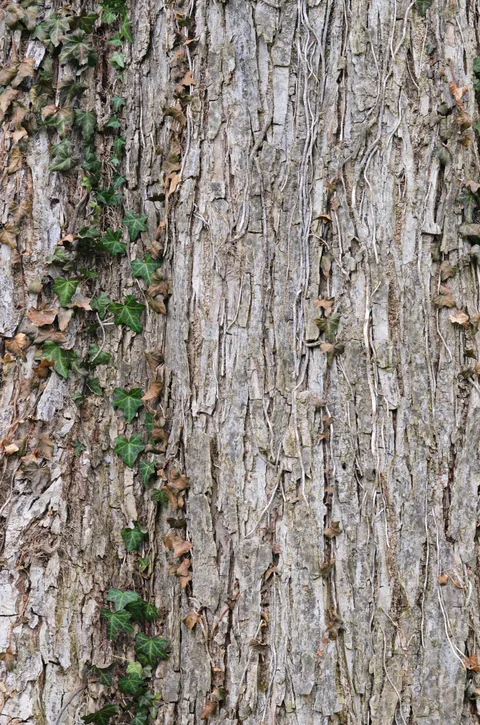
Dark reddish-brown to grey-brown bark with shallow furrows and irregular, scaly ridges. The tree's name comes from the inner bark: it is fragrant and full of mucilage, so it feels slippery. Cut a small chip of outer bark and look at the edge: on slippery elm it is evenly brown, while American elm shows alternating dark and light (buff) layers.
Bark
Flowers
Small greenish-red flowers open in early spring, before the leaves, each on its own short stalk in dense, tassel-like clusters.
Fruit
Nearly round, papery, winged seeds 10-15 mm (about 1/2 in) long that ripen in late spring as the leaves expand. Reddish-brown hairs cover only the seed in the centre; the wing itself is smooth with a shallow notch at the tip. American elm seeds have a hairy fringe around the edge of the wing and a deep notch. Finches, ducks and other birds eat the buds and seeds.
Valuable wildlife food source
Growing Conditions
Climate
Very cold-hardy and well suited to Belleville's zone 5b climate. It grows best in moist, well-drained loam or clay loam, the deeper soils of stream valleys and lower slopes in the Bay of Quinte lowlands, and also takes drier limestone ground. It puts up with brief flooding but not frequent or long flooding. It is fairly shade tolerant. The USDA reports crown breakage on slippery elm after severe ice storms, so watch for split and hanging limbs after freezing rain.
Hardiness Zones: 3, 4a, 4b, 5a, 5b
Light Requirements
Soil
Moisture: moist
Drainage: well-drained, moderate
pH Range: 5.5 - 8
Tolerance
Care & Maintenance
Pruning
Best Season: Winter
Frequency: Every 3-5 years on yard trees; remove dead or wilting branches promptly
- Prune in the dormant season, late fall to early spring, when elm bark beetles are not flying
- Remove dead and dying limbs promptly: elm bark beetles that carry Dutch elm disease breed in dead and weakened elm wood
- Do not move or stockpile elm firewood with the bark on; Ontario advises against moving elm wood because it spreads the disease
- Clean tools between elms, and cut well below any branch showing brown streaks under the bark
Avoid: Spring and summer, when elm bark beetles are active
Watering
Establishment: Deep watering every week or two for the first two summers
Mature: Prefers evenly moist soil; established trees rarely need watering
Seasonal Care Timeline
Spring
- Flowers and seeds appear before and with the leaves; heavy seed crops are normal
- Elm bark beetles start flying: finish elm pruning before leaf-out
- Slime flux is often most noticeable in spring
Summer
- Watch for wilting, yellowing branches (Dutch elm disease) in June and July
- Late-summer yellowing of the whole crown can mean elm yellows
- Leaf feeders and leafminers are usually cosmetic
Fall
- Leaves turn dull yellow and drop early on stressed trees
- Book dormant-season pruning and removals of dead elm wood
- Do not keep elm firewood with the bark on into next spring
Winter
- Best time to prune
- Ice storms can split or break limbs
- Identify it in winter by the rusty-hairy buds and rough, slimy-when-chewed twigs
Common Issues
Dutch Elm Disease
SevereAn invasive fungal disease (Ophiostoma ulmi and O. novo-ulmi) that grows under the bark and blocks the tree's water-conducting wood. It is carried from tree to tree by the European elm bark beetle and the native elm bark beetle. Slippery elm is as susceptible as American elm, and infected trees usually die within 1 to 3 years.
Symptoms: Leaves on one or more branches wilt, curl and turn yellow, then brown, in early to mid summer, 'Flagging': dead branches that keep their brown leaves, Brown streaks in the sapwood just under the bark of affected branches, Crown dieback that spreads quickly through the tree, Tiny round beetle holes and galleries under loose bark on dead limbs
Treatment: If caught early, removing the infected branches well below the streaking can sometimes save a tree, and high-value trees can be protected with fungicide injections. A tree with widespread wilting cannot be saved and should be removed promptly so beetles do not breed in it.
Prevention: Keep elms vigorous, remove dead elm wood, prune only in the dormant season and never move elm firewood. Preventive fungicide injection is an option for a valued yard tree.
Professional arborist recommended
Elm Yellows (Elm Phloem Necrosis)
SevereA disease caused by a phytoplasma (a bacteria-like organism) that kills the inner bark. The USDA Forest Service reports that it kills slippery elm across much of its range; it is spread mainly by the white-banded elm leafhopper.
Symptoms: Whole crown yellows and droops in mid to late summer, rather than one branch at a time, Early leaf drop, Rapid decline and death
Treatment: No cure. Remove infected trees promptly to protect nearby elms.
Prevention: Plant a mix of species rather than relying on elms; have any sudden whole-crown yellowing on an elm checked.
Professional arborist recommended
Wetwood and Slime Flux
LowA bacterial infection of the inner wood that builds up gas pressure and forces sour-smelling liquid out of cracks and pruning wounds. The USDA lists slime flux and wetwood among the diseases of slippery elm. It is usually a chronic problem rather than a killer.
Symptoms: Wet, dark streaks running down the bark from a crack or old wound, Sour or fermented smell, Grey-white crust where the liquid dries, Occasional wilting on the affected side
Treatment: No cure, and usually none needed. Have large cracks or wilting on the affected side checked.
Prevention: Avoid wounding the trunk and roots; make clean pruning cuts at the branch collar.
Leaf-Feeding Insects (Elm Leafminer, Elm Leaf Beetle, Cankerworms)
LowMore than 100 insect species feed on slippery elm. Natural Resources Canada lists the elm leafminer, and the USDA lists the elm leaf beetle, cankerworms and other caterpillars among its leaf feeders. Damage is usually cosmetic on a healthy tree.
Symptoms: Brown blotches or blisters on the leaves (leafminer), Leaves skeletonized or riddled with holes, Early leaf drop in heavy years
Treatment: Usually none needed. Repeated heavy defoliation weakens the tree and makes it more attractive to elm bark beetles, so have it assessed if it happens year after year.
Prevention: Water during drought and avoid root damage to keep the tree vigorous.
Sources & References
Information compiled from the following authoritative sources:
Quick Facts
When to Call an Arborist
Recommended inspection: Every summer, in June and July, when Dutch elm disease wilt first shows
- •Wilting, yellowing or browning on one branch in early summer
- •Brown streaking under the bark of a cut branch
- •Sudden yellowing of the whole crown in late summer
- •Dead limbs over the house, driveway or play areas
- •Cracks with dripping, sour-smelling slime
- •Large limbs broken by ice or wind
Free consultation for Belleville residents
Recommended Services
Based on Slippery Elm characteristics